

this ceases to occur. The topographic culmination
occurs approximately above this position. In the
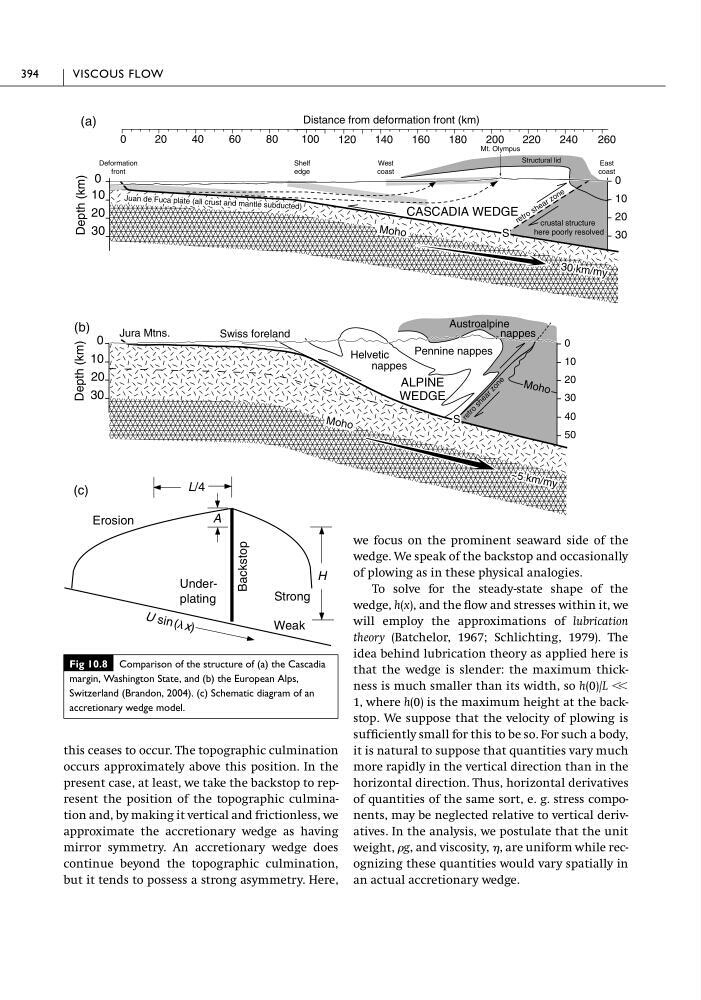
present case, at least, we take the backstop to represent the position of the topographic culmination and, by making it vertical and frictionless, we
approximate the accretionary wedge as having
mirror symmetry. An accretionary wedge does
continue beyond the topographic culmination,
but it tends to possess a strong asymmetry. Here,
394
VISCOUS FLOW
Fig 10.8 Comparison of the structure of (a) the Cascadia
margin, Washington State, and (b) the European Alps,
Switzerland (Brandon, 2004). (c) Schematic diagram of an
accretionary wedge model.
Mt. Olympus
Structural lid
0
10
20
30
0
10
20
30
0
10
20
30
0
10
20
30
Shelf
edge
West
coast
East
coast
Deformation
front
100
80
60
40
20
0
260
240
220
200
180
160
140
120
Distance from deformation front (km)
40
50
CASCADIA WEDGE
re tr o s h e a r z o n e
Pennine nappes
Helvetic
nappes
Jura Mtns.
Swiss foreland
M oh o
M oh o
M oh o
r e t r o
s h e a r z o n e
Austroalpine
nappes
crustal structure
here poorly resolved
ALPINE
WEDGE
Depth (km)
Depth (km)
Juan de Fuca plate (all crust and mantle subducte d)
Juan de Fuca plate (all crust and mantle subducte d)
36 km /m y
30 km /m y
~5 km /m y
~5 km /m y
S S
S S
(a)
(b)
Mo ho
Mo ho
M oh o
M oh o
L/4
U s in (l x )
H
Backstop
Strong
Weak
A
Erosion
Underplating
(c)
we focus on the prominent seaward side of the
wedge. We speak of the backstop and occasionally
of plowing as in these physical analogies.
To solve for the steady-state shape of the
wedge, h(x), and the flow and stresses within it, we
will employ the approximations of lubrication
theory (Batchelor, 1967; Schlichting, 1979). The
idea behind lubrication theory as applied here is
that the wedge is slender: the maximum thickness is much smaller than its width, so h(0)/L Ͻ Ͻ
1, where h(0) is the maximum height at the backstop. We suppose that the velocity of plowing is
sufficiently small for this to be so. For such a body,
it is natural to suppose that quantities vary much
more rapidly in the vertical direction than in the
horizontal direction. Thus, horizontal derivatives
of quantities of the same sort, e. g. stress components, may be neglected relative to vertical derivatives. In the analysis, we postulate that the unit
weight, g, and viscosity, , are uniform while recognizing these quantities would vary spatially in
an actual accretionary wedge.
occurs approximately above this position. In the
present case, at least, we take the backstop to represent the position of the topographic culmination and, by making it vertical and frictionless, we
approximate the accretionary wedge as having
mirror symmetry. An accretionary wedge does
continue beyond the topographic culmination,
but it tends to possess a strong asymmetry. Here,
394
VISCOUS FLOW
Fig 10.8 Comparison of the structure of (a) the Cascadia
margin, Washington State, and (b) the European Alps,
Switzerland (Brandon, 2004). (c) Schematic diagram of an
accretionary wedge model.
Mt. Olympus
Structural lid
0
10
20
30
0
10
20
30
0
10
20
30
0
10
20
30
Shelf
edge
West
coast
East
coast
Deformation
front
100
80
60
40
20
0
260
240
220
200
180
160
140
120
Distance from deformation front (km)
40
50
CASCADIA WEDGE
re tr o s h e a r z o n e
Pennine nappes
Helvetic
nappes
Jura Mtns.
Swiss foreland
M oh o
M oh o
M oh o
r e t r o
s h e a r z o n e
Austroalpine
nappes
crustal structure
here poorly resolved
ALPINE
WEDGE
Depth (km)
Depth (km)
Juan de Fuca plate (all crust and mantle subducte d)
Juan de Fuca plate (all crust and mantle subducte d)
36 km /m y
30 km /m y
~5 km /m y
~5 km /m y
S S
S S
(a)
(b)
Mo ho
Mo ho
M oh o
M oh o
L/4
U s in (l x )
H
Backstop
Strong
Weak
A
Erosion
Underplating
(c)
we focus on the prominent seaward side of the
wedge. We speak of the backstop and occasionally
of plowing as in these physical analogies.
To solve for the steady-state shape of the
wedge, h(x), and the flow and stresses within it, we
will employ the approximations of lubrication
theory (Batchelor, 1967; Schlichting, 1979). The
idea behind lubrication theory as applied here is
that the wedge is slender: the maximum thickness is much smaller than its width, so h(0)/L Ͻ Ͻ
1, where h(0) is the maximum height at the backstop. We suppose that the velocity of plowing is
sufficiently small for this to be so. For such a body,
it is natural to suppose that quantities vary much
more rapidly in the vertical direction than in the
horizontal direction. Thus, horizontal derivatives
of quantities of the same sort, e. g. stress components, may be neglected relative to vertical derivatives. In the analysis, we postulate that the unit
weight, g, and viscosity, , are uniform while recognizing these quantities would vary spatially in
an actual accretionary wedge.