

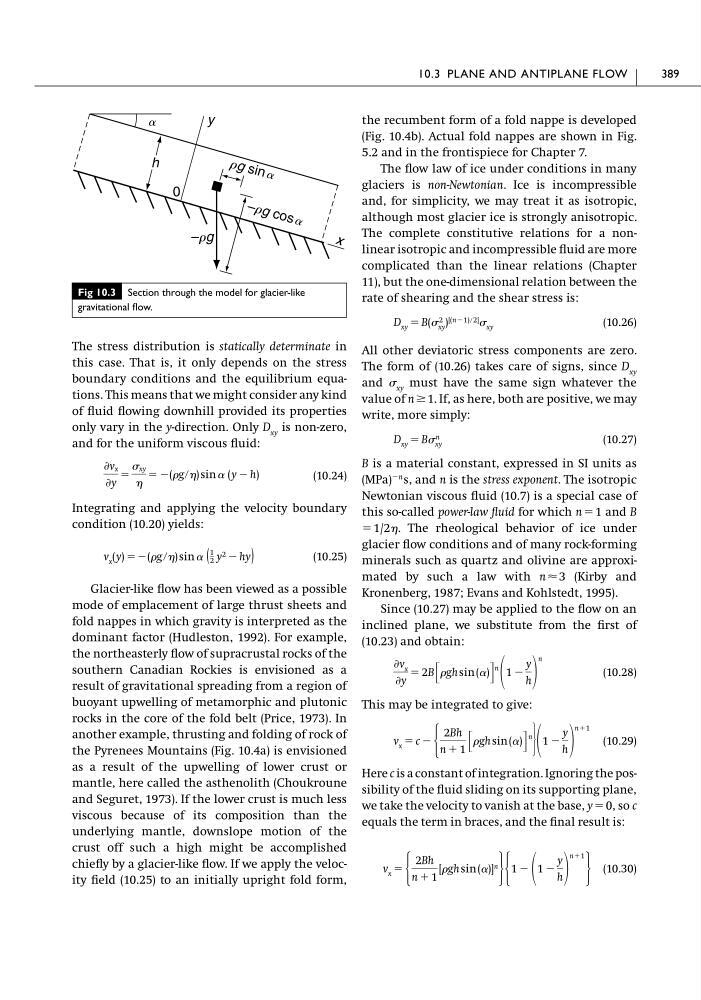
The stress distribution is statically determinate in
this case. That is, it only depends on the stress
boundary conditions and the equilibrium equations. This means that we might consider any kind
of fluid flowing downhill provided its properties
only vary in the y-direction. Only D xy is non-zero,
and for the uniform viscous fluid:
(10.24)
Integrating and applying the velocity boundary
condition (10.20) yields:
(10.25)
Glacier-like flow has been viewed as a possible
mode of emplacement of large thrust sheets and
fold nappes in which gravity is interpreted as the
dominant factor (Hudleston, 1992). For example,
the northeasterly flow of supracrustal rocks of the
southern Canadian Rockies is envisioned as a
result of gravitational spreading from a region of
buoyant upwelling of metamorphic and plutonic
rocks in the core of the fold belt (Price, 1973). In
another example, thrusting and folding of rock of
the Pyrenees Mountains (Fig. 10.4a) is envisioned
as a result of the upwelling of lower crust or
mantle, here called the asthenolith (Choukroune
and Seguret, 1973). If the lower crust is much less
viscous because of its composition than the
underlying mantle, downslope motion of the
crust off such a high might be accomplished
chiefly by a glacier-like flow. If we apply the velocity field (10.25) to an initially upright fold form,
v x (y) ϭϪ(g ր) sin ␣ (
1
2 y 2 Ϫ hy)
Ѩv x
Ѩy
ϭ
xy
ϭ Ϫ(gր) sin ␣ (y Ϫ h)
the recumbent form of a fold nappe is developed
(Fig. 10.4b). Actual fold nappes are shown in Fig.
5.2 and in the frontispiece for Chapter 7.
The flow law of ice under conditions in many
glaciers is non-Newtonian. Ice is incompressible
and, for simplicity, we may treat it as isotropic,
although most glacier ice is strongly anisotropic.
The complete constitutive relations for a nonlinear isotropic and incompressible fluid are more
complicated than the linear relations (Chapter
11), but the one-dimensional relation between the
rate of shearing and the shear stress is:
(10.26)
All other deviatoric stress components are zero.
The form of (10.26) takes care of signs, since D xy
and xy must have the same sign whatever the
value of n Ն 1. If, as here, both are positive, we may
write, more simply:
(10.27)
B is a material constant, expressed in SI units as
(MPa)
Ϫn s, and n is the stress exponent. The isotropic
Newtonian viscous fluid (10.7) is a special case of
this so-called power-law fluid for which n ϭ 1 and B
ϭ 1/2. The rheological behavior of ice under
glacier flow conditions and of many rock-forming
minerals such as quartz and olivine are approximated by such a law with n Ϸ 3 (Kirby and
Kronenberg, 1987; Evans and Kohlstedt, 1995).
Since (10.27) may be applied to the flow on an
inclined plane, we substitute from the first of
(10.23) and obtain:
(10.28)
This may be integrated to give:
(10.29)
Here c is a constant of integration. Ignoring the possibility of the fluid sliding on its supporting plane,
we take the velocity to vanish at the base, y ϭ 0, so c
equals the term in braces, and the final result is:
(10.30)
v x ϭ Ά
2Bh
n ϩ 1
[gh sin (␣)] n
·Ά 1 Ϫ 1 Ϫ
y
h
nϩ1
·
v x ϭ c Ϫ Ά
2Bh
n ϩ 1 ΄ gh sin (␣) ΅
n
· 1 Ϫ
y
h
nϩ1
Ѩv x
Ѩy
ϭ 2B ΄ gh sin (␣) ΅
n
1 Ϫ
y
h
n
D xy ϭ B n
xy
D xy ϭ B( 2
xy ) [(nϪ1) ր 2] xy
10.3 PLANE AND ANTIPLANE FLOW
389
Fig 10.3 Section through the model for glacier-like
gravitational flow.
y
h
a
0
r g s in a
–rg
– r g c o s a
x
this case. That is, it only depends on the stress
boundary conditions and the equilibrium equations. This means that we might consider any kind
of fluid flowing downhill provided its properties
only vary in the y-direction. Only D xy is non-zero,
and for the uniform viscous fluid:
(10.24)
Integrating and applying the velocity boundary
condition (10.20) yields:
(10.25)
Glacier-like flow has been viewed as a possible
mode of emplacement of large thrust sheets and
fold nappes in which gravity is interpreted as the
dominant factor (Hudleston, 1992). For example,
the northeasterly flow of supracrustal rocks of the
southern Canadian Rockies is envisioned as a
result of gravitational spreading from a region of
buoyant upwelling of metamorphic and plutonic
rocks in the core of the fold belt (Price, 1973). In
another example, thrusting and folding of rock of
the Pyrenees Mountains (Fig. 10.4a) is envisioned
as a result of the upwelling of lower crust or
mantle, here called the asthenolith (Choukroune
and Seguret, 1973). If the lower crust is much less
viscous because of its composition than the
underlying mantle, downslope motion of the
crust off such a high might be accomplished
chiefly by a glacier-like flow. If we apply the velocity field (10.25) to an initially upright fold form,
v x (y) ϭϪ(g ր) sin ␣ (
1
2 y 2 Ϫ hy)
Ѩv x
Ѩy
ϭ
xy
ϭ Ϫ(gր) sin ␣ (y Ϫ h)
the recumbent form of a fold nappe is developed
(Fig. 10.4b). Actual fold nappes are shown in Fig.
5.2 and in the frontispiece for Chapter 7.
The flow law of ice under conditions in many
glaciers is non-Newtonian. Ice is incompressible
and, for simplicity, we may treat it as isotropic,
although most glacier ice is strongly anisotropic.
The complete constitutive relations for a nonlinear isotropic and incompressible fluid are more
complicated than the linear relations (Chapter
11), but the one-dimensional relation between the
rate of shearing and the shear stress is:
(10.26)
All other deviatoric stress components are zero.
The form of (10.26) takes care of signs, since D xy
and xy must have the same sign whatever the
value of n Ն 1. If, as here, both are positive, we may
write, more simply:
(10.27)
B is a material constant, expressed in SI units as
(MPa)
Ϫn s, and n is the stress exponent. The isotropic
Newtonian viscous fluid (10.7) is a special case of
this so-called power-law fluid for which n ϭ 1 and B
ϭ 1/2. The rheological behavior of ice under
glacier flow conditions and of many rock-forming
minerals such as quartz and olivine are approximated by such a law with n Ϸ 3 (Kirby and
Kronenberg, 1987; Evans and Kohlstedt, 1995).
Since (10.27) may be applied to the flow on an
inclined plane, we substitute from the first of
(10.23) and obtain:
(10.28)
This may be integrated to give:
(10.29)
Here c is a constant of integration. Ignoring the possibility of the fluid sliding on its supporting plane,
we take the velocity to vanish at the base, y ϭ 0, so c
equals the term in braces, and the final result is:
(10.30)
v x ϭ Ά
2Bh
n ϩ 1
[gh sin (␣)] n
·Ά 1 Ϫ 1 Ϫ
y
h
nϩ1
·
v x ϭ c Ϫ Ά
2Bh
n ϩ 1 ΄ gh sin (␣) ΅
n
· 1 Ϫ
y
h
nϩ1
Ѩv x
Ѩy
ϭ 2B ΄ gh sin (␣) ΅
n
1 Ϫ
y
h
n
D xy ϭ B n
xy
D xy ϭ B( 2
xy ) [(nϪ1) ր 2] xy
10.3 PLANE AND ANTIPLANE FLOW
389
Fig 10.3 Section through the model for glacier-like
gravitational flow.
y
h
a
0
r g s in a
–rg
– r g c o s a
x