

10.3 Plane and antiplane flow
10.3.1 Governing equations
The flows considered in this chapter depend only
on coordinates x and y. Two sorts of flow satisfy
this restriction, and interesting cases have both
going on simultaneously. For plane steady flow:
(10.11)
Non-zero components of the rate of deformation
tensor are:
(10.12)
For D zz ϭ 0, (10.10) gives:
(10.13)
The constitutive relations for plane flow in an
isotropic fluid are:
(10.14)
The equilibrium equations for plane flow are:
(10.15)
Here f x and f y are the body force components per
unit volume. Here, and in what follows, it is
understood that xy ϭ yx . With the y-axis vertical
and upward, and gravity as the only body force,
the components would evaluate as Ϫf x ϭ 0 and Ϫf y
ϭ g. Equations (10.12)–(10.15) are the governing
equations for plane flow of an isotropic viscous
fluid.
A second flow independent of the coordinate z
is the antiplane flow where the velocity components are constrained as:
(10.16)
There are only two non-zero components of the
rate of deformation tensor:
(10.17)
D xz ϭ
1
2
Ѩv z
Ѩx
, D yz ϭ
1
2
Ѩv z
Ѩy
v x ϭ 0, v y ϭ 0, v z ϭ v z (x, y)
Ѩ xy
Ѩx
ϩ
Ѩ yy
Ѩy
ϭ Ϫf y
Ѩ xx
Ѩx
ϩ
Ѩ yx
Ѩy
ϭ Ϫf x
D xy ϭ xy ր2
D xx ϭ ϪD yy ϭ ( xx Ϫ yy ) ր4
zz ϭ ( xx ϩ yy ) ր2
D xx ϭ
Ѩv x
Ѩx
, D yy ϭ
Ѩv y
Ѩy
, D xy ϭ
1
2
Ѩv y
Ѩx
ϩ
Ѩv x
Ѩy
v x ϭ v x (x, y), v y ϭ v y (x, y), v z ϭ 0
The two constitutive relations are:
(10.18)
The single equilibrium equation is:
(10.19)
Here f z is the body force component per unit
volume acting in the z-direction. Equations
(10.17)–(10.19) are a complete set of governing
equations for antiplane flow in an isotropic
incompressible viscous fluid. Antiplane flows are
not treated further in this chapter.
10.3.2 Flow down an inclined plane
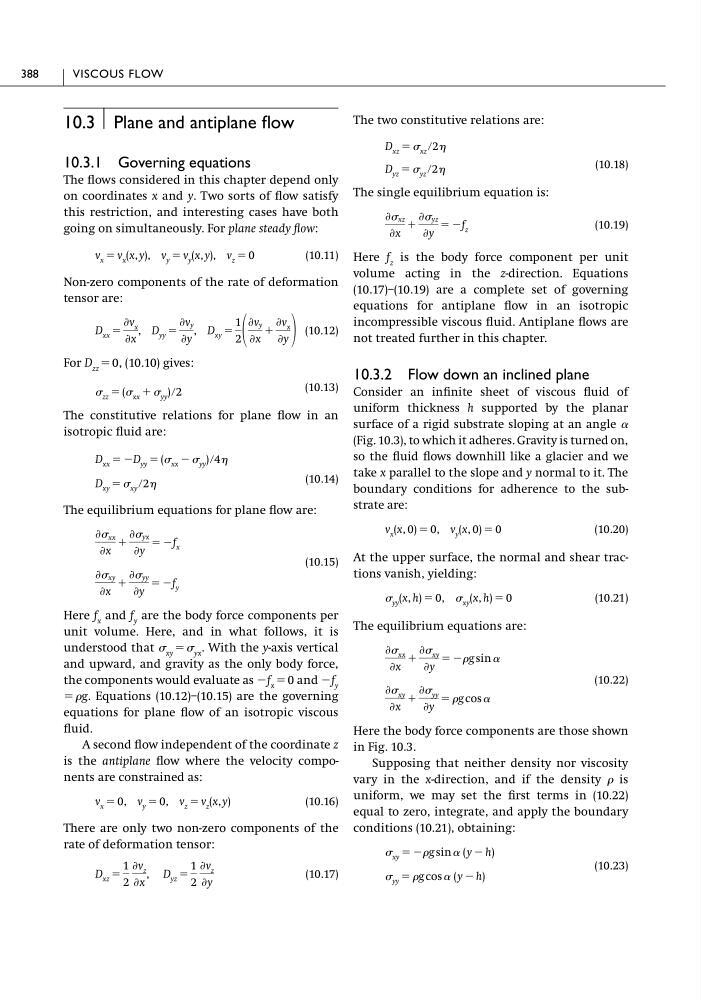
Consider an infinite sheet of viscous fluid of
uniform thickness h supported by the planar
surface of a rigid substrate sloping at an angle ␣
(Fig. 10.3), to which it adheres. Gravity is turned on,
so the fluid flows downhill like a glacier and we
take x parallel to the slope and y normal to it. The
boundary conditions for adherence to the substrate are:
(10.20)
At the upper surface, the normal and shear tractions vanish, yielding:
(10.21)
The equilibrium equations are:
(10.22)
Here the body force components are those shown
in Fig. 10.3.
Supposing that neither density nor viscosity
vary in the x-direction, and if the density is
uniform, we may set the first terms in (10.22)
equal to zero, integrate, and apply the boundary
conditions (10.21), obtaining:
(10.23)
yy ϭ g cos ␣ (y Ϫ h)
xy ϭ Ϫg sin ␣ (y Ϫ h)
Ѩ xy
Ѩx
ϩ
Ѩ yy
Ѩy
ϭ g cos ␣
Ѩ xx
Ѩx
ϩ
Ѩ xy
Ѩy
ϭ Ϫg sin ␣
yy (x, h) ϭ 0, xy (x, h) ϭ 0
v x (x, 0) ϭ 0, v y (x, 0) ϭ 0
Ѩ xz
Ѩx
ϩ
Ѩ yz
Ѩy
ϭ Ϫf z
D yz ϭ yz ր2
D xz ϭ xz ր2
388
VISCOUS FLOW
10.3.1 Governing equations
The flows considered in this chapter depend only
on coordinates x and y. Two sorts of flow satisfy
this restriction, and interesting cases have both
going on simultaneously. For plane steady flow:
(10.11)
Non-zero components of the rate of deformation
tensor are:
(10.12)
For D zz ϭ 0, (10.10) gives:
(10.13)
The constitutive relations for plane flow in an
isotropic fluid are:
(10.14)
The equilibrium equations for plane flow are:
(10.15)
Here f x and f y are the body force components per
unit volume. Here, and in what follows, it is
understood that xy ϭ yx . With the y-axis vertical
and upward, and gravity as the only body force,
the components would evaluate as Ϫf x ϭ 0 and Ϫf y
ϭ g. Equations (10.12)–(10.15) are the governing
equations for plane flow of an isotropic viscous
fluid.
A second flow independent of the coordinate z
is the antiplane flow where the velocity components are constrained as:
(10.16)
There are only two non-zero components of the
rate of deformation tensor:
(10.17)
D xz ϭ
1
2
Ѩv z
Ѩx
, D yz ϭ
1
2
Ѩv z
Ѩy
v x ϭ 0, v y ϭ 0, v z ϭ v z (x, y)
Ѩ xy
Ѩx
ϩ
Ѩ yy
Ѩy
ϭ Ϫf y
Ѩ xx
Ѩx
ϩ
Ѩ yx
Ѩy
ϭ Ϫf x
D xy ϭ xy ր2
D xx ϭ ϪD yy ϭ ( xx Ϫ yy ) ր4
zz ϭ ( xx ϩ yy ) ր2
D xx ϭ
Ѩv x
Ѩx
, D yy ϭ
Ѩv y
Ѩy
, D xy ϭ
1
2
Ѩv y
Ѩx
ϩ
Ѩv x
Ѩy
v x ϭ v x (x, y), v y ϭ v y (x, y), v z ϭ 0
The two constitutive relations are:
(10.18)
The single equilibrium equation is:
(10.19)
Here f z is the body force component per unit
volume acting in the z-direction. Equations
(10.17)–(10.19) are a complete set of governing
equations for antiplane flow in an isotropic
incompressible viscous fluid. Antiplane flows are
not treated further in this chapter.
10.3.2 Flow down an inclined plane
Consider an infinite sheet of viscous fluid of
uniform thickness h supported by the planar
surface of a rigid substrate sloping at an angle ␣
(Fig. 10.3), to which it adheres. Gravity is turned on,
so the fluid flows downhill like a glacier and we
take x parallel to the slope and y normal to it. The
boundary conditions for adherence to the substrate are:
(10.20)
At the upper surface, the normal and shear tractions vanish, yielding:
(10.21)
The equilibrium equations are:
(10.22)
Here the body force components are those shown
in Fig. 10.3.
Supposing that neither density nor viscosity
vary in the x-direction, and if the density is
uniform, we may set the first terms in (10.22)
equal to zero, integrate, and apply the boundary
conditions (10.21), obtaining:
(10.23)
yy ϭ g cos ␣ (y Ϫ h)
xy ϭ Ϫg sin ␣ (y Ϫ h)
Ѩ xy
Ѩx
ϩ
Ѩ yy
Ѩy
ϭ g cos ␣
Ѩ xx
Ѩx
ϩ
Ѩ xy
Ѩy
ϭ Ϫg sin ␣
yy (x, h) ϭ 0, xy (x, h) ϭ 0
v x (x, 0) ϭ 0, v y (x, 0) ϭ 0
Ѩ xz
Ѩx
ϩ
Ѩ yz
Ѩy
ϭ Ϫf z
D yz ϭ yz ր2
D xz ϭ xz ր2
388
VISCOUS FLOW