

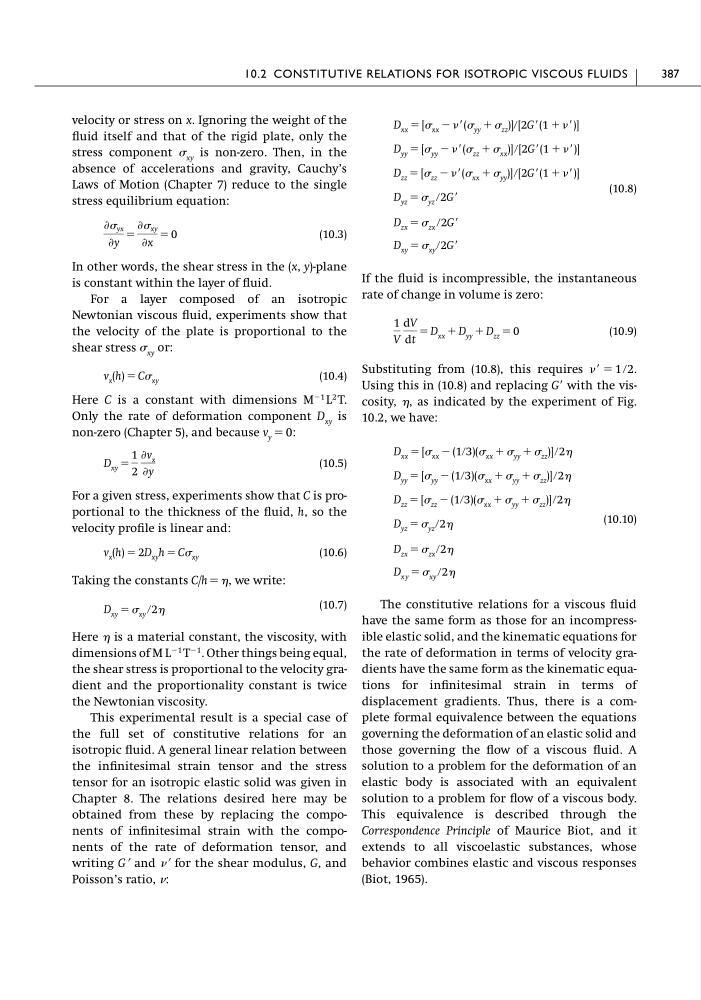
velocity or stress on x. Ignoring the weight of the
fluid itself and that of the rigid plate, only the
stress component xy is non-zero. Then, in the
absence of accelerations and gravity, Cauchy’s
Laws of Motion (Chapter 7) reduce to the single
stress equilibrium equation:
(10.3)
In other words, the shear stress in the (x, y)-plane
is constant within the layer of fluid.
For a layer composed of an isotropic
Newtonian viscous fluid, experiments show that
the velocity of the plate is proportional to the
shear stress xy or:
(10.4)
Here C is a constant with dimensions M
Ϫ1 L
2 T.
Only the rate of deformation component D xy is
non-zero (Chapter 5), and because
(10.5)
For a given stress, experiments show that C is proportional to the thickness of the fluid, h, so the
velocity profile is linear and:
(10.6)
Taking the constants C/h ϭ , we write:
(10.7)
Here is a material constant, the viscosity, with
dimensions of M L
Ϫ1 T
Ϫ1 . Other things being equal,
the shear stress is proportional to the velocity gradient and the proportionality constant is twice
the Newtonian viscosity.
This experimental result is a special case of
the full set of constitutive relations for an
isotropic fluid. A general linear relation between
the infinitesimal strain tensor and the stress
tensor for an isotropic elastic solid was given in
Chapter 8. The relations desired here may be
obtained from these by replacing the components of infinitesimal strain with the components of the rate of deformation tensor, and
writing GЈ and Ј for the shear modulus, G, and
Poisson’s ratio, :
D xy ϭ xy ր2
v x (h) ϭ 2D xy h ϭ C xy
D xy ϭ
1
2
Ѩv x
Ѩy
v y ϭ 0:
v x (h) ϭ C xy
Ѩ yx
Ѩy
ϭ
Ѩ xy
Ѩx
ϭ 0
(10.8)
If the fluid is incompressible, the instantaneous
rate of change in volume is zero:
(10.9)
Substituting from (10.8), this requires
Using this in (10.8) and replacing GЈ with the viscosity, , as indicated by the experiment of Fig.
10.2, we have:
(10.10)
The constitutive relations for a viscous fluid
have the same form as those for an incompressible elastic solid, and the kinematic equations for
the rate of deformation in terms of velocity gradients have the same form as the kinematic equations for infinitesimal strain in terms of
displacement gradients. Thus, there is a complete formal equivalence between the equations
governing the deformation of an elastic solid and
those governing the flow of a viscous fluid. A
solution to a problem for the deformation of an
elastic body is associated with an equivalent
solution to a problem for flow of a viscous body.
This equivalence is described through the
Correspondence Principle of Maurice Biot, and it
extends to all viscoelastic substances, whose
behavior combines elastic and viscous responses
(Biot, 1965).
D xy ϭ xy ր2
D zx ϭ zx ր2
D yz ϭ yz ր2
D zz ϭ [ zz Ϫ (1ր3)( xx ϩ yy ϩ zz )] ր2
D yy ϭ [ yy Ϫ (1ր3)( xx ϩ yy ϩ zz )] ր2
D xx ϭ [ xx Ϫ (1ր3)( xx ϩ yy ϩ zz )] ր2
Ј ϭ 1 ր2.
1
V
dV
dt
ϭ D xx ϩ D yy ϩ D zz ϭ 0
D xy ϭ xy ր2GЈ
D zx ϭ zx ր2GЈ
D yz ϭ yz ր2GЈ
D zz ϭ [ zz Ϫ Ј( xx ϩ yy )] ր[2GЈ(1 ϩ Ј)]
D yy ϭ [ yy Ϫ Ј( zz ϩ xx )] ր[2GЈ(1 ϩ Ј)]
D xx ϭ [ xx Ϫ Ј( yy ϩ zz )]ր[2GЈ(1 ϩ Ј)]
10.2 CONSTITUTIVE RELATIONS FOR ISOTROPIC VISCOUS FLUIDS
387
fluid itself and that of the rigid plate, only the
stress component xy is non-zero. Then, in the
absence of accelerations and gravity, Cauchy’s
Laws of Motion (Chapter 7) reduce to the single
stress equilibrium equation:
(10.3)
In other words, the shear stress in the (x, y)-plane
is constant within the layer of fluid.
For a layer composed of an isotropic
Newtonian viscous fluid, experiments show that
the velocity of the plate is proportional to the
shear stress xy or:
(10.4)
Here C is a constant with dimensions M
Ϫ1 L
2 T.
Only the rate of deformation component D xy is
non-zero (Chapter 5), and because
(10.5)
For a given stress, experiments show that C is proportional to the thickness of the fluid, h, so the
velocity profile is linear and:
(10.6)
Taking the constants C/h ϭ , we write:
(10.7)
Here is a material constant, the viscosity, with
dimensions of M L
Ϫ1 T
Ϫ1 . Other things being equal,
the shear stress is proportional to the velocity gradient and the proportionality constant is twice
the Newtonian viscosity.
This experimental result is a special case of
the full set of constitutive relations for an
isotropic fluid. A general linear relation between
the infinitesimal strain tensor and the stress
tensor for an isotropic elastic solid was given in
Chapter 8. The relations desired here may be
obtained from these by replacing the components of infinitesimal strain with the components of the rate of deformation tensor, and
writing GЈ and Ј for the shear modulus, G, and
Poisson’s ratio, :
D xy ϭ xy ր2
v x (h) ϭ 2D xy h ϭ C xy
D xy ϭ
1
2
Ѩv x
Ѩy
v y ϭ 0:
v x (h) ϭ C xy
Ѩ yx
Ѩy
ϭ
Ѩ xy
Ѩx
ϭ 0
(10.8)
If the fluid is incompressible, the instantaneous
rate of change in volume is zero:
(10.9)
Substituting from (10.8), this requires
Using this in (10.8) and replacing GЈ with the viscosity, , as indicated by the experiment of Fig.
10.2, we have:
(10.10)
The constitutive relations for a viscous fluid
have the same form as those for an incompressible elastic solid, and the kinematic equations for
the rate of deformation in terms of velocity gradients have the same form as the kinematic equations for infinitesimal strain in terms of
displacement gradients. Thus, there is a complete formal equivalence between the equations
governing the deformation of an elastic solid and
those governing the flow of a viscous fluid. A
solution to a problem for the deformation of an
elastic body is associated with an equivalent
solution to a problem for flow of a viscous body.
This equivalence is described through the
Correspondence Principle of Maurice Biot, and it
extends to all viscoelastic substances, whose
behavior combines elastic and viscous responses
(Biot, 1965).
D xy ϭ xy ր2
D zx ϭ zx ր2
D yz ϭ yz ր2
D zz ϭ [ zz Ϫ (1ր3)( xx ϩ yy ϩ zz )] ր2
D yy ϭ [ yy Ϫ (1ր3)( xx ϩ yy ϩ zz )] ր2
D xx ϭ [ xx Ϫ (1ր3)( xx ϩ yy ϩ zz )] ր2
Ј ϭ 1 ր2.
1
V
dV
dt
ϭ D xx ϩ D yy ϩ D zz ϭ 0
D xy ϭ xy ր2GЈ
D zx ϭ zx ր2GЈ
D yz ϭ yz ր2GЈ
D zz ϭ [ zz Ϫ Ј( xx ϩ yy )] ր[2GЈ(1 ϩ Ј)]
D yy ϭ [ yy Ϫ Ј( zz ϩ xx )] ր[2GЈ(1 ϩ Ј)]
D xx ϭ [ xx Ϫ Ј( yy ϩ zz )]ր[2GЈ(1 ϩ Ј)]
10.2 CONSTITUTIVE RELATIONS FOR ISOTROPIC VISCOUS FLUIDS
387