

of their plane. Lack of lubricity is viscosity.
Resistance is shear stress and separation velocity
must be the velocity gradient perpendicular to
the plane of the plates. We study Newton’s fluid in
this chapter, although much experimental work
has demonstrated that glacier ice and other rocks
at high homologous temperatures (temperature/
temperature of melting) and slow rates of deformation behave as non-Newtonian fluids. By slow we
mean rates of order D xx ϭϪ10
Ϫ14 s
Ϫ1 , which would
for example account for a shortening to 50% in 2.2
Ma. None-the-less, many viscous boundary value
problems used by engineers have application to
questions motivated by geological field observations. Several are discussed in the classic text
Elasticity, Fracture, and Flow . . . (Jaeger, 1964a),
including the flow of a viscous fluid between
approaching or separating rigid plates (Robin and
Cruden, 1994), which we discuss later in this
chapter.
The aim this chapter is to establish familiarity
with the formulation and analysis of models
involving slow, creeping flow that have application in structural geology. Models are developed
analytically, although some require numerical
implementation to evaluate expressions or
contour quantities. Current research in this area
often uses numerical codes based on the finiteelement, the finite-difference, or other methods
for solving the field equations subject to boundary
conditions. The models or boundary value problems examined here provide preparatory experience and insight necessary for further study using
these numerical methods, and a better fundamental understanding of these phenomena.
10.2 Constitutive relations for
isotropic viscous fluids
10.2.1 Newtonian viscous fluid
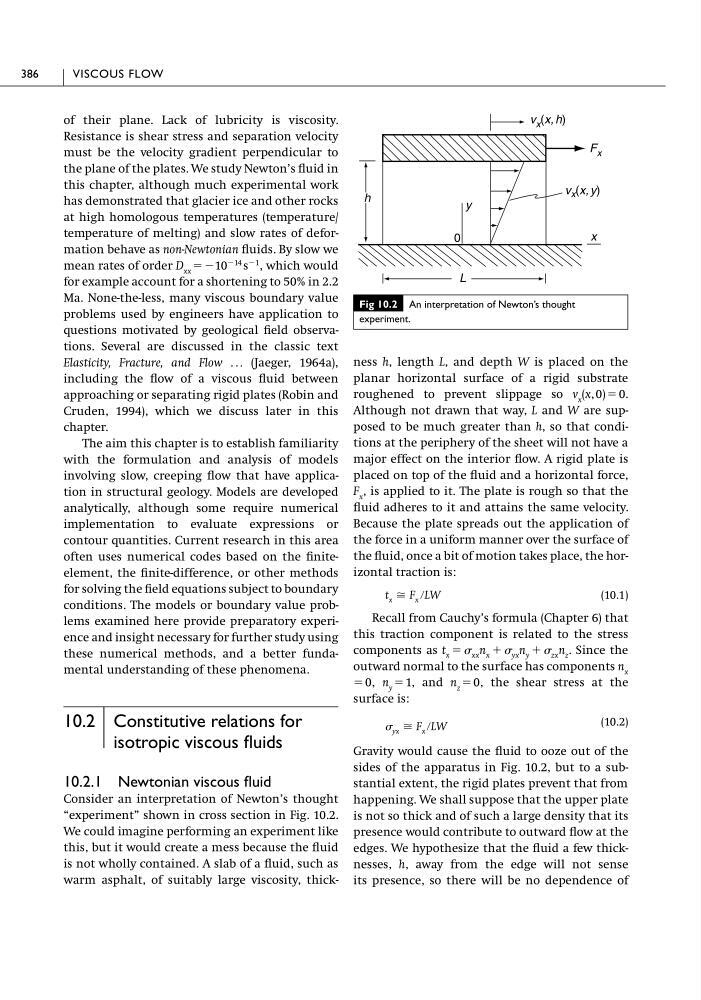
Consider an interpretation of Newton’s thought
“experiment” shown in cross section in Fig. 10.2.
We could imagine performing an experiment like
this, but it would create a mess because the fluid
is not wholly contained. A slab of a fluid, such as
warm asphalt, of suitably large viscosity, thickness h, length L, and depth W is placed on the
planar horizontal surface of a rigid substrate
roughened to prevent slippage so v x (x, 0) ϭ 0.
Although not drawn that way, L and W are supposed to be much greater than h, so that conditions at the periphery of the sheet will not have a
major effect on the interior flow. A rigid plate is
placed on top of the fluid and a horizontal force,
F x , is applied to it. The plate is rough so that the
fluid adheres to it and attains the same velocity.
Because the plate spreads out the application of
the force in a uniform manner over the surface of
the fluid, once a bit of motion takes place, the horizontal traction is:
(10.1)
Recall from Cauchy’s formula (Chapter 6) that
this traction component is related to the stress
components as
. Since the
outward normal to the surface has components n x
ϭ 0, n y ϭ 1, and n z ϭ 0, the shear stress at the
surface is:
(10.2)
Gravity would cause the fluid to ooze out of the
sides of the apparatus in Fig. 10.2, but to a substantial extent, the rigid plates prevent that from
happening. We shall suppose that the upper plate
is not so thick and of such a large density that its
presence would contribute to outward flow at the
edges. We hypothesize that the fluid a few thicknesses, h, away from the edge will not sense
its presence, so there will be no dependence of
yx Х F x րLW
t x ϭ xx n x ϩ yx n y ϩ zx n z
t x Х F x րLW
386
VISCOUS FLOW
Fig 10.2 An interpretation of Newton’s thought
experiment.
F x
v x (x, h)
v x (x, y)
y
0
x
h
L
Resistance is shear stress and separation velocity
must be the velocity gradient perpendicular to
the plane of the plates. We study Newton’s fluid in
this chapter, although much experimental work
has demonstrated that glacier ice and other rocks
at high homologous temperatures (temperature/
temperature of melting) and slow rates of deformation behave as non-Newtonian fluids. By slow we
mean rates of order D xx ϭϪ10
Ϫ14 s
Ϫ1 , which would
for example account for a shortening to 50% in 2.2
Ma. None-the-less, many viscous boundary value
problems used by engineers have application to
questions motivated by geological field observations. Several are discussed in the classic text
Elasticity, Fracture, and Flow . . . (Jaeger, 1964a),
including the flow of a viscous fluid between
approaching or separating rigid plates (Robin and
Cruden, 1994), which we discuss later in this
chapter.
The aim this chapter is to establish familiarity
with the formulation and analysis of models
involving slow, creeping flow that have application in structural geology. Models are developed
analytically, although some require numerical
implementation to evaluate expressions or
contour quantities. Current research in this area
often uses numerical codes based on the finiteelement, the finite-difference, or other methods
for solving the field equations subject to boundary
conditions. The models or boundary value problems examined here provide preparatory experience and insight necessary for further study using
these numerical methods, and a better fundamental understanding of these phenomena.
10.2 Constitutive relations for
isotropic viscous fluids
10.2.1 Newtonian viscous fluid
Consider an interpretation of Newton’s thought
“experiment” shown in cross section in Fig. 10.2.
We could imagine performing an experiment like
this, but it would create a mess because the fluid
is not wholly contained. A slab of a fluid, such as
warm asphalt, of suitably large viscosity, thickness h, length L, and depth W is placed on the
planar horizontal surface of a rigid substrate
roughened to prevent slippage so v x (x, 0) ϭ 0.
Although not drawn that way, L and W are supposed to be much greater than h, so that conditions at the periphery of the sheet will not have a
major effect on the interior flow. A rigid plate is
placed on top of the fluid and a horizontal force,
F x , is applied to it. The plate is rough so that the
fluid adheres to it and attains the same velocity.
Because the plate spreads out the application of
the force in a uniform manner over the surface of
the fluid, once a bit of motion takes place, the horizontal traction is:
(10.1)
Recall from Cauchy’s formula (Chapter 6) that
this traction component is related to the stress
components as
. Since the
outward normal to the surface has components n x
ϭ 0, n y ϭ 1, and n z ϭ 0, the shear stress at the
surface is:
(10.2)
Gravity would cause the fluid to ooze out of the
sides of the apparatus in Fig. 10.2, but to a substantial extent, the rigid plates prevent that from
happening. We shall suppose that the upper plate
is not so thick and of such a large density that its
presence would contribute to outward flow at the
edges. We hypothesize that the fluid a few thicknesses, h, away from the edge will not sense
its presence, so there will be no dependence of
yx Х F x րLW
t x ϭ xx n x ϩ yx n y ϩ zx n z
t x Х F x րLW
386
VISCOUS FLOW
Fig 10.2 An interpretation of Newton’s thought
experiment.
F x
v x (x, h)
v x (x, y)
y
0
x
h
L