

10.1 Rock deformation by viscous
flow
A
s the above quotation indicates, over one
hundred years ago, the first director of the
United States Geological Survey, Clarence
King, hired a scientist to determine the viscosity of
rock. Searching through King’s account of the
survey of the fortieth parallel, we find no mention
of “Questions bearing directly on the viscosity of
rock masses . . .” King did not write much, and so
it appears his thoughts on this subject and the
observations that motivated them may have been
lost. King undoubtedly looked at rock masses that
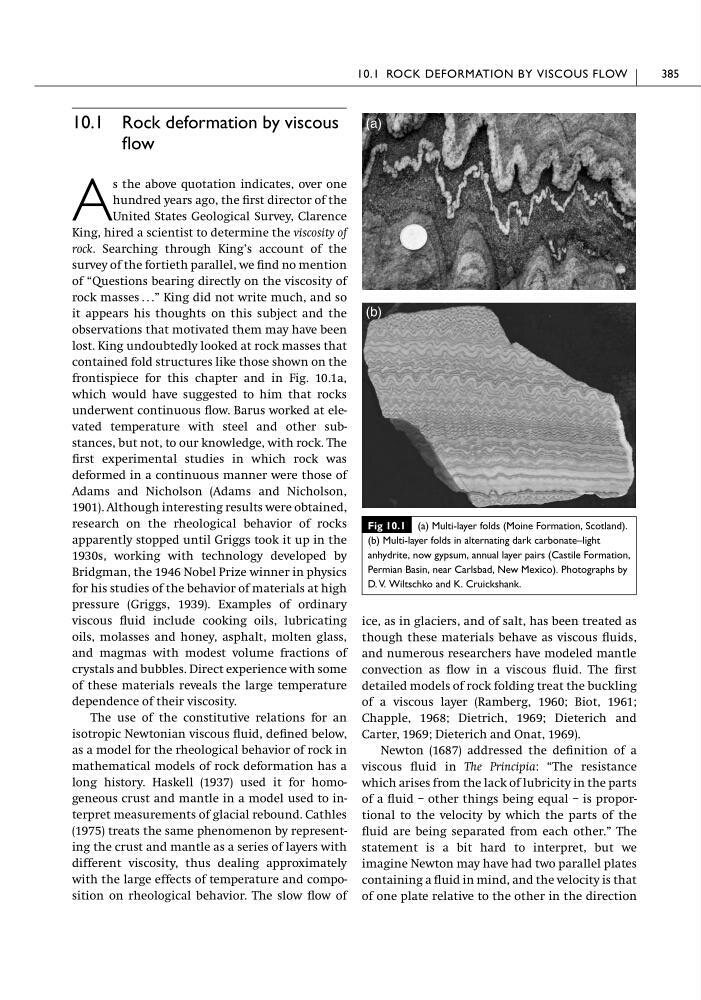
contained fold structures like those shown on the
frontispiece for this chapter and in Fig. 10.1a,
which would have suggested to him that rocks
underwent continuous flow. Barus worked at elevated temperature with steel and other substances, but not, to our knowledge, with rock. The
first experimental studies in which rock was
deformed in a continuous manner were those of
Adams and Nicholson (Adams and Nicholson,
1901). Although interesting results were obtained,
research on the rheological behavior of rocks
apparently stopped until Griggs took it up in the
1930s, working with technology developed by
Bridgman, the 1946 Nobel Prize winner in physics
for his studies of the behavior of materials at high
pressure (Griggs, 1939). Examples of ordinary
viscous fluid include cooking oils, lubricating
oils, molasses and honey, asphalt, molten glass,
and magmas with modest volume fractions of
crystals and bubbles. Direct experience with some
of these materials reveals the large temperature
dependence of their viscosity.
The use of the constitutive relations for an
isotropic Newtonian viscous fluid, defined below,
as a model for the rheological behavior of rock in
mathematical models of rock deformation has a
long history. Haskell (1937) used it for homogeneous crust and mantle in a model used to interpret measurements of glacial rebound. Cathles
(1975) treats the same phenomenon by representing the crust and mantle as a series of layers with
different viscosity, thus dealing approximately
with the large effects of temperature and composition on rheological behavior. The slow flow of
ice, as in glaciers, and of salt, has been treated as
though these materials behave as viscous fluids,
and numerous researchers have modeled mantle
convection as flow in a viscous fluid. The first
detailed models of rock folding treat the buckling
of a viscous layer (Ramberg, 1960; Biot, 1961;
Chapple, 1968; Dietrich, 1969; Dieterich and
Carter, 1969; Dieterich and Onat, 1969).
Newton (1687) addressed the definition of a
viscous fluid in The Principia: “The resistance
which arises from the lack of lubricity in the parts
of a fluid – other things being equal – is proportional to the velocity by which the parts of the
fluid are being separated from each other.” The
statement is a bit hard to interpret, but we
imagine Newton may have had two parallel plates
containing a fluid in mind, and the velocity is that
of one plate relative to the other in the direction
10.1 ROCK DEFORMATION BY VISCOUS FLOW
385
Fig 10.1 (a) Multi-layer folds (Moine Formation, Scotland).
(b) Multi-layer folds in alternating dark carbonate–light
anhydrite, now gypsum, annual layer pairs (Castile Formation,
Permian Basin, near Carlsbad, New Mexico). Photographs by
D. V. Wiltschko and K. Cruickshank.
(a)
(b)
flow
A
s the above quotation indicates, over one
hundred years ago, the first director of the
United States Geological Survey, Clarence
King, hired a scientist to determine the viscosity of
rock. Searching through King’s account of the
survey of the fortieth parallel, we find no mention
of “Questions bearing directly on the viscosity of
rock masses . . .” King did not write much, and so
it appears his thoughts on this subject and the
observations that motivated them may have been
lost. King undoubtedly looked at rock masses that
contained fold structures like those shown on the
frontispiece for this chapter and in Fig. 10.1a,
which would have suggested to him that rocks
underwent continuous flow. Barus worked at elevated temperature with steel and other substances, but not, to our knowledge, with rock. The
first experimental studies in which rock was
deformed in a continuous manner were those of
Adams and Nicholson (Adams and Nicholson,
1901). Although interesting results were obtained,
research on the rheological behavior of rocks
apparently stopped until Griggs took it up in the
1930s, working with technology developed by
Bridgman, the 1946 Nobel Prize winner in physics
for his studies of the behavior of materials at high
pressure (Griggs, 1939). Examples of ordinary
viscous fluid include cooking oils, lubricating
oils, molasses and honey, asphalt, molten glass,
and magmas with modest volume fractions of
crystals and bubbles. Direct experience with some
of these materials reveals the large temperature
dependence of their viscosity.
The use of the constitutive relations for an
isotropic Newtonian viscous fluid, defined below,
as a model for the rheological behavior of rock in
mathematical models of rock deformation has a
long history. Haskell (1937) used it for homogeneous crust and mantle in a model used to interpret measurements of glacial rebound. Cathles
(1975) treats the same phenomenon by representing the crust and mantle as a series of layers with
different viscosity, thus dealing approximately
with the large effects of temperature and composition on rheological behavior. The slow flow of
ice, as in glaciers, and of salt, has been treated as
though these materials behave as viscous fluids,
and numerous researchers have modeled mantle
convection as flow in a viscous fluid. The first
detailed models of rock folding treat the buckling
of a viscous layer (Ramberg, 1960; Biot, 1961;
Chapple, 1968; Dietrich, 1969; Dieterich and
Carter, 1969; Dieterich and Onat, 1969).
Newton (1687) addressed the definition of a
viscous fluid in The Principia: “The resistance
which arises from the lack of lubricity in the parts
of a fluid – other things being equal – is proportional to the velocity by which the parts of the
fluid are being separated from each other.” The
statement is a bit hard to interpret, but we
imagine Newton may have had two parallel plates
containing a fluid in mind, and the velocity is that
of one plate relative to the other in the direction
10.1 ROCK DEFORMATION BY VISCOUS FLOW
385
Fig 10.1 (a) Multi-layer folds (Moine Formation, Scotland).
(b) Multi-layer folds in alternating dark carbonate–light
anhydrite, now gypsum, annual layer pairs (Castile Formation,
Permian Basin, near Carlsbad, New Mexico). Photographs by
D. V. Wiltschko and K. Cruickshank.
(a)
(b)