

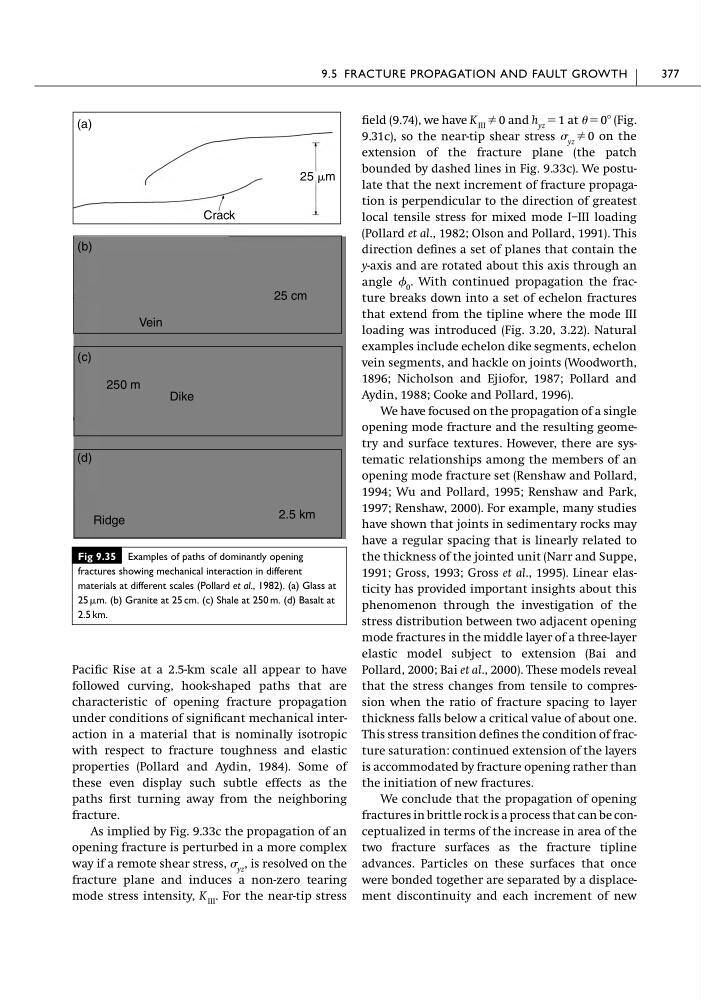
Pacific Rise at a 2.5-km scale all appear to have
followed curving, hook-shaped paths that are
characteristic of opening fracture propagation
under conditions of significant mechanical interaction in a material that is nominally isotropic
with respect to fracture toughness and elastic
properties (Pollard and Aydin, 1984). Some of
these even display such subtle effects as the
paths first turning away from the neighboring
fracture.
As implied by Fig. 9.33c the propagation of an
opening fracture is perturbed in a more complex
way if a remote shear stress, yz , is resolved on the
fracture plane and induces a non-zero tearing
mode stress intensity, K III . For the near-tip stress
field (9.74), we have K III 0 and h yz ϭ 1 at ϭ 0Њ (Fig.
9.31c), so the near-tip shear stress yz 0 on the
extension of the fracture plane (the patch
bounded by dashed lines in Fig. 9.33c). We postulate that the next increment of fracture propagation is perpendicular to the direction of greatest
local tensile stress for mixed mode I–III loading
(Pollard et al., 1982; Olson and Pollard, 1991). This
direction defines a set of planes that contain the
y-axis and are rotated about this axis through an
angle 0 . With continued propagation the fracture breaks down into a set of echelon fractures
that extend from the tipline where the mode III
loading was introduced (Fig. 3.20, 3.22). Natural
examples include echelon dike segments, echelon
vein segments, and hackle on joints (Woodworth,
1896; Nicholson and Ejiofor, 1987; Pollard and
Aydin, 1988; Cooke and Pollard, 1996).
We have focused on the propagation of a single
opening mode fracture and the resulting geometry and surface textures. However, there are systematic relationships among the members of an
opening mode fracture set (Renshaw and Pollard,
1994; Wu and Pollard, 1995; Renshaw and Park,
1997; Renshaw, 2000). For example, many studies
have shown that joints in sedimentary rocks may
have a regular spacing that is linearly related to
the thickness of the jointed unit (Narr and Suppe,
1991; Gross, 1993; Gross et al., 1995). Linear elasticity has provided important insights about this
phenomenon through the investigation of the
stress distribution between two adjacent opening
mode fractures in the middle layer of a three-layer
elastic model subject to extension (Bai and
Pollard, 2000; Bai et al., 2000). These models reveal
that the stress changes from tensile to compression when the ratio of fracture spacing to layer
thickness falls below a critical value of about one.
This stress transition defines the condition of fracture saturation: continued extension of the layers
is accommodated by fracture opening rather than
the initiation of new fractures.
We conclude that the propagation of opening
fractures in brittle rock is a process that can be conceptualized in terms of the increase in area of the
two fracture surfaces as the fracture tipline
advances. Particles on these surfaces that once
were bonded together are separated by a displacement discontinuity and each increment of new
9.5 FRACTURE PROPAGATION AND FAULT GROWTH
377
Fig 9.35 Examples of paths of dominantly opening
fractures showing mechanical interaction in different
materials at different scales (Pollard et al., 1982). (a) Glass at
25m. (b) Granite at 25 cm. (c) Shale at 250 m. (d) Basalt at
2.5 km.
(a)
(b)
(c)
(d)
Crack
Vein
Dike
Ridge
2.5 km
25 m
25 cm
250 m
followed curving, hook-shaped paths that are
characteristic of opening fracture propagation
under conditions of significant mechanical interaction in a material that is nominally isotropic
with respect to fracture toughness and elastic
properties (Pollard and Aydin, 1984). Some of
these even display such subtle effects as the
paths first turning away from the neighboring
fracture.
As implied by Fig. 9.33c the propagation of an
opening fracture is perturbed in a more complex
way if a remote shear stress, yz , is resolved on the
fracture plane and induces a non-zero tearing
mode stress intensity, K III . For the near-tip stress
field (9.74), we have K III 0 and h yz ϭ 1 at ϭ 0Њ (Fig.
9.31c), so the near-tip shear stress yz 0 on the
extension of the fracture plane (the patch
bounded by dashed lines in Fig. 9.33c). We postulate that the next increment of fracture propagation is perpendicular to the direction of greatest
local tensile stress for mixed mode I–III loading
(Pollard et al., 1982; Olson and Pollard, 1991). This
direction defines a set of planes that contain the
y-axis and are rotated about this axis through an
angle 0 . With continued propagation the fracture breaks down into a set of echelon fractures
that extend from the tipline where the mode III
loading was introduced (Fig. 3.20, 3.22). Natural
examples include echelon dike segments, echelon
vein segments, and hackle on joints (Woodworth,
1896; Nicholson and Ejiofor, 1987; Pollard and
Aydin, 1988; Cooke and Pollard, 1996).
We have focused on the propagation of a single
opening mode fracture and the resulting geometry and surface textures. However, there are systematic relationships among the members of an
opening mode fracture set (Renshaw and Pollard,
1994; Wu and Pollard, 1995; Renshaw and Park,
1997; Renshaw, 2000). For example, many studies
have shown that joints in sedimentary rocks may
have a regular spacing that is linearly related to
the thickness of the jointed unit (Narr and Suppe,
1991; Gross, 1993; Gross et al., 1995). Linear elasticity has provided important insights about this
phenomenon through the investigation of the
stress distribution between two adjacent opening
mode fractures in the middle layer of a three-layer
elastic model subject to extension (Bai and
Pollard, 2000; Bai et al., 2000). These models reveal
that the stress changes from tensile to compression when the ratio of fracture spacing to layer
thickness falls below a critical value of about one.
This stress transition defines the condition of fracture saturation: continued extension of the layers
is accommodated by fracture opening rather than
the initiation of new fractures.
We conclude that the propagation of opening
fractures in brittle rock is a process that can be conceptualized in terms of the increase in area of the
two fracture surfaces as the fracture tipline
advances. Particles on these surfaces that once
were bonded together are separated by a displacement discontinuity and each increment of new
9.5 FRACTURE PROPAGATION AND FAULT GROWTH
377
Fig 9.35 Examples of paths of dominantly opening
fractures showing mechanical interaction in different
materials at different scales (Pollard et al., 1982). (a) Glass at
25m. (b) Granite at 25 cm. (c) Shale at 250 m. (d) Basalt at
2.5 km.
(a)
(b)
(c)
(d)
Crack
Vein
Dike
Ridge
2.5 km
25 m
25 cm
250 m