

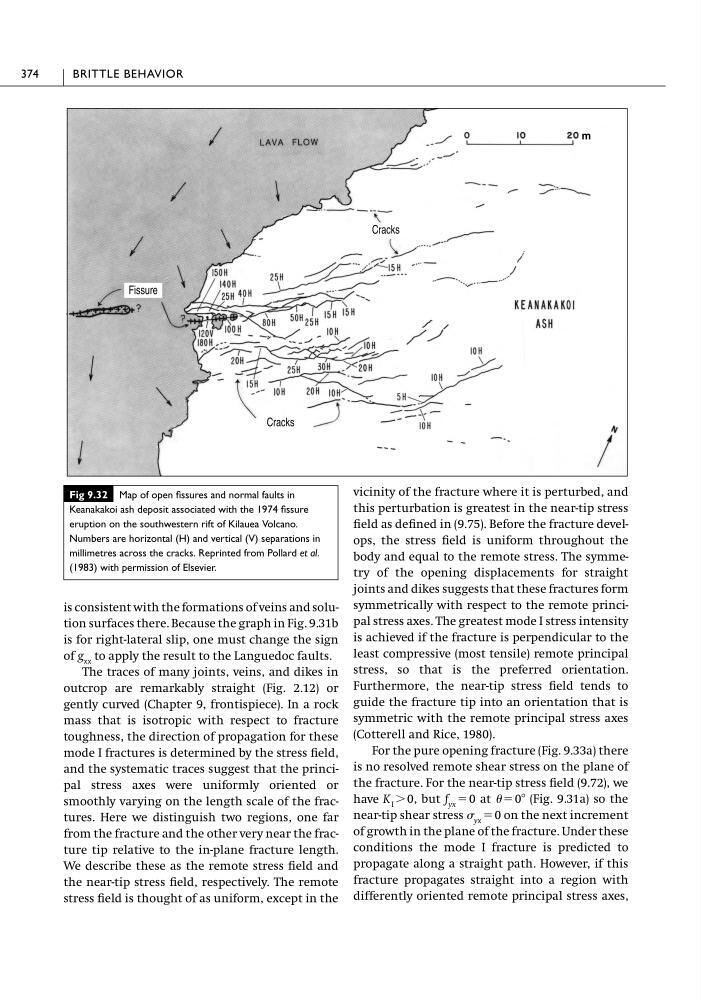
Fig 9.32 Map of open fissures and normal faults in
Keanakakoi ash deposit associated with the 1974 fissure
eruption on the southwestern rift of Kilauea Volcano.
Numbers are horizontal (H) and vertical (V) separations in
millimetres across the cracks. Reprinted from Pollard et al.
(1983) with permission of Elsevier.
is consistent with the formations of veins and solution surfaces there. Because the graph in Fig. 9.31b
is for right-lateral slip, one must change the sign
of g xx to apply the result to the Languedoc faults.
The traces of many joints, veins, and dikes in
outcrop are remarkably straight (Fig. 2.12) or
gently curved (Chapter 9, frontispiece). In a rock
mass that is isotropic with respect to fracture
toughness, the direction of propagation for these
mode I fractures is determined by the stress field,
and the systematic traces suggest that the principal stress axes were uniformly oriented or
smoothly varying on the length scale of the fractures. Here we distinguish two regions, one far
from the fracture and the other very near the fracture tip relative to the in-plane fracture length.
We describe these as the remote stress field and
the near-tip stress field, respectively. The remote
stress field is thought of as uniform, except in the
vicinity of the fracture where it is perturbed, and
this perturbation is greatest in the near-tip stress
field as defined in (9.75). Before the fracture develops, the stress field is uniform throughout the
body and equal to the remote stress. The symmetry of the opening displacements for straight
joints and dikes suggests that these fractures form
symmetrically with respect to the remote principal stress axes. The greatest mode I stress intensity
is achieved if the fracture is perpendicular to the
least compressive (most tensile) remote principal
stress, so that is the preferred orientation.
Furthermore, the near-tip stress field tends to
guide the fracture tip into an orientation that is
symmetric with the remote principal stress axes
(Cotterell and Rice, 1980).
For the pure opening fracture (Fig. 9.33a) there
is no resolved remote shear stress on the plane of
the fracture. For the near-tip stress field (9.72), we
have K I Ͼ 0, but f yx ϭ 0 at ϭ 0Њ (Fig. 9.31a) so the
near-tip shear stress yx ϭ 0 on the next increment
of growth in the plane of the fracture. Under these
conditions the mode I fracture is predicted to
propagate along a straight path. However, if this
fracture propagates straight into a region with
differently oriented remote principal stress axes,
374
BRITTLE BEHAVIOR
Fissure
Cracks
Cracks
m
Keanakakoi ash deposit associated with the 1974 fissure
eruption on the southwestern rift of Kilauea Volcano.
Numbers are horizontal (H) and vertical (V) separations in
millimetres across the cracks. Reprinted from Pollard et al.
(1983) with permission of Elsevier.
is consistent with the formations of veins and solution surfaces there. Because the graph in Fig. 9.31b
is for right-lateral slip, one must change the sign
of g xx to apply the result to the Languedoc faults.
The traces of many joints, veins, and dikes in
outcrop are remarkably straight (Fig. 2.12) or
gently curved (Chapter 9, frontispiece). In a rock
mass that is isotropic with respect to fracture
toughness, the direction of propagation for these
mode I fractures is determined by the stress field,
and the systematic traces suggest that the principal stress axes were uniformly oriented or
smoothly varying on the length scale of the fractures. Here we distinguish two regions, one far
from the fracture and the other very near the fracture tip relative to the in-plane fracture length.
We describe these as the remote stress field and
the near-tip stress field, respectively. The remote
stress field is thought of as uniform, except in the
vicinity of the fracture where it is perturbed, and
this perturbation is greatest in the near-tip stress
field as defined in (9.75). Before the fracture develops, the stress field is uniform throughout the
body and equal to the remote stress. The symmetry of the opening displacements for straight
joints and dikes suggests that these fractures form
symmetrically with respect to the remote principal stress axes. The greatest mode I stress intensity
is achieved if the fracture is perpendicular to the
least compressive (most tensile) remote principal
stress, so that is the preferred orientation.
Furthermore, the near-tip stress field tends to
guide the fracture tip into an orientation that is
symmetric with the remote principal stress axes
(Cotterell and Rice, 1980).
For the pure opening fracture (Fig. 9.33a) there
is no resolved remote shear stress on the plane of
the fracture. For the near-tip stress field (9.72), we
have K I Ͼ 0, but f yx ϭ 0 at ϭ 0Њ (Fig. 9.31a) so the
near-tip shear stress yx ϭ 0 on the next increment
of growth in the plane of the fracture. Under these
conditions the mode I fracture is predicted to
propagate along a straight path. However, if this
fracture propagates straight into a region with
differently oriented remote principal stress axes,
374
BRITTLE BEHAVIOR
Fissure
Cracks
Cracks
m