

an arbitrary polyaxial loading characterized by
the principal stresses ( 1 , 2 , and 3 ) we derived
the magnitude of the maximum shear stress in
Chapter 6 as
This shear stress is
independent of the intermediate principal stress,
2 . We define the maximum shear strength, S m , as
this shear stress at its limiting value:
(9.37)
The planes carrying the maximum shear stress
form an orthogonal pair that intersect along the
intermediate principal stress axis and are bisected
by the 1 - and 3 -axes. That is, the normals to these
planes lie in the ( 1 , 3 )-plane and make angles of
Ϯ45Њ with the 1 -axis. At failure this criterion
would predict the initiation of orthogonal shear
fractures in these two orientations.
The concept of shear failure embodied in (9.37)
is consistent with the uniaxial tensile and compressive strength criteria, (9.8) and (9.9), but it
neglects the fundamental insight provided by
Coulomb. Coulomb studied the frictional characteristics of materials in the eighteenth century
and hypothesized that shear fracturing was
driven by the applied shear stress and resisted by
a combination of the cohesive strength (adherence)
and the normal compressive stress acting across
the predicted fracture surface (Coulomb, 1773;
Jaeger and Cook, 1979). Accordingly, the compressive stress plays a role in shear fracture similar to
the role of the normal traction in sliding friction
(9.30): greater compression leads to greater resistance to shear fracture, just as greater inward
directed normal traction leads to greater resistance to sliding.
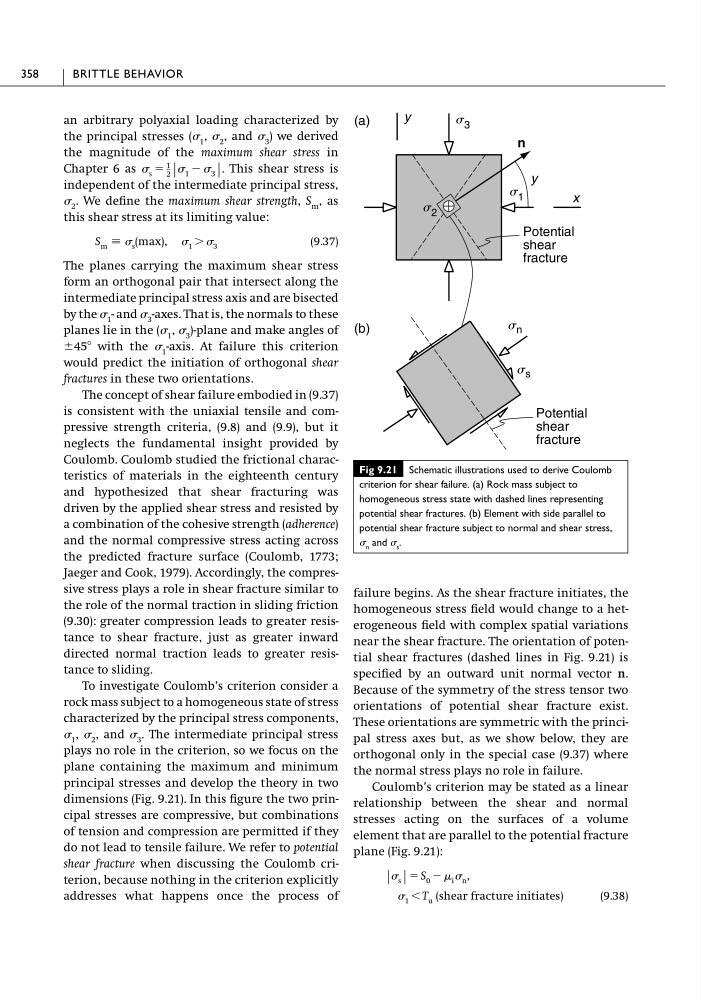
To investigate Coulomb’s criterion consider a
rock mass subject to a homogeneous state of stress
characterized by the principal stress components,
1 , 2 , and 3 . The intermediate principal stress
plays no role in the criterion, so we focus on the
plane containing the maximum and minimum
principal stresses and develop the theory in two
dimensions (Fig. 9.21). In this figure the two principal stresses are compressive, but combinations
of tension and compression are permitted if they
do not lead to tensile failure. We refer to potential
shear fracture when discussing the Coulomb criterion, because nothing in the criterion explicitly
addresses what happens once the process of
S m ϵ s (max), 1 Ͼ 3
s ϭ
1
2 | 1 Ϫ 3 |.
failure begins. As the shear fracture initiates, the
homogeneous stress field would change to a heterogeneous field with complex spatial variations
near the shear fracture. The orientation of potential shear fractures (dashed lines in Fig. 9.21) is
specified by an outward unit normal vector n.
Because of the symmetry of the stress tensor two
orientations of potential shear fracture exist.
These orientations are symmetric with the principal stress axes but, as we show below, they are
orthogonal only in the special case (9.37) where
the normal stress plays no role in failure.
Coulomb’s criterion may be stated as a linear
relationship between the shear and normal
stresses acting on the surfaces of a volume
element that are parallel to the potential fracture
plane (Fig. 9.21):
(9.38)
1 Ͻ T u (shear fracture initiates)
| s | ϭ S 0 Ϫ i n ,
358
BRITTLE BEHAVIOR
Fig 9.21 Schematic illustrations used to derive Coulomb
criterion for shear failure. (a) Rock mass subject to
homogeneous stress state with dashed lines representing
potential shear fractures. (b) Element with side parallel to
potential shear fracture subject to normal and shear stress,
n and s .
n
s 2
Potential
shear
fracture
y
x
s 3
s 1
s n
s s
Potential
shear
fracture
y
(a)
(b)
the principal stresses ( 1 , 2 , and 3 ) we derived
the magnitude of the maximum shear stress in
Chapter 6 as
This shear stress is
independent of the intermediate principal stress,
2 . We define the maximum shear strength, S m , as
this shear stress at its limiting value:
(9.37)
The planes carrying the maximum shear stress
form an orthogonal pair that intersect along the
intermediate principal stress axis and are bisected
by the 1 - and 3 -axes. That is, the normals to these
planes lie in the ( 1 , 3 )-plane and make angles of
Ϯ45Њ with the 1 -axis. At failure this criterion
would predict the initiation of orthogonal shear
fractures in these two orientations.
The concept of shear failure embodied in (9.37)
is consistent with the uniaxial tensile and compressive strength criteria, (9.8) and (9.9), but it
neglects the fundamental insight provided by
Coulomb. Coulomb studied the frictional characteristics of materials in the eighteenth century
and hypothesized that shear fracturing was
driven by the applied shear stress and resisted by
a combination of the cohesive strength (adherence)
and the normal compressive stress acting across
the predicted fracture surface (Coulomb, 1773;
Jaeger and Cook, 1979). Accordingly, the compressive stress plays a role in shear fracture similar to
the role of the normal traction in sliding friction
(9.30): greater compression leads to greater resistance to shear fracture, just as greater inward
directed normal traction leads to greater resistance to sliding.
To investigate Coulomb’s criterion consider a
rock mass subject to a homogeneous state of stress
characterized by the principal stress components,
1 , 2 , and 3 . The intermediate principal stress
plays no role in the criterion, so we focus on the
plane containing the maximum and minimum
principal stresses and develop the theory in two
dimensions (Fig. 9.21). In this figure the two principal stresses are compressive, but combinations
of tension and compression are permitted if they
do not lead to tensile failure. We refer to potential
shear fracture when discussing the Coulomb criterion, because nothing in the criterion explicitly
addresses what happens once the process of
S m ϵ s (max), 1 Ͼ 3
s ϭ
1
2 | 1 Ϫ 3 |.
failure begins. As the shear fracture initiates, the
homogeneous stress field would change to a heterogeneous field with complex spatial variations
near the shear fracture. The orientation of potential shear fractures (dashed lines in Fig. 9.21) is
specified by an outward unit normal vector n.
Because of the symmetry of the stress tensor two
orientations of potential shear fracture exist.
These orientations are symmetric with the principal stress axes but, as we show below, they are
orthogonal only in the special case (9.37) where
the normal stress plays no role in failure.
Coulomb’s criterion may be stated as a linear
relationship between the shear and normal
stresses acting on the surfaces of a volume
element that are parallel to the potential fracture
plane (Fig. 9.21):
(9.38)
1 Ͻ T u (shear fracture initiates)
| s | ϭ S 0 Ϫ i n ,
358
BRITTLE BEHAVIOR
Fig 9.21 Schematic illustrations used to derive Coulomb
criterion for shear failure. (a) Rock mass subject to
homogeneous stress state with dashed lines representing
potential shear fractures. (b) Element with side parallel to
potential shear fracture subject to normal and shear stress,
n and s .
n
s 2
Potential
shear
fracture
y
x
s 3
s 1
s n
s s
Potential
shear
fracture
y
(a)
(b)