

The quantity s is called the static friction and this
proportionality is known as Amonton’s Law after
Guillaume Amonton who published his experimental results in 1699 (Bowden and Tabor, 1950).
In this relationship the friction is independent of
the apparent area of contact. There is no relative
motion if the inequality is satisfied, because the
force F is insufficient to overcome the frictional
resistance between the object and the surface.
Sliding initiates at the moment the force equals
the product of the static friction and the weight.
Today, the microscopic to macroscopic phenomena associated with frictional sliding on faults is
one of the most fascinating pursuits of Earth
scientists studying earthquakes (Dieterich, 1986,
1994; Linker and Dieterich, 1992; Lockner and
Beeler, 2003).
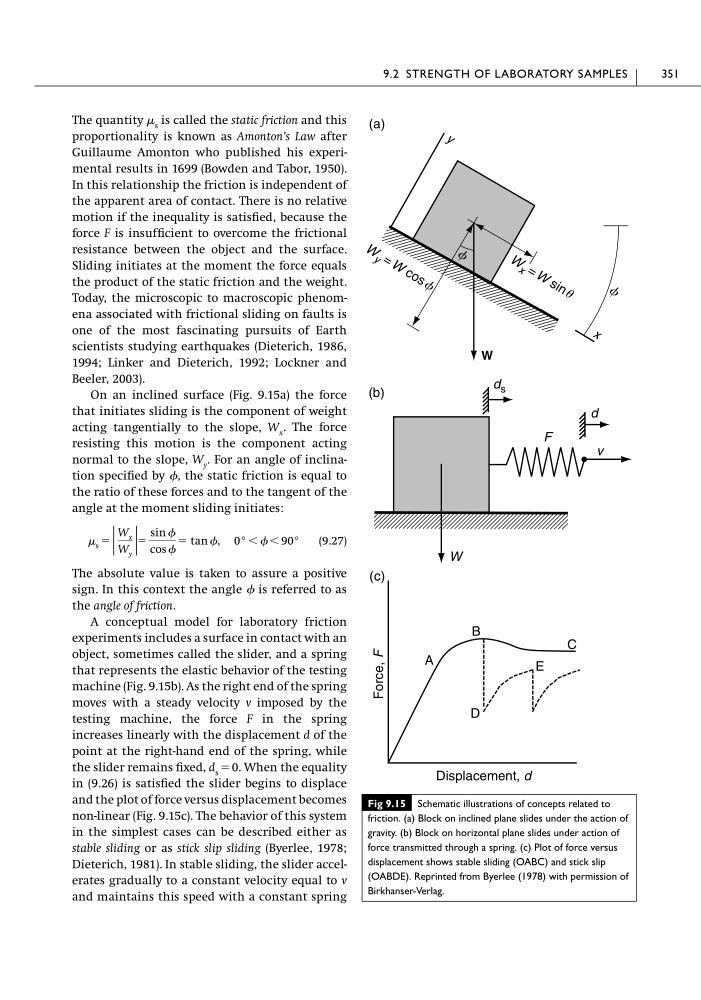
On an inclined surface (Fig. 9.15a) the force
that initiates sliding is the component of weight
acting tangentially to the slope, W x . The force
resisting this motion is the component acting
normal to the slope, W y . For an angle of inclination specified by , the static friction is equal to
the ratio of these forces and to the tangent of the
angle at the moment sliding initiates:
(9.27)
The absolute value is taken to assure a positive
sign. In this context the angle is referred to as
the angle of friction.
A conceptual model for laboratory friction
experiments includes a surface in contact with an
object, sometimes called the slider, and a spring
that represents the elastic behavior of the testing
machine (Fig. 9.15b). As the right end of the spring
moves with a steady velocity v imposed by the
testing machine, the force F in the spring
increases linearly with the displacement d of the
point at the right-hand end of the spring, while
the slider remains fixed, d s ϭ 0. When the equality
in (9.26) is satisfied the slider begins to displace
and the plot of force versus displacement becomes
non-linear (Fig. 9.15c). The behavior of this system
in the simplest cases can be described either as
stable sliding or as stick slip sliding (Byerlee, 1978;
Dieterich, 1981). In stable sliding, the slider accelerates gradually to a constant velocity equal to v
and maintains this speed with a constant spring
s ϭ |
W x
W y
| ϭ
sin
cos
ϭ tan , 0° Ͻ Ͻ 90°
9.2 STRENGTH OF LABORATORY SAMPLES
351
Fig 9.15 Schematic illustrations of concepts related to
friction. (a) Block on inclined plane slides under the action of
gravity. (b) Block on horizontal plane slides under action of
force transmitted through a spring. (c) Plot of force versus
displacement shows stable sliding (OABC) and stick slip
(OABDE). Reprinted from Byerlee (1978) with permission of
Birkhanser-Verlag.
(a)
x
y
W
f
f
W
y = W c o s f
W
x = W s i n U
(b)
W
F
v
d s
Displacement, d
Force,
F
A
B
C
D
E
(c)
d
proportionality is known as Amonton’s Law after
Guillaume Amonton who published his experimental results in 1699 (Bowden and Tabor, 1950).
In this relationship the friction is independent of
the apparent area of contact. There is no relative
motion if the inequality is satisfied, because the
force F is insufficient to overcome the frictional
resistance between the object and the surface.
Sliding initiates at the moment the force equals
the product of the static friction and the weight.
Today, the microscopic to macroscopic phenomena associated with frictional sliding on faults is
one of the most fascinating pursuits of Earth
scientists studying earthquakes (Dieterich, 1986,
1994; Linker and Dieterich, 1992; Lockner and
Beeler, 2003).
On an inclined surface (Fig. 9.15a) the force
that initiates sliding is the component of weight
acting tangentially to the slope, W x . The force
resisting this motion is the component acting
normal to the slope, W y . For an angle of inclination specified by , the static friction is equal to
the ratio of these forces and to the tangent of the
angle at the moment sliding initiates:
(9.27)
The absolute value is taken to assure a positive
sign. In this context the angle is referred to as
the angle of friction.
A conceptual model for laboratory friction
experiments includes a surface in contact with an
object, sometimes called the slider, and a spring
that represents the elastic behavior of the testing
machine (Fig. 9.15b). As the right end of the spring
moves with a steady velocity v imposed by the
testing machine, the force F in the spring
increases linearly with the displacement d of the
point at the right-hand end of the spring, while
the slider remains fixed, d s ϭ 0. When the equality
in (9.26) is satisfied the slider begins to displace
and the plot of force versus displacement becomes
non-linear (Fig. 9.15c). The behavior of this system
in the simplest cases can be described either as
stable sliding or as stick slip sliding (Byerlee, 1978;
Dieterich, 1981). In stable sliding, the slider accelerates gradually to a constant velocity equal to v
and maintains this speed with a constant spring
s ϭ |
W x
W y
| ϭ
sin
cos
ϭ tan , 0° Ͻ Ͻ 90°
9.2 STRENGTH OF LABORATORY SAMPLES
351
Fig 9.15 Schematic illustrations of concepts related to
friction. (a) Block on inclined plane slides under the action of
gravity. (b) Block on horizontal plane slides under action of
force transmitted through a spring. (c) Plot of force versus
displacement shows stable sliding (OABC) and stick slip
(OABDE). Reprinted from Byerlee (1978) with permission of
Birkhanser-Verlag.
(a)
x
y
W
f
f
W
y = W c o s f
W
x = W s i n U
(b)
W
F
v
d s
Displacement, d
Force,
F
A
B
C
D
E
(c)
d