

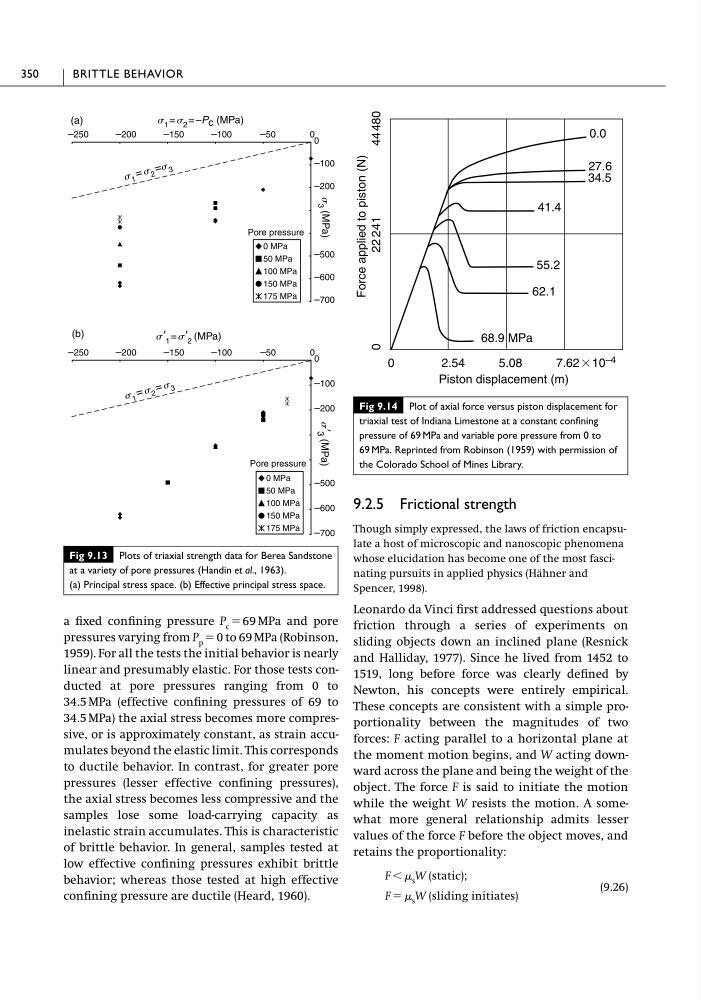
a fixed confining pressure P c ϭ 69 MPa and pore
pressures varying from P p ϭ 0 to 69 MPa (Robinson,
1959). For all the tests the initial behavior is nearly
linear and presumably elastic. For those tests conducted at pore pressures ranging from 0 to
34.5 MPa (effective confining pressures of 69 to
34.5 MPa) the axial stress becomes more compressive, or is approximately constant, as strain accumulates beyond the elastic limit. This corresponds
to ductile behavior. In contrast, for greater pore
pressures (lesser effective confining pressures),
the axial stress becomes less compressive and the
samples lose some load-carrying capacity as
inelastic strain accumulates. This is characteristic
of brittle behavior. In general, samples tested at
low effective confining pressures exhibit brittle
behavior; whereas those tested at high effective
confining pressure are ductile (Heard, 1960).
9.2.5 Frictional strength
Though simply expressed, the laws of friction encapsulate a host of microscopic and nanoscopic phenomena
whose elucidation has become one of the most fascinating pursuits in applied physics (Hähner and
Spencer, 1998).
Leonardo da Vinci first addressed questions about
friction through a series of experiments on
sliding objects down an inclined plane (Resnick
and Halliday, 1977). Since he lived from 1452 to
1519, long before force was clearly defined by
Newton, his concepts were entirely empirical.
These concepts are consistent with a simple proportionality between the magnitudes of two
forces: F acting parallel to a horizontal plane at
the moment motion begins, and W acting downward across the plane and being the weight of the
object. The force F is said to initiate the motion
while the weight W resists the motion. A somewhat more general relationship admits lesser
values of the force F before the object moves, and
retains the proportionality:
(9.26)
F ϭ s W (sliding initiates)
F Ͻ s W (static);
350
BRITTLE BEHAVIOR
Fig 9.13 Plots of triaxial strength data for Berea Sandstone
at a variety of pore pressures (Handin et al., 1963).
(a) Principal stress space. (b) Effective principal stress space.
–700
–600
–500
–200
–100
0
–250
–200
–150
–100
–50
0
0 MPa
50 MPa
100 MPa
150 MPa
175 MPa
Pore pressure
s 1 = s 2 = –P c (MPa)
s 3 (MPa)
(a)
–700
–600
–500
–200
–100
0
–250
–200
–150
–100
–50
0
0 MPa
50 MPa
100 MPa
150 MPa
175 MPa
sЈ 1 = sЈ 2 (MPa)
(b)
sЈ 3 (MPa)
Pore pressure
s 1 = s 2 = s 3
s 1 = s 2 = s 3
Fig 9.14 Plot of axial force versus piston displacement for
triaxial test of Indiana Limestone at a constant confining
pressure of 69 MPa and variable pore pressure from 0 to
69 MPa. Reprinted from Robinson (1959) with permission of
the Colorado School of Mines Library.
0
2.54
5.08
7.62 ϫ 10 –4
0
22 241
44 480
Piston displacement (m)
Force applied to piston (N)
68.9 MPa
62.1
55.2
41.4
34.5
27.6
0.0
pressures varying from P p ϭ 0 to 69 MPa (Robinson,
1959). For all the tests the initial behavior is nearly
linear and presumably elastic. For those tests conducted at pore pressures ranging from 0 to
34.5 MPa (effective confining pressures of 69 to
34.5 MPa) the axial stress becomes more compressive, or is approximately constant, as strain accumulates beyond the elastic limit. This corresponds
to ductile behavior. In contrast, for greater pore
pressures (lesser effective confining pressures),
the axial stress becomes less compressive and the
samples lose some load-carrying capacity as
inelastic strain accumulates. This is characteristic
of brittle behavior. In general, samples tested at
low effective confining pressures exhibit brittle
behavior; whereas those tested at high effective
confining pressure are ductile (Heard, 1960).
9.2.5 Frictional strength
Though simply expressed, the laws of friction encapsulate a host of microscopic and nanoscopic phenomena
whose elucidation has become one of the most fascinating pursuits in applied physics (Hähner and
Spencer, 1998).
Leonardo da Vinci first addressed questions about
friction through a series of experiments on
sliding objects down an inclined plane (Resnick
and Halliday, 1977). Since he lived from 1452 to
1519, long before force was clearly defined by
Newton, his concepts were entirely empirical.
These concepts are consistent with a simple proportionality between the magnitudes of two
forces: F acting parallel to a horizontal plane at
the moment motion begins, and W acting downward across the plane and being the weight of the
object. The force F is said to initiate the motion
while the weight W resists the motion. A somewhat more general relationship admits lesser
values of the force F before the object moves, and
retains the proportionality:
(9.26)
F ϭ s W (sliding initiates)
F Ͻ s W (static);
350
BRITTLE BEHAVIOR
Fig 9.13 Plots of triaxial strength data for Berea Sandstone
at a variety of pore pressures (Handin et al., 1963).
(a) Principal stress space. (b) Effective principal stress space.
–700
–600
–500
–200
–100
0
–250
–200
–150
–100
–50
0
0 MPa
50 MPa
100 MPa
150 MPa
175 MPa
Pore pressure
s 1 = s 2 = –P c (MPa)
s 3 (MPa)
(a)
–700
–600
–500
–200
–100
0
–250
–200
–150
–100
–50
0
0 MPa
50 MPa
100 MPa
150 MPa
175 MPa
sЈ 1 = sЈ 2 (MPa)
(b)
sЈ 3 (MPa)
Pore pressure
s 1 = s 2 = s 3
s 1 = s 2 = s 3
Fig 9.14 Plot of axial force versus piston displacement for
triaxial test of Indiana Limestone at a constant confining
pressure of 69 MPa and variable pore pressure from 0 to
69 MPa. Reprinted from Robinson (1959) with permission of
the Colorado School of Mines Library.
0
2.54
5.08
7.62 ϫ 10 –4
0
22 241
44 480
Piston displacement (m)
Force applied to piston (N)
68.9 MPa
62.1
55.2
41.4
34.5
27.6
0.0