

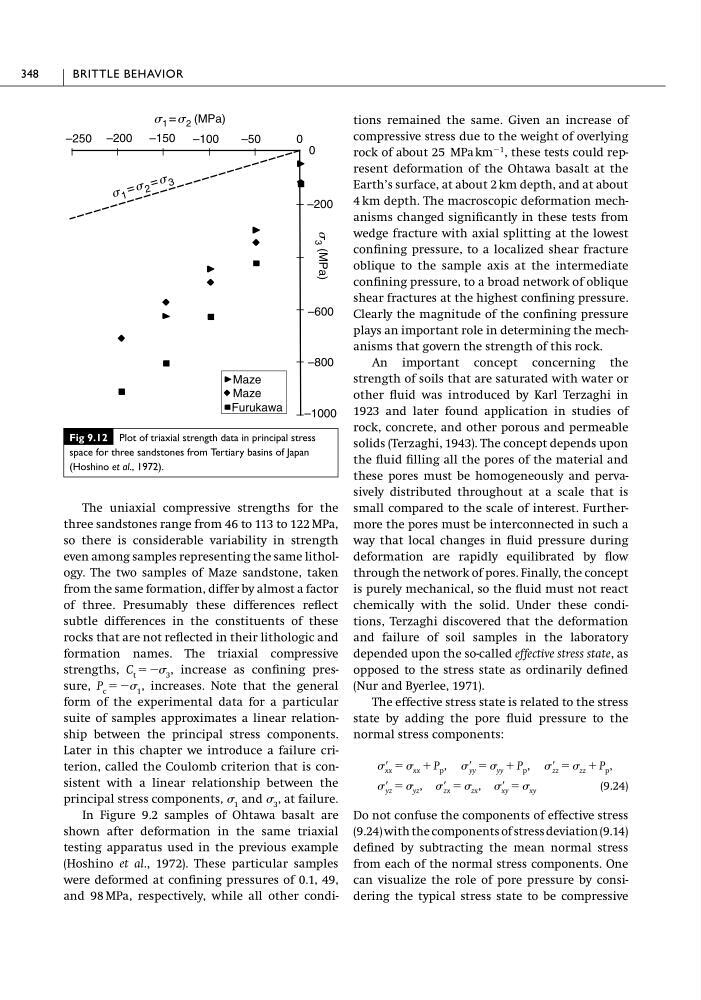
The uniaxial compressive strengths for the
three sandstones range from 46 to 113 to 122 MPa,
so there is considerable variability in strength
even among samples representing the same lithology. The two samples of Maze sandstone, taken
from the same formation, differ by almost a factor
of three. Presumably these differences reflect
subtle differences in the constituents of these
rocks that are not reflected in their lithologic and
formation names. The triaxial compressive
strengths, C t ϭϪ 3 , increase as confining pressure, P c ϭϪ 1 , increases. Note that the general
form of the experimental data for a particular
suite of samples approximates a linear relationship between the principal stress components.
Later in this chapter we introduce a failure criterion, called the Coulomb criterion that is consistent with a linear relationship between the
principal stress components, 1 and 3 , at failure.
In Figure 9.2 samples of Ohtawa basalt are
shown after deformation in the same triaxial
testing apparatus used in the previous example
(Hoshino et al., 1972). These particular samples
were deformed at confining pressures of 0.1, 49,
and 98 MPa, respectively, while all other conditions remained the same. Given an increase of
compressive stress due to the weight of overlying
rock of about 25 MPa km
Ϫ1 , these tests could represent deformation of the Ohtawa basalt at the
Earth’s surface, at about 2 km depth, and at about
4 km depth. The macroscopic deformation mechanisms changed significantly in these tests from
wedge fracture with axial splitting at the lowest
confining pressure, to a localized shear fracture
oblique to the sample axis at the intermediate
confining pressure, to a broad network of oblique
shear fractures at the highest confining pressure.
Clearly the magnitude of the confining pressure
plays an important role in determining the mechanisms that govern the strength of this rock.
An important concept concerning the
strength of soils that are saturated with water or
other fluid was introduced by Karl Terzaghi in
1923 and later found application in studies of
rock, concrete, and other porous and permeable
solids (Terzaghi, 1943). The concept depends upon
the fluid filling all the pores of the material and
these pores must be homogeneously and pervasively distributed throughout at a scale that is
small compared to the scale of interest. Furthermore the pores must be interconnected in such a
way that local changes in fluid pressure during
deformation are rapidly equilibrated by flow
through the network of pores. Finally, the concept
is purely mechanical, so the fluid must not react
chemically with the solid. Under these conditions, Terzaghi discovered that the deformation
and failure of soil samples in the laboratory
depended upon the so-called effective stress state, as
opposed to the stress state as ordinarily defined
(Nur and Byerlee, 1971).
The effective stress state is related to the stress
state by adding the pore fluid pressure to the
normal stress components:
(9.24)
Do not confuse the components of effective stress
(9.24) with the components of stress deviation (9.14)
defined by subtracting the mean normal stress
from each of the normal stress components. One
can visualize the role of pore pressure by considering the typical stress state to be compressive
Ј yz ϭ yz , Ј zx ϭ zx , Ј xy ϭ xy
Ј xx ϭ xx ϩ P p ,Ј yy ϭ yy ϩ P p ,Ј zz ϭ zz ϩ P p ,
348
BRITTLE BEHAVIOR
Fig 9.12 Plot of triaxial strength data in principal stress
space for three sandstones from Tertiary basins of Japan
(Hoshino et al., 1972).
–250 –200 –150
–100
–50
–1000
–800
–600
–200
Furukawa
Maze
Maze
s 3 (MPa)
s 1 = s 2 (MPa)
s 1 = s 2 = s 3
0
0
three sandstones range from 46 to 113 to 122 MPa,
so there is considerable variability in strength
even among samples representing the same lithology. The two samples of Maze sandstone, taken
from the same formation, differ by almost a factor
of three. Presumably these differences reflect
subtle differences in the constituents of these
rocks that are not reflected in their lithologic and
formation names. The triaxial compressive
strengths, C t ϭϪ 3 , increase as confining pressure, P c ϭϪ 1 , increases. Note that the general
form of the experimental data for a particular
suite of samples approximates a linear relationship between the principal stress components.
Later in this chapter we introduce a failure criterion, called the Coulomb criterion that is consistent with a linear relationship between the
principal stress components, 1 and 3 , at failure.
In Figure 9.2 samples of Ohtawa basalt are
shown after deformation in the same triaxial
testing apparatus used in the previous example
(Hoshino et al., 1972). These particular samples
were deformed at confining pressures of 0.1, 49,
and 98 MPa, respectively, while all other conditions remained the same. Given an increase of
compressive stress due to the weight of overlying
rock of about 25 MPa km
Ϫ1 , these tests could represent deformation of the Ohtawa basalt at the
Earth’s surface, at about 2 km depth, and at about
4 km depth. The macroscopic deformation mechanisms changed significantly in these tests from
wedge fracture with axial splitting at the lowest
confining pressure, to a localized shear fracture
oblique to the sample axis at the intermediate
confining pressure, to a broad network of oblique
shear fractures at the highest confining pressure.
Clearly the magnitude of the confining pressure
plays an important role in determining the mechanisms that govern the strength of this rock.
An important concept concerning the
strength of soils that are saturated with water or
other fluid was introduced by Karl Terzaghi in
1923 and later found application in studies of
rock, concrete, and other porous and permeable
solids (Terzaghi, 1943). The concept depends upon
the fluid filling all the pores of the material and
these pores must be homogeneously and pervasively distributed throughout at a scale that is
small compared to the scale of interest. Furthermore the pores must be interconnected in such a
way that local changes in fluid pressure during
deformation are rapidly equilibrated by flow
through the network of pores. Finally, the concept
is purely mechanical, so the fluid must not react
chemically with the solid. Under these conditions, Terzaghi discovered that the deformation
and failure of soil samples in the laboratory
depended upon the so-called effective stress state, as
opposed to the stress state as ordinarily defined
(Nur and Byerlee, 1971).
The effective stress state is related to the stress
state by adding the pore fluid pressure to the
normal stress components:
(9.24)
Do not confuse the components of effective stress
(9.24) with the components of stress deviation (9.14)
defined by subtracting the mean normal stress
from each of the normal stress components. One
can visualize the role of pore pressure by considering the typical stress state to be compressive
Ј yz ϭ yz , Ј zx ϭ zx , Ј xy ϭ xy
Ј xx ϭ xx ϩ P p ,Ј yy ϭ yy ϩ P p ,Ј zz ϭ zz ϩ P p ,
348
BRITTLE BEHAVIOR
Fig 9.12 Plot of triaxial strength data in principal stress
space for three sandstones from Tertiary basins of Japan
(Hoshino et al., 1972).
–250 –200 –150
–100
–50
–1000
–800
–600
–200
Furukawa
Maze
Maze
s 3 (MPa)
s 1 = s 2 (MPa)
s 1 = s 2 = s 3
0
0