

region that has a more homogeneous state of
stress.
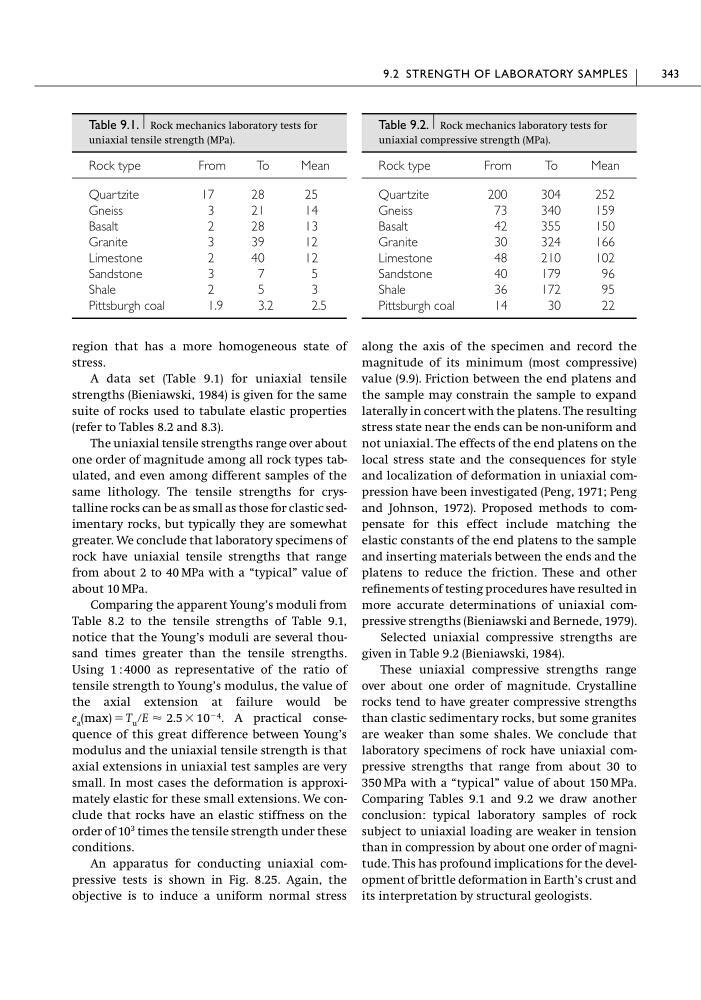
A data set (Table 9.1) for uniaxial tensile
strengths (Bieniawski, 1984) is given for the same
suite of rocks used to tabulate elastic properties
(refer to Tables 8.2 and 8.3).
The uniaxial tensile strengths range over about
one order of magnitude among all rock types tabulated, and even among different samples of the
same lithology. The tensile strengths for crystalline rocks can be as small as those for clastic sedimentary rocks, but typically they are somewhat
greater. We conclude that laboratory specimens of
rock have uniaxial tensile strengths that range
from about 2 to 40 MPa with a “typical” value of
about 10 MPa.
Comparing the apparent Young’s moduli from
Table 8.2 to the tensile strengths of Table 9.1,
notice that the Young’s moduli are several thousand times greater than the tensile strengths.
Using 1 : 4000 as representative of the ratio of
tensile strength to Young’s modulus, the value of
the axial extension at failure would be
A practical consequence of this great difference between Young’s
modulus and the uniaxial tensile strength is that
axial extensions in uniaxial test samples are very
small. In most cases the deformation is approximately elastic for these small extensions. We conclude that rocks have an elastic stiffness on the
order of 10
3 times the tensile strength under these
conditions.
An apparatus for conducting uniaxial compressive tests is shown in Fig. 8.25. Again, the
objective is to induce a uniform normal stress
e a (max) ϭ T u րE Ϸ 2.5 ϫ 10 Ϫ4 .
along the axis of the specimen and record the
magnitude of its minimum (most compressive)
value (9.9). Friction between the end platens and
the sample may constrain the sample to expand
laterally in concert with the platens. The resulting
stress state near the ends can be non-uniform and
not uniaxial. The effects of the end platens on the
local stress state and the consequences for style
and localization of deformation in uniaxial compression have been investigated (Peng, 1971; Peng
and Johnson, 1972). Proposed methods to compensate for this effect include matching the
elastic constants of the end platens to the sample
and inserting materials between the ends and the
platens to reduce the friction. These and other
refinements of testing procedures have resulted in
more accurate determinations of uniaxial compressive strengths (Bieniawski and Bernede, 1979).
Selected uniaxial compressive strengths are
given in Table 9.2 (Bieniawski, 1984).
These uniaxial compressive strengths range
over about one order of magnitude. Crystalline
rocks tend to have greater compressive strengths
than clastic sedimentary rocks, but some granites
are weaker than some shales. We conclude that
laboratory specimens of rock have uniaxial compressive strengths that range from about 30 to
350 MPa with a “typical” value of about 150 MPa.
Comparing Tables 9.1 and 9.2 we draw another
conclusion: typical laboratory samples of rock
subject to uniaxial loading are weaker in tension
than in compression by about one order of magnitude. This has profound implications for the development of brittle deformation in Earth’s crust and
its interpretation by structural geologists.
9.2 STRENGTH OF LABORATORY SAMPLES
343
Table 9.1. Rock mechanics laboratory tests for
uniaxial tensile strength (MPa).
Rock type
From
To
Mean
Quartzite
17
28
25
Gneiss
3
21
14
Basalt
2
28
13
Granite
3
39
12
Limestone
2
40
12
Sandstone
3
7
5
Shale
2
5
3
Pittsburgh coal
1.9
3.2
2.5
Table 9.2. Rock mechanics laboratory tests for
uniaxial compressive strength (MPa).
Rock type
From
To
Mean
Quartzite
200
304
252
Gneiss
73
340
159
Basalt
42
355
150
Granite
30
324
166
Limestone
48
210
102
Sandstone
40
179
96
Shale
36
172
95
Pittsburgh coal
14
30
22
stress.
A data set (Table 9.1) for uniaxial tensile
strengths (Bieniawski, 1984) is given for the same
suite of rocks used to tabulate elastic properties
(refer to Tables 8.2 and 8.3).
The uniaxial tensile strengths range over about
one order of magnitude among all rock types tabulated, and even among different samples of the
same lithology. The tensile strengths for crystalline rocks can be as small as those for clastic sedimentary rocks, but typically they are somewhat
greater. We conclude that laboratory specimens of
rock have uniaxial tensile strengths that range
from about 2 to 40 MPa with a “typical” value of
about 10 MPa.
Comparing the apparent Young’s moduli from
Table 8.2 to the tensile strengths of Table 9.1,
notice that the Young’s moduli are several thousand times greater than the tensile strengths.
Using 1 : 4000 as representative of the ratio of
tensile strength to Young’s modulus, the value of
the axial extension at failure would be
A practical consequence of this great difference between Young’s
modulus and the uniaxial tensile strength is that
axial extensions in uniaxial test samples are very
small. In most cases the deformation is approximately elastic for these small extensions. We conclude that rocks have an elastic stiffness on the
order of 10
3 times the tensile strength under these
conditions.
An apparatus for conducting uniaxial compressive tests is shown in Fig. 8.25. Again, the
objective is to induce a uniform normal stress
e a (max) ϭ T u րE Ϸ 2.5 ϫ 10 Ϫ4 .
along the axis of the specimen and record the
magnitude of its minimum (most compressive)
value (9.9). Friction between the end platens and
the sample may constrain the sample to expand
laterally in concert with the platens. The resulting
stress state near the ends can be non-uniform and
not uniaxial. The effects of the end platens on the
local stress state and the consequences for style
and localization of deformation in uniaxial compression have been investigated (Peng, 1971; Peng
and Johnson, 1972). Proposed methods to compensate for this effect include matching the
elastic constants of the end platens to the sample
and inserting materials between the ends and the
platens to reduce the friction. These and other
refinements of testing procedures have resulted in
more accurate determinations of uniaxial compressive strengths (Bieniawski and Bernede, 1979).
Selected uniaxial compressive strengths are
given in Table 9.2 (Bieniawski, 1984).
These uniaxial compressive strengths range
over about one order of magnitude. Crystalline
rocks tend to have greater compressive strengths
than clastic sedimentary rocks, but some granites
are weaker than some shales. We conclude that
laboratory specimens of rock have uniaxial compressive strengths that range from about 30 to
350 MPa with a “typical” value of about 150 MPa.
Comparing Tables 9.1 and 9.2 we draw another
conclusion: typical laboratory samples of rock
subject to uniaxial loading are weaker in tension
than in compression by about one order of magnitude. This has profound implications for the development of brittle deformation in Earth’s crust and
its interpretation by structural geologists.
9.2 STRENGTH OF LABORATORY SAMPLES
343
Table 9.1. Rock mechanics laboratory tests for
uniaxial tensile strength (MPa).
Rock type
From
To
Mean
Quartzite
17
28
25
Gneiss
3
21
14
Basalt
2
28
13
Granite
3
39
12
Limestone
2
40
12
Sandstone
3
7
5
Shale
2
5
3
Pittsburgh coal
1.9
3.2
2.5
Table 9.2. Rock mechanics laboratory tests for
uniaxial compressive strength (MPa).
Rock type
From
To
Mean
Quartzite
200
304
252
Gneiss
73
340
159
Basalt
42
355
150
Granite
30
324
166
Limestone
48
210
102
Sandstone
40
179
96
Shale
36
172
95
Pittsburgh coal
14
30
22