

systems in which computers, connected to transducers monitoring force and displacement, are
capable of feeding back the corrective action to
sensitive hydraulic valves in order to stabilize
the test.
Because C m is always positive, instability requires that the derivative of the specimen force–
displacement curve, f Ј(u s ), be negative according to
(9.6). Therefore we conclude that instability is only
possible in the post-failure region of the typical
stress–strain curve. Furthermore, instability
requires that the magnitude of f Ј(u s ) exceed that of
C m . Thus, unstable specimen behavior is defined as:
(9.7)
A soft testing machine is one in which the postfailure behavior is unstable. It should be clear that
rock testing to failure and beyond is not a trivial
endeavor, but these issues are, for the most part,
addressed by modern servo-controlled testing
machines.
9.2.2 Uniaxial tensile and compressive
strength
Definitions of the uniaxial tensile strength, T u , and
uniaxial compressive strength, C u , are written in
terms of the extreme values of the axial stress, a ,
and are conditional on the presumed homogeneous state of stress written here in terms of
the principal values:
(9.8)
(9.9)
The tests usually are conducted at room (atmospheric) pressure, so the actual values of the two
equal principal stresses are about Ϫ0.1 MPa. This
is negligible compared to typical rock strengths in
uniaxial tests which are of the order 10 to 100 MPa.
The uniaxial tensile and compressive strengths
have the same units and dimensions as stress:
(9.10)
(9.11)
Strength is a scalar quantity and does not carry a
sign.
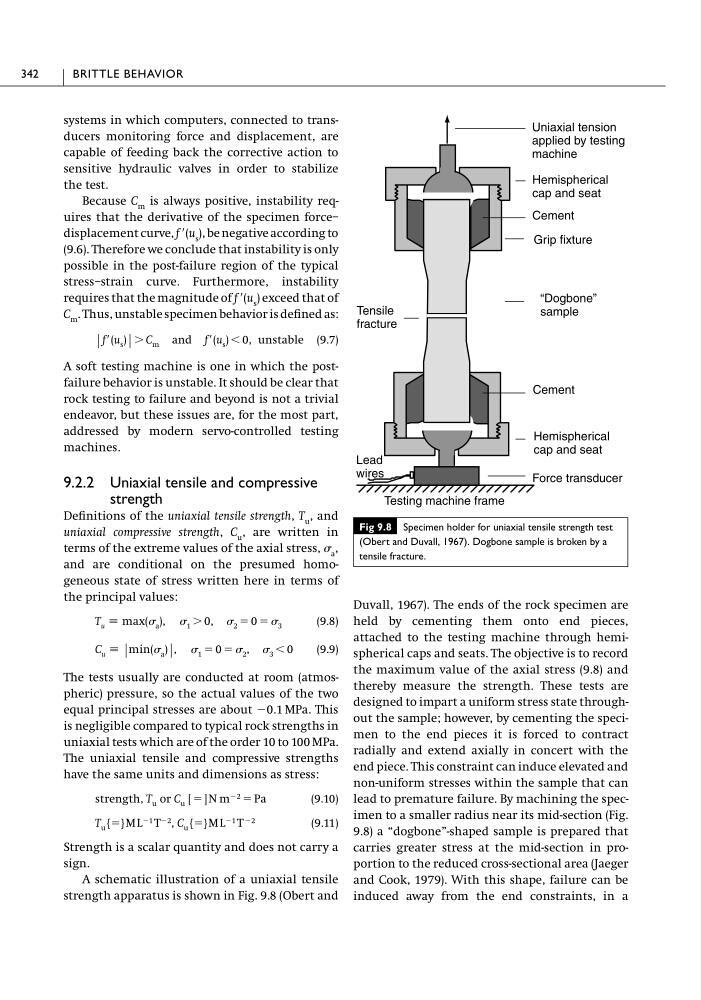
A schematic illustration of a uniaxial tensile
strength apparatus is shown in Fig. 9.8 (Obert and
T u {ϭ}M L Ϫ1 T Ϫ2 , C u {ϭ}M L Ϫ1 T Ϫ2
strength, T u or C u [ ϭ ] N m Ϫ2 ϭ Pa
C u ϵ |min( a ) |, 1 ϭ 0 ϭ 2 , 3 Ͻ 0
T u ϵ max( a ), 1 Ͼ 0, 2 ϭ 0 ϭ 3
| fЈ(u s ) | Ͼ C m and fЈ(u s ) Ͻ 0, unstable
Duvall, 1967). The ends of the rock specimen are
held by cementing them onto end pieces,
attached to the testing machine through hemispherical caps and seats. The objective is to record
the maximum value of the axial stress (9.8) and
thereby measure the strength. These tests are
designed to impart a uniform stress state throughout the sample; however, by cementing the specimen to the end pieces it is forced to contract
radially and extend axially in concert with the
end piece. This constraint can induce elevated and
non-uniform stresses within the sample that can
lead to premature failure. By machining the specimen to a smaller radius near its mid-section (Fig.
9.8) a “dogbone”-shaped sample is prepared that
carries greater stress at the mid-section in proportion to the reduced cross-sectional area (Jaeger
and Cook, 1979). With this shape, failure can be
induced away from the end constraints, in a
342
BRITTLE BEHAVIOR
Fig 9.8 Specimen holder for uniaxial tensile strength test
(Obert and Duvall, 1967). Dogbone sample is broken by a
tensile fracture.
Force transducer
Uniaxial tension
applied by testing
machine
Cement
Hemispherical
cap and seat
Cement
Lead
wires
Testing machine frame
“Dogbone”
sample
Tensile
fracture
Hemispherical
cap and seat
Grip fixture
capable of feeding back the corrective action to
sensitive hydraulic valves in order to stabilize
the test.
Because C m is always positive, instability requires that the derivative of the specimen force–
displacement curve, f Ј(u s ), be negative according to
(9.6). Therefore we conclude that instability is only
possible in the post-failure region of the typical
stress–strain curve. Furthermore, instability
requires that the magnitude of f Ј(u s ) exceed that of
C m . Thus, unstable specimen behavior is defined as:
(9.7)
A soft testing machine is one in which the postfailure behavior is unstable. It should be clear that
rock testing to failure and beyond is not a trivial
endeavor, but these issues are, for the most part,
addressed by modern servo-controlled testing
machines.
9.2.2 Uniaxial tensile and compressive
strength
Definitions of the uniaxial tensile strength, T u , and
uniaxial compressive strength, C u , are written in
terms of the extreme values of the axial stress, a ,
and are conditional on the presumed homogeneous state of stress written here in terms of
the principal values:
(9.8)
(9.9)
The tests usually are conducted at room (atmospheric) pressure, so the actual values of the two
equal principal stresses are about Ϫ0.1 MPa. This
is negligible compared to typical rock strengths in
uniaxial tests which are of the order 10 to 100 MPa.
The uniaxial tensile and compressive strengths
have the same units and dimensions as stress:
(9.10)
(9.11)
Strength is a scalar quantity and does not carry a
sign.
A schematic illustration of a uniaxial tensile
strength apparatus is shown in Fig. 9.8 (Obert and
T u {ϭ}M L Ϫ1 T Ϫ2 , C u {ϭ}M L Ϫ1 T Ϫ2
strength, T u or C u [ ϭ ] N m Ϫ2 ϭ Pa
C u ϵ |min( a ) |, 1 ϭ 0 ϭ 2 , 3 Ͻ 0
T u ϵ max( a ), 1 Ͼ 0, 2 ϭ 0 ϭ 3
| fЈ(u s ) | Ͼ C m and fЈ(u s ) Ͻ 0, unstable
Duvall, 1967). The ends of the rock specimen are
held by cementing them onto end pieces,
attached to the testing machine through hemispherical caps and seats. The objective is to record
the maximum value of the axial stress (9.8) and
thereby measure the strength. These tests are
designed to impart a uniform stress state throughout the sample; however, by cementing the specimen to the end pieces it is forced to contract
radially and extend axially in concert with the
end piece. This constraint can induce elevated and
non-uniform stresses within the sample that can
lead to premature failure. By machining the specimen to a smaller radius near its mid-section (Fig.
9.8) a “dogbone”-shaped sample is prepared that
carries greater stress at the mid-section in proportion to the reduced cross-sectional area (Jaeger
and Cook, 1979). With this shape, failure can be
induced away from the end constraints, in a
342
BRITTLE BEHAVIOR
Fig 9.8 Specimen holder for uniaxial tensile strength test
(Obert and Duvall, 1967). Dogbone sample is broken by a
tensile fracture.
Force transducer
Uniaxial tension
applied by testing
machine
Cement
Hemispherical
cap and seat
Cement
Lead
wires
Testing machine frame
“Dogbone”
sample
Tensile
fracture
Hemispherical
cap and seat
Grip fixture