

fracture the limestone beds but terminate at or
near interfaces with adjacent shale beds. Clearly a
given limestone bed did not break along a single
fracture: multiple parallel joints formed with a
regular spacing and ultimately several differently
oriented sets of joints developed. Two faults crop
out in this exposure that cut across and locally
disrupt the otherwise nearly horizontal bedding.
Unlike a single open joint, each fault is composed
of multiple closely spaced surfaces and each
surface is in intimate contact with another
surface. Members of this set of faults do not terminate within the exposure so their extent is
unknown, but detailed knowledge of the stratigraphy has been used to estimate a few meters to a few
tens of meters of slip (Engelder and Peacock, 2001).
The juxtaposition of limestone and shale beds, the
magnitude of the slip, the rotation of the fractured
limestone blocks, and the flowage of the shale are
some of the characteristics of these faults that are
not duplicated in laboratory experiments.
Laboratory experiments other than the standard triaxial test are motivated by field observations of joints and faults. For example, exposures
that reveal the tips of joints (Chapter 9, frontispiece) raise the question: what is the resistance
to propagation of a single opening fracture in
rock? To understand how the concentrated tensile
stresses along the advancing fracture tip are
resisted by rock strength one may conduct an
experiment (Fig. 9.4a) where control of the oppositely directed displacement of the two pins
enables one to monitor fracture propagation and
measure the so-called fracture toughness of the rock
specimen (Atkinson and Meredith, 1987). Specimens made up of layers of the same or different
materials enable the researcher to investigate
opening fractures that stop or propagate across
layer interfaces (Renshaw and Pollard, 1995;
McConaughy and Engelder, 2001). Exposures of
faults such as those at Lilstock Beach (Fig. 9.3)
raise the question: what is the resistance to
sliding of one specimen in direct contact with
another of the same or dissimilar rock type?
Laboratory studies (Fig. 9.4b) of frictional strength
help to address this question. While fracture
toughness or friction experiments focus attention
on mechanical aspects of opening fractures or
336
BRITTLE BEHAVIOR
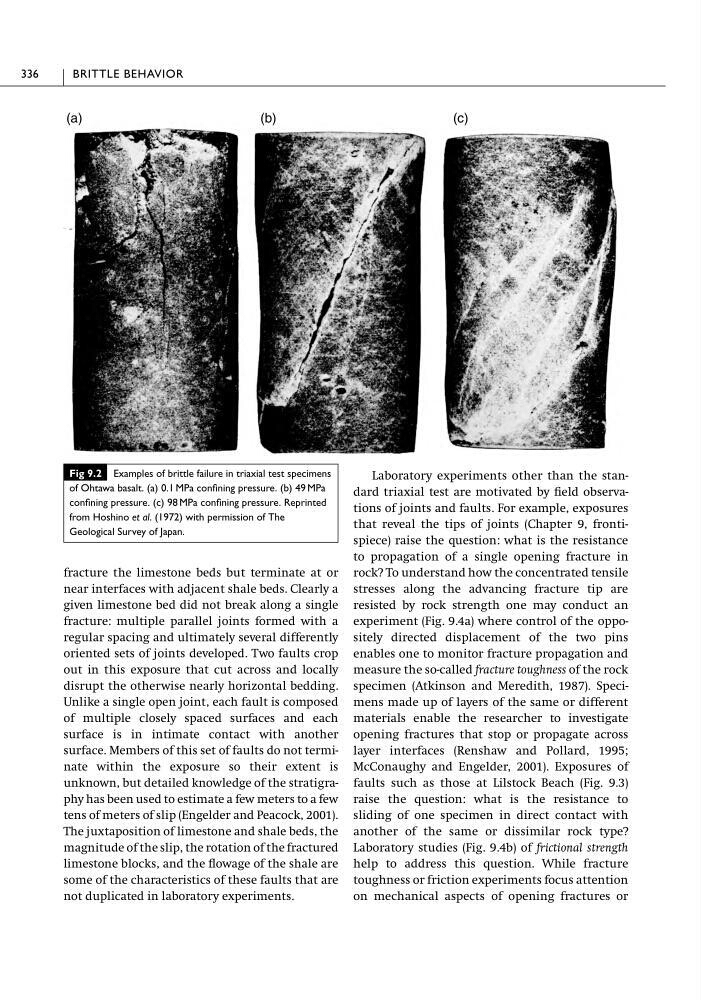
Fig 9.2 Examples of brittle failure in triaxial test specimens
of Ohtawa basalt. (a) 0.1 MPa confining pressure. (b) 49 MPa
confining pressure. (c) 98 MPa confining pressure. Reprinted
from Hoshino et al. (1972) with permission of The
Geological Survey of Japan.
(a)
(b)
(c)
near interfaces with adjacent shale beds. Clearly a
given limestone bed did not break along a single
fracture: multiple parallel joints formed with a
regular spacing and ultimately several differently
oriented sets of joints developed. Two faults crop
out in this exposure that cut across and locally
disrupt the otherwise nearly horizontal bedding.
Unlike a single open joint, each fault is composed
of multiple closely spaced surfaces and each
surface is in intimate contact with another
surface. Members of this set of faults do not terminate within the exposure so their extent is
unknown, but detailed knowledge of the stratigraphy has been used to estimate a few meters to a few
tens of meters of slip (Engelder and Peacock, 2001).
The juxtaposition of limestone and shale beds, the
magnitude of the slip, the rotation of the fractured
limestone blocks, and the flowage of the shale are
some of the characteristics of these faults that are
not duplicated in laboratory experiments.
Laboratory experiments other than the standard triaxial test are motivated by field observations of joints and faults. For example, exposures
that reveal the tips of joints (Chapter 9, frontispiece) raise the question: what is the resistance
to propagation of a single opening fracture in
rock? To understand how the concentrated tensile
stresses along the advancing fracture tip are
resisted by rock strength one may conduct an
experiment (Fig. 9.4a) where control of the oppositely directed displacement of the two pins
enables one to monitor fracture propagation and
measure the so-called fracture toughness of the rock
specimen (Atkinson and Meredith, 1987). Specimens made up of layers of the same or different
materials enable the researcher to investigate
opening fractures that stop or propagate across
layer interfaces (Renshaw and Pollard, 1995;
McConaughy and Engelder, 2001). Exposures of
faults such as those at Lilstock Beach (Fig. 9.3)
raise the question: what is the resistance to
sliding of one specimen in direct contact with
another of the same or dissimilar rock type?
Laboratory studies (Fig. 9.4b) of frictional strength
help to address this question. While fracture
toughness or friction experiments focus attention
on mechanical aspects of opening fractures or
336
BRITTLE BEHAVIOR
Fig 9.2 Examples of brittle failure in triaxial test specimens
of Ohtawa basalt. (a) 0.1 MPa confining pressure. (b) 49 MPa
confining pressure. (c) 98 MPa confining pressure. Reprinted
from Hoshino et al. (1972) with permission of The
Geological Survey of Japan.
(a)
(b)
(c)