

Jaeger and Cook comment on the naming of
inclined fractures in compression test specimens
(Fig. 9.1c and 9.2b) as follows:
Griggs and Handin (1960) . . . call it [the inclined fracture] a fault because of its correspondence with geological faulting, and they have been followed by many
writers; however, it seems preferable to confine the
term fault to the geological context and to retain the
term shear fracture in the experimental context
(Jaeger and Cook, 1979, pp. 92).
Here we choose to follow the recommendation of
Jaeger and Cook so the two phenomena, shear
fractures in laboratory specimens and faults in
Earth’s crust, are clearly distinguished. Furthermore, we extend this recommendation to other
styles of localized deformation. For example,
extension fracture and splitting fracture are terms
appropriate for laboratory fractures that open,
whereas we confine the term joint to the geological context. What may seem like a semantic detail
is important because it emphasizes the fact that
laboratory tests rarely duplicate the length and
time scales, the materials, or the conditions of
formation of faults or joints. On the other hand
laboratory tests may produce useful values of
material properties such as elastic stiffness, frictional strength, or fracture toughness over a range
of confining pressures, temperatures, and strain
rates. Although laboratory triaxial experiments
may provide few insights about the processes of
faulting or jointing, knowledge of the material
properties obtained from them is vital for the
development of models of faulting and jointing.
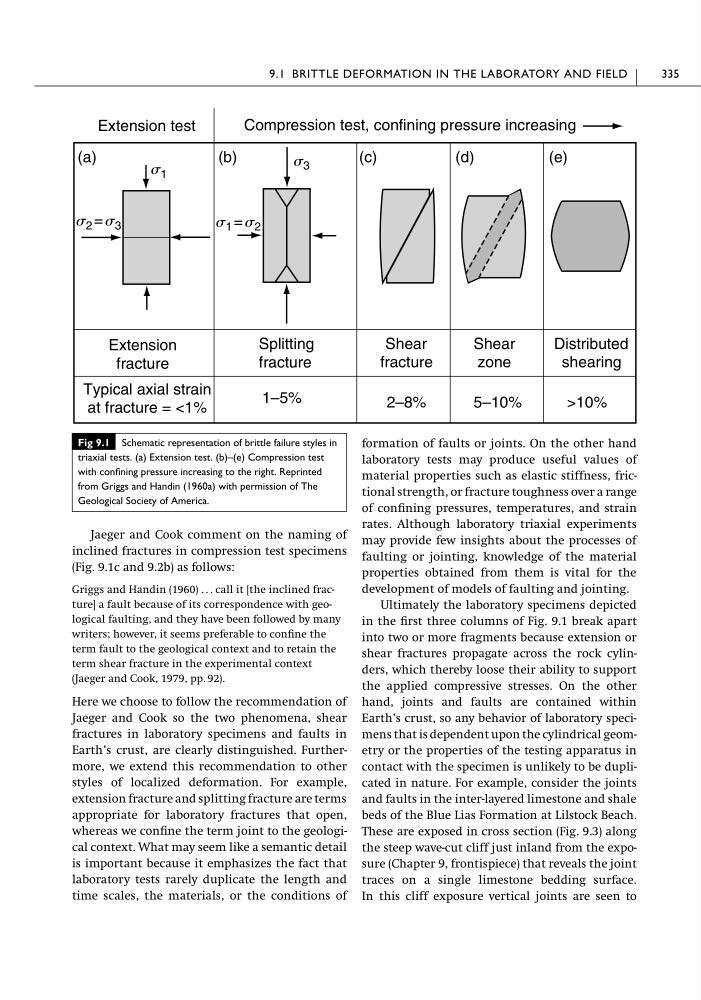
Ultimately the laboratory specimens depicted
in the first three columns of Fig. 9.1 break apart
into two or more fragments because extension or
shear fractures propagate across the rock cylinders, which thereby loose their ability to support
the applied compressive stresses. On the other
hand, joints and faults are contained within
Earth’s crust, so any behavior of laboratory specimens that is dependent upon the cylindrical geometry or the properties of the testing apparatus in
contact with the specimen is unlikely to be duplicated in nature. For example, consider the joints
and faults in the inter-layered limestone and shale
beds of the Blue Lias Formation at Lilstock Beach.
These are exposed in cross section (Fig. 9.3) along
the steep wave-cut cliff just inland from the exposure (Chapter 9, frontispiece) that reveals the joint
traces on a single limestone bedding surface.
In this cliff exposure vertical joints are seen to
9.1 BRITTLE DEFORMATION IN THE LABORATORY AND FIELD
335
Fig 9.1 Schematic representation of brittle failure styles in
triaxial tests. (a) Extension test. (b)–(e) Compression test
with confining pressure increasing to the right. Reprinted
from Griggs and Handin (1960a) with permission of The
Geological Society of America.
(a)
(b)
(c)
(d)
(e)
s 2 = s 3
Typical axial strain
at fracture = <1%
Extension
fracture
Splitting
fracture
Shear
fracture
Shear
zone
Distributed
shearing
1–5%
2–8%
5–10%
>10%
s 1
s 3
s 1 = s 2
Extension test
Compression test, confining pressure increasing
inclined fractures in compression test specimens
(Fig. 9.1c and 9.2b) as follows:
Griggs and Handin (1960) . . . call it [the inclined fracture] a fault because of its correspondence with geological faulting, and they have been followed by many
writers; however, it seems preferable to confine the
term fault to the geological context and to retain the
term shear fracture in the experimental context
(Jaeger and Cook, 1979, pp. 92).
Here we choose to follow the recommendation of
Jaeger and Cook so the two phenomena, shear
fractures in laboratory specimens and faults in
Earth’s crust, are clearly distinguished. Furthermore, we extend this recommendation to other
styles of localized deformation. For example,
extension fracture and splitting fracture are terms
appropriate for laboratory fractures that open,
whereas we confine the term joint to the geological context. What may seem like a semantic detail
is important because it emphasizes the fact that
laboratory tests rarely duplicate the length and
time scales, the materials, or the conditions of
formation of faults or joints. On the other hand
laboratory tests may produce useful values of
material properties such as elastic stiffness, frictional strength, or fracture toughness over a range
of confining pressures, temperatures, and strain
rates. Although laboratory triaxial experiments
may provide few insights about the processes of
faulting or jointing, knowledge of the material
properties obtained from them is vital for the
development of models of faulting and jointing.
Ultimately the laboratory specimens depicted
in the first three columns of Fig. 9.1 break apart
into two or more fragments because extension or
shear fractures propagate across the rock cylinders, which thereby loose their ability to support
the applied compressive stresses. On the other
hand, joints and faults are contained within
Earth’s crust, so any behavior of laboratory specimens that is dependent upon the cylindrical geometry or the properties of the testing apparatus in
contact with the specimen is unlikely to be duplicated in nature. For example, consider the joints
and faults in the inter-layered limestone and shale
beds of the Blue Lias Formation at Lilstock Beach.
These are exposed in cross section (Fig. 9.3) along
the steep wave-cut cliff just inland from the exposure (Chapter 9, frontispiece) that reveals the joint
traces on a single limestone bedding surface.
In this cliff exposure vertical joints are seen to
9.1 BRITTLE DEFORMATION IN THE LABORATORY AND FIELD
335
Fig 9.1 Schematic representation of brittle failure styles in
triaxial tests. (a) Extension test. (b)–(e) Compression test
with confining pressure increasing to the right. Reprinted
from Griggs and Handin (1960a) with permission of The
Geological Society of America.
(a)
(b)
(c)
(d)
(e)
s 2 = s 3
Typical axial strain
at fracture = <1%
Extension
fracture
Splitting
fracture
Shear
fracture
Shear
zone
Distributed
shearing
1–5%
2–8%
5–10%
>10%
s 1
s 3
s 1 = s 2
Extension test
Compression test, confining pressure increasing