

in many examples the individual mineral grains
are arranged with random orientations. Taking a
sample of such a rock that is large compared to
the grain size, the elastic properties would be
approximately isotropic. Calculation procedures
have been derived to estimate the average
isotropic elastic constants for a rock from knowledge of the elastic properties and abundances of
each mineral (Hearmon, 1961).
Some rocks at the hand-sample scale are
anisotropic with respect to elastic properties
because the constituent grains are not randomly
oriented. For example, slates have a strong preferred orientation of the platy minerals. Such
rocks are likely to have an axis of elastic symmetry perpendicular to the plane of the mineral
fabric. Within the plane of the fabric the rock may
be approximately isotropic. Such a material is
described as having a plane of isotropy, or an axis
(perpendicular to this plane) of rotational symmetry (Lekhnitskii, 1963, p. 24) and the linear
strain–stress equations reduce to:
(8.123)
(8.124)
(8.125)
(8.126)
Here the z-axis is the axis of rotational symmetry
and the (x, y)-plane is the plane of isotropy. Notice
yz ϭ s 44 yz , zx ϭ s 44 zx , xy ϭ 2(s 11 Ϫ s 12 ) xy
zz ϭ s 13 xx ϩ s 13 yy ϩ s 33 zz
yy ϭ s 12 xx ϩ s 11 yy ϩ s 13 zz
xx ϭ s 11 xx ϩ s 12 yy ϩ s 13 zz
that there are five independent compliances for
rocks with this form of symmetry and that the
compliances have the same relationship to one
another as in the hexagonal crystal class. Rocks
with these elastic properties are referred to being
transversally isotropic.
The strain–stress relations for the transversally
isotropic rock can be written using variants of the
more familiar elastic constants, Young’s modulus
and Poisson’s ratio as follows:
(8.127)
(8.128)
(8.129)
(8.130)
Here E and are Young’s modulus and Poisson’s
ratio for any direction of applied normal stress
within the plane of isotropy. The constants EЈ and
Ј are Young’s modulus and Poisson’s ratio for an
applied normal stress along the axis of symmetry.
The constant GЈ is the shear modulus for an
applied shear stress in any plane that contains the
axis of symmetry.
For plane strain deformation (8.30) with u z ϭ 0
consider the possibility that there are two
orthogonal axes of elastic symmetry in the (x, y)plane. These conditions require four compliances
yz ϭ
1
GЈ
yz , zx ϭ
1
GЈ
zx , xy ϭ
2(1 ϩ )
E
xy
zz ϭ
1
EЈ
zz Ϫ
Ј
EЈ
( xx ϩ yy )
yy ϭ
1
E
( yy Ϫ xx ) Ϫ
Ј
EЈ
zz
xx ϭ
1
E
( xx Ϫ yy ) Ϫ
Ј
EЈ
zz
328
ELASTIC DEFORMATION
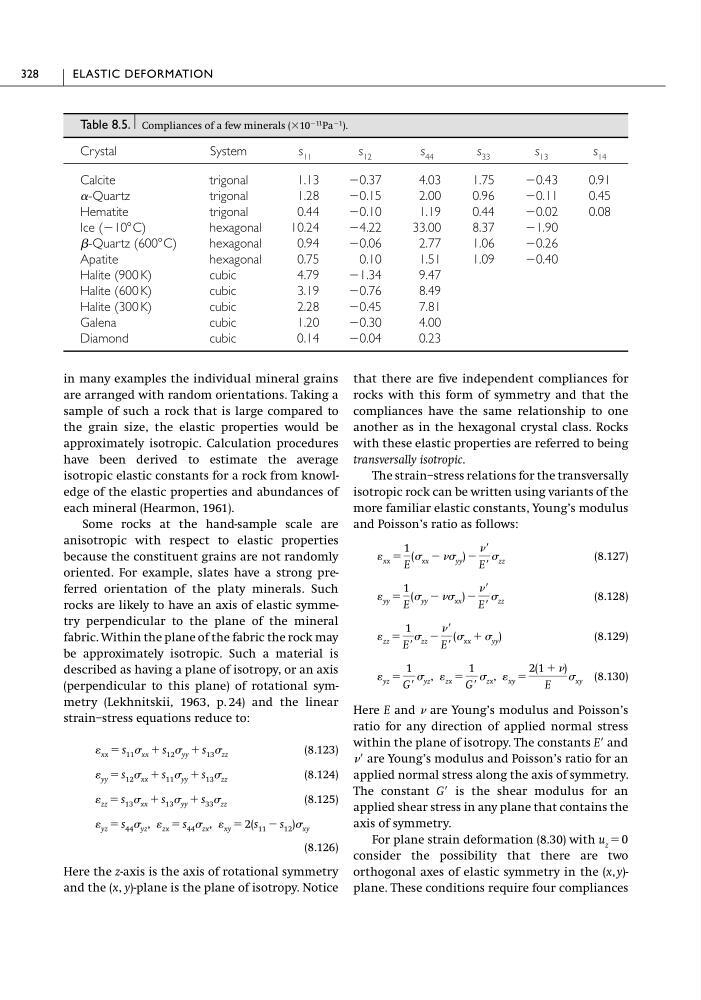
Table 8.5. Compliances of a few minerals (ϫ10
Ϫ11 Pa
Ϫ1
).
Crystal
System
s 11
s 12
s 44
s 33
s 13
s 14
Calcite
trigonal
1.13
Ϫ0.37
4.03
1.75
Ϫ0.43
0.91
␣-Quartz
trigonal
1.28
Ϫ0.15
2.00
0.96
Ϫ0.11
0.45
Hematite
trigonal
0.44
Ϫ0.10
1.19
0.44
Ϫ0.02
0.08
Ice (Ϫ10ЊC)
hexagonal
10.24
Ϫ4.22
33.00
8.37
Ϫ1.90
-Quartz (600ЊC)
hexagonal
0.94
Ϫ0.06
2.77
1.06
Ϫ0.26
Apatite
hexagonal
0.75
0.10
1.51
1.09
Ϫ0.40
Halite (900 K)
cubic
4.79
Ϫ1.34
9.47
Halite (600 K)
cubic
3.19
Ϫ0.76
8.49
Halite (300 K)
cubic
2.28
Ϫ0.45
7.81
Galena
cubic
1.20
Ϫ0.30
4.00
Diamond
cubic
0.14
Ϫ0.04
0.23
are arranged with random orientations. Taking a
sample of such a rock that is large compared to
the grain size, the elastic properties would be
approximately isotropic. Calculation procedures
have been derived to estimate the average
isotropic elastic constants for a rock from knowledge of the elastic properties and abundances of
each mineral (Hearmon, 1961).
Some rocks at the hand-sample scale are
anisotropic with respect to elastic properties
because the constituent grains are not randomly
oriented. For example, slates have a strong preferred orientation of the platy minerals. Such
rocks are likely to have an axis of elastic symmetry perpendicular to the plane of the mineral
fabric. Within the plane of the fabric the rock may
be approximately isotropic. Such a material is
described as having a plane of isotropy, or an axis
(perpendicular to this plane) of rotational symmetry (Lekhnitskii, 1963, p. 24) and the linear
strain–stress equations reduce to:
(8.123)
(8.124)
(8.125)
(8.126)
Here the z-axis is the axis of rotational symmetry
and the (x, y)-plane is the plane of isotropy. Notice
yz ϭ s 44 yz , zx ϭ s 44 zx , xy ϭ 2(s 11 Ϫ s 12 ) xy
zz ϭ s 13 xx ϩ s 13 yy ϩ s 33 zz
yy ϭ s 12 xx ϩ s 11 yy ϩ s 13 zz
xx ϭ s 11 xx ϩ s 12 yy ϩ s 13 zz
that there are five independent compliances for
rocks with this form of symmetry and that the
compliances have the same relationship to one
another as in the hexagonal crystal class. Rocks
with these elastic properties are referred to being
transversally isotropic.
The strain–stress relations for the transversally
isotropic rock can be written using variants of the
more familiar elastic constants, Young’s modulus
and Poisson’s ratio as follows:
(8.127)
(8.128)
(8.129)
(8.130)
Here E and are Young’s modulus and Poisson’s
ratio for any direction of applied normal stress
within the plane of isotropy. The constants EЈ and
Ј are Young’s modulus and Poisson’s ratio for an
applied normal stress along the axis of symmetry.
The constant GЈ is the shear modulus for an
applied shear stress in any plane that contains the
axis of symmetry.
For plane strain deformation (8.30) with u z ϭ 0
consider the possibility that there are two
orthogonal axes of elastic symmetry in the (x, y)plane. These conditions require four compliances
yz ϭ
1
GЈ
yz , zx ϭ
1
GЈ
zx , xy ϭ
2(1 ϩ )
E
xy
zz ϭ
1
EЈ
zz Ϫ
Ј
EЈ
( xx ϩ yy )
yy ϭ
1
E
( yy Ϫ xx ) Ϫ
Ј
EЈ
zz
xx ϭ
1
E
( xx Ϫ yy ) Ϫ
Ј
EЈ
zz
328
ELASTIC DEFORMATION
Table 8.5. Compliances of a few minerals (ϫ10
Ϫ11 Pa
Ϫ1
).
Crystal
System
s 11
s 12
s 44
s 33
s 13
s 14
Calcite
trigonal
1.13
Ϫ0.37
4.03
1.75
Ϫ0.43
0.91
␣-Quartz
trigonal
1.28
Ϫ0.15
2.00
0.96
Ϫ0.11
0.45
Hematite
trigonal
0.44
Ϫ0.10
1.19
0.44
Ϫ0.02
0.08
Ice (Ϫ10ЊC)
hexagonal
10.24
Ϫ4.22
33.00
8.37
Ϫ1.90
-Quartz (600ЊC)
hexagonal
0.94
Ϫ0.06
2.77
1.06
Ϫ0.26
Apatite
hexagonal
0.75
0.10
1.51
1.09
Ϫ0.40
Halite (900 K)
cubic
4.79
Ϫ1.34
9.47
Halite (600 K)
cubic
3.19
Ϫ0.76
8.49
Halite (300 K)
cubic
2.28
Ϫ0.45
7.81
Galena
cubic
1.20
Ϫ0.30
4.00
Diamond
cubic
0.14
Ϫ0.04
0.23