

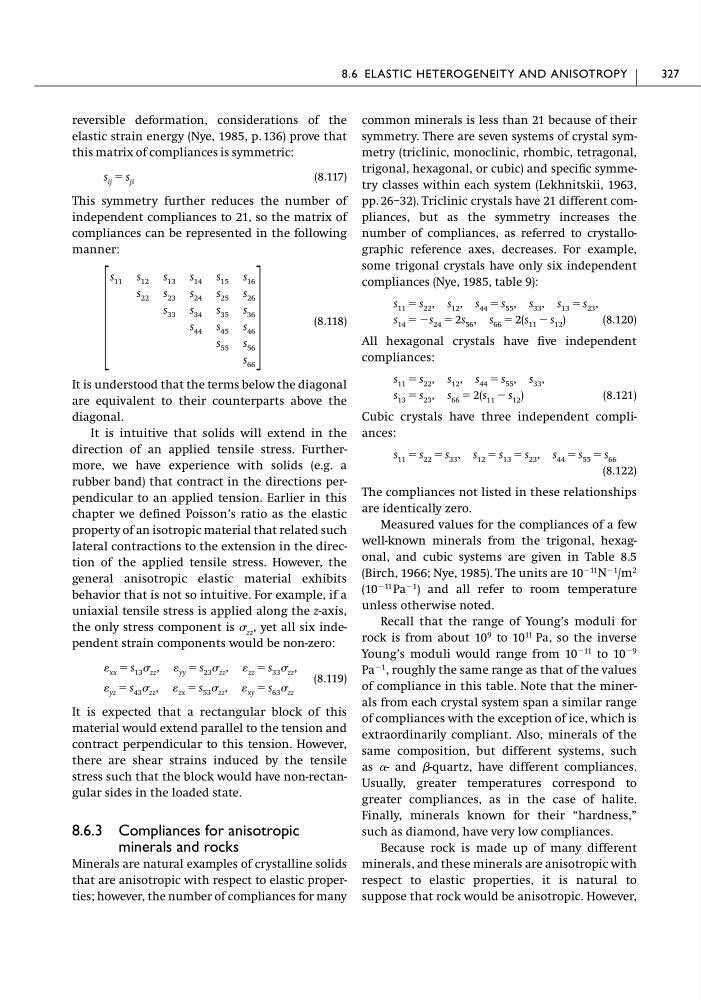
reversible deformation, considerations of the
elastic strain energy (Nye, 1985, p. 136) prove that
this matrix of compliances is symmetric:
(8.117)
This symmetry further reduces the number of
independent compliances to 21, so the matrix of
compliances can be represented in the following
manner:
(8.118)
It is understood that the terms below the diagonal
are equivalent to their counterparts above the
diagonal.
It is intuitive that solids will extend in the
direction of an applied tensile stress. Furthermore, we have experience with solids (e.g. a
rubber band) that contract in the directions perpendicular to an applied tension. Earlier in this
chapter we defined Poisson’s ratio as the elastic
property of an isotropic material that related such
lateral contractions to the extension in the direction of the applied tensile stress. However, the
general anisotropic elastic material exhibits
behavior that is not so intuitive. For example, if a
uniaxial tensile stress is applied along the z-axis,
the only stress component is zz , yet all six independent strain components would be non-zero:
(8.119)
It is expected that a rectangular block of this
material would extend parallel to the tension and
contract perpendicular to this tension. However,
there are shear strains induced by the tensile
stress such that the block would have non-rectangular sides in the loaded state.
8.6.3 Compliances for anisotropic
minerals and rocks
Minerals are natural examples of crystalline solids
that are anisotropic with respect to elastic properties; however, the number of compliances for many
yz ϭ s 43 zz , zx ϭ s 53 zz , xy ϭ s 63 zz
xx ϭ s 13 zz , yy ϭ s 23 zz , zz ϭ s 33 zz ,
΄
s 11 s 12 s 13 s 14 s 15 s 16
s 22 s 23 s 24 s 25 s 26
s 33 s 34 s 35 s 36
s 44 s 45 s 46
s 55 s 56
s 66
΅
s ij ϭ s ji
common minerals is less than 21 because of their
symmetry. There are seven systems of crystal symmetry (triclinic, monoclinic, rhombic, tetragonal,
trigonal, hexagonal, or cubic) and specific symmetry classes within each system (Lekhnitskii, 1963,
pp. 26–32). Triclinic crystals have 21 different compliances, but as the symmetry increases the
number of compliances, as referred to crystallographic reference axes, decreases. For example,
some trigonal crystals have only six independent
compliances (Nye, 1985, table 9):
(8.120)
All hexagonal crystals have five independent
compliances:
(8.121)
Cubic crystals have three independent compliances:
(8.122)
The compliances not listed in these relationships
are identically zero.
Measured values for the compliances of a few
well-known minerals from the trigonal, hexagonal, and cubic systems are given in Table 8.5
(Birch, 1966; Nye, 1985). The units are 10
Ϫ11 N
Ϫ1 /m
2
(10
Ϫ11 Pa
Ϫ1 ) and all refer to room temperature
unless otherwise noted.
Recall that the range of Young’s moduli for
rock is from about 10
9 to 10
11 Pa, so the inverse
Young’s moduli would range from 10
Ϫ11 to 10
Ϫ9
Pa
Ϫ1 , roughly the same range as that of the values
of compliance in this table. Note that the minerals from each crystal system span a similar range
of compliances with the exception of ice, which is
extraordinarily compliant. Also, minerals of the
same composition, but different systems, such
as ␣- and -quartz, have different compliances.
Usually, greater temperatures correspond to
greater compliances, as in the case of halite.
Finally, minerals known for their “hardness,”
such as diamond, have very low compliances.
Because rock is made up of many different
minerals, and these minerals are anisotropic with
respect to elastic properties, it is natural to
suppose that rock would be anisotropic. However,
s 11 ϭ s 22 ϭ s 33 , s 12 ϭ s 13 ϭ s 23 , s 44 ϭ s 55 ϭ s 66
s 13 ϭ s 23 , s 66 ϭ 2(s 11 Ϫ s 12 )
s 11 ϭ s 22 , s 12 , s 44 ϭ s 55 , s 33 ,
s 14 ϭ Ϫs 24 ϭ 2s 56 , s 66 ϭ 2(s 11 Ϫ s 12 )
s 11 ϭ s 22 , s 12 , s 44 ϭ s 55 , s 33 , s 13 ϭ s 23 ,
8.6 ELASTIC HETEROGENEITY AND ANISOTROPY
327
elastic strain energy (Nye, 1985, p. 136) prove that
this matrix of compliances is symmetric:
(8.117)
This symmetry further reduces the number of
independent compliances to 21, so the matrix of
compliances can be represented in the following
manner:
(8.118)
It is understood that the terms below the diagonal
are equivalent to their counterparts above the
diagonal.
It is intuitive that solids will extend in the
direction of an applied tensile stress. Furthermore, we have experience with solids (e.g. a
rubber band) that contract in the directions perpendicular to an applied tension. Earlier in this
chapter we defined Poisson’s ratio as the elastic
property of an isotropic material that related such
lateral contractions to the extension in the direction of the applied tensile stress. However, the
general anisotropic elastic material exhibits
behavior that is not so intuitive. For example, if a
uniaxial tensile stress is applied along the z-axis,
the only stress component is zz , yet all six independent strain components would be non-zero:
(8.119)
It is expected that a rectangular block of this
material would extend parallel to the tension and
contract perpendicular to this tension. However,
there are shear strains induced by the tensile
stress such that the block would have non-rectangular sides in the loaded state.
8.6.3 Compliances for anisotropic
minerals and rocks
Minerals are natural examples of crystalline solids
that are anisotropic with respect to elastic properties; however, the number of compliances for many
yz ϭ s 43 zz , zx ϭ s 53 zz , xy ϭ s 63 zz
xx ϭ s 13 zz , yy ϭ s 23 zz , zz ϭ s 33 zz ,
΄
s 11 s 12 s 13 s 14 s 15 s 16
s 22 s 23 s 24 s 25 s 26
s 33 s 34 s 35 s 36
s 44 s 45 s 46
s 55 s 56
s 66
΅
s ij ϭ s ji
common minerals is less than 21 because of their
symmetry. There are seven systems of crystal symmetry (triclinic, monoclinic, rhombic, tetragonal,
trigonal, hexagonal, or cubic) and specific symmetry classes within each system (Lekhnitskii, 1963,
pp. 26–32). Triclinic crystals have 21 different compliances, but as the symmetry increases the
number of compliances, as referred to crystallographic reference axes, decreases. For example,
some trigonal crystals have only six independent
compliances (Nye, 1985, table 9):
(8.120)
All hexagonal crystals have five independent
compliances:
(8.121)
Cubic crystals have three independent compliances:
(8.122)
The compliances not listed in these relationships
are identically zero.
Measured values for the compliances of a few
well-known minerals from the trigonal, hexagonal, and cubic systems are given in Table 8.5
(Birch, 1966; Nye, 1985). The units are 10
Ϫ11 N
Ϫ1 /m
2
(10
Ϫ11 Pa
Ϫ1 ) and all refer to room temperature
unless otherwise noted.
Recall that the range of Young’s moduli for
rock is from about 10
9 to 10
11 Pa, so the inverse
Young’s moduli would range from 10
Ϫ11 to 10
Ϫ9
Pa
Ϫ1 , roughly the same range as that of the values
of compliance in this table. Note that the minerals from each crystal system span a similar range
of compliances with the exception of ice, which is
extraordinarily compliant. Also, minerals of the
same composition, but different systems, such
as ␣- and -quartz, have different compliances.
Usually, greater temperatures correspond to
greater compliances, as in the case of halite.
Finally, minerals known for their “hardness,”
such as diamond, have very low compliances.
Because rock is made up of many different
minerals, and these minerals are anisotropic with
respect to elastic properties, it is natural to
suppose that rock would be anisotropic. However,
s 11 ϭ s 22 ϭ s 33 , s 12 ϭ s 13 ϭ s 23 , s 44 ϭ s 55 ϭ s 66
s 13 ϭ s 23 , s 66 ϭ 2(s 11 Ϫ s 12 )
s 11 ϭ s 22 , s 12 , s 44 ϭ s 55 , s 33 ,
s 14 ϭ Ϫs 24 ϭ 2s 56 , s 66 ϭ 2(s 11 Ϫ s 12 )
s 11 ϭ s 22 , s 12 , s 44 ϭ s 55 , s 33 , s 13 ϭ s 23 ,
8.6 ELASTIC HETEROGENEITY AND ANISOTROPY
327