

the nine components of stress, and each one
having nine proportionality constants. Altogether
there are 81 constants that are referred to as compliances. These constants make up a fourth-rank
tensor quantity (Nye, 1985, p. 133). A compliant
material is one in which relatively small stresses
cause relatively large strains. In other words, the
respective constants for a compliant material are
greater than those for a stiff material.
The units and dimensions of compliance are
the inverse of those for stress:
(8.109)
The symmetry of the infinitesimal strain components and of the stress components enables a
reduction in the number of independent compliances to 36 according to:
(8.110)
Therefore, the linear anisotropic elastic material
is one in which each of the six independent components of strain is linearly related to the six independent components of stress (Lekhnitskii, 1963;
Jaeger and Cook, 1979):
(8.111)
(8.112)
(8.113)
(8.114)
(8.115)
(8.116)
The s ij form a matrix of constants of proportionality
which also are referred to as compliances. Here the
subscript notation for the compliances has been
simplified, based on the order of listing the strain
and stress components. The first subscript corresponds to the rank of the strain component in the
column on the left-hand side. The second subscript
corresponds to the rank of the stress component in
each row on the right-hand side. For isothermal and
ϩ s 65 zx ϩ s 66 xy
xy ϭ s 61 xx ϩ s 62 yy ϩ s 63 zz ϩ s 64 yz
ϩ s 55 zx ϩ s 56 xy
zx ϭ s 51 xx ϩ s 52 yy ϩ s 53 zz ϩ s 54 yz
ϩ s 45 zx ϩ s 46 xy
yz ϭ s 41 xx ϩ s 42 yy ϩ s 43 zz ϩ s 44 yz
ϩ s 35 zx ϩ s 36 xy
zz ϭ s 31 xx ϩ s 32 yy ϩ s 33 zz ϩ s 34 yz
ϩ s 25 zx ϩ s 26 xy
yy ϭ s 21 xx ϩ s 22 yy ϩ s 23 zz ϩ s 24 yz
ϩ s 15 zx ϩ s 16 xy
xx ϭ s 11 xx ϩ s 12 yy ϩ s 13 zz ϩ s 14 yz
s ijkl ϭ s jikl and s ijkl ϭ s ijlk
compliance, s{ ϭ } M Ϫ1 L T 2
compliance, s[ ϭ ] N Ϫ1 m 2 ϭ Pa Ϫ1
326
ELASTIC DEFORMATION
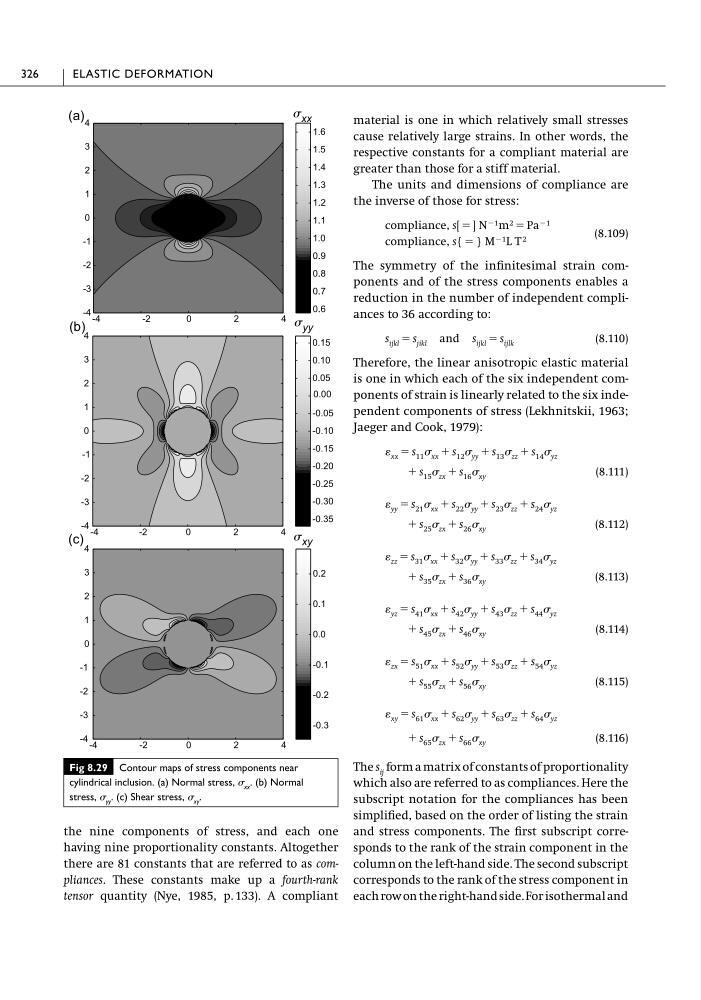
Fig 8.29 Contour maps of stress components near
cylindrical inclusion. (a) Normal stress, xx . (b) Normal
stress, yy . (c) Shear stress, xy .
xx
yy
xy
-4
-2
0
2
4
-4
-3
-2
-1
0
1
2
3
4
0. .6
0. .7
0. .8
0. .9
1.0
1. .1
1. .2
1. .3
1. .4
1.5
1.6
(a)
-4
-2
0
2
4
-4
-3
-2
-1
0
1
2
3
4
-0.35
-0.30
-0.25
-0.20
-0.15
-0.10
-0.05
0.05
0.10
0.15
(b)
-4
-2
0
2
4
-4
-3
-2
-1
0
1
2
3
4
-0.3
-0.2
-0.1
0.0
0. .1
0. .2
(c)
0.00
having nine proportionality constants. Altogether
there are 81 constants that are referred to as compliances. These constants make up a fourth-rank
tensor quantity (Nye, 1985, p. 133). A compliant
material is one in which relatively small stresses
cause relatively large strains. In other words, the
respective constants for a compliant material are
greater than those for a stiff material.
The units and dimensions of compliance are
the inverse of those for stress:
(8.109)
The symmetry of the infinitesimal strain components and of the stress components enables a
reduction in the number of independent compliances to 36 according to:
(8.110)
Therefore, the linear anisotropic elastic material
is one in which each of the six independent components of strain is linearly related to the six independent components of stress (Lekhnitskii, 1963;
Jaeger and Cook, 1979):
(8.111)
(8.112)
(8.113)
(8.114)
(8.115)
(8.116)
The s ij form a matrix of constants of proportionality
which also are referred to as compliances. Here the
subscript notation for the compliances has been
simplified, based on the order of listing the strain
and stress components. The first subscript corresponds to the rank of the strain component in the
column on the left-hand side. The second subscript
corresponds to the rank of the stress component in
each row on the right-hand side. For isothermal and
ϩ s 65 zx ϩ s 66 xy
xy ϭ s 61 xx ϩ s 62 yy ϩ s 63 zz ϩ s 64 yz
ϩ s 55 zx ϩ s 56 xy
zx ϭ s 51 xx ϩ s 52 yy ϩ s 53 zz ϩ s 54 yz
ϩ s 45 zx ϩ s 46 xy
yz ϭ s 41 xx ϩ s 42 yy ϩ s 43 zz ϩ s 44 yz
ϩ s 35 zx ϩ s 36 xy
zz ϭ s 31 xx ϩ s 32 yy ϩ s 33 zz ϩ s 34 yz
ϩ s 25 zx ϩ s 26 xy
yy ϭ s 21 xx ϩ s 22 yy ϩ s 23 zz ϩ s 24 yz
ϩ s 15 zx ϩ s 16 xy
xx ϭ s 11 xx ϩ s 12 yy ϩ s 13 zz ϩ s 14 yz
s ijkl ϭ s jikl and s ijkl ϭ s ijlk
compliance, s{ ϭ } M Ϫ1 L T 2
compliance, s[ ϭ ] N Ϫ1 m 2 ϭ Pa Ϫ1
326
ELASTIC DEFORMATION
Fig 8.29 Contour maps of stress components near
cylindrical inclusion. (a) Normal stress, xx . (b) Normal
stress, yy . (c) Shear stress, xy .
xx
yy
xy
-4
-2
0
2
4
-4
-3
-2
-1
0
1
2
3
4
0. .6
0. .7
0. .8
0. .9
1.0
1. .1
1. .2
1. .3
1. .4
1.5
1.6
(a)
-4
-2
0
2
4
-4
-3
-2
-1
0
1
2
3
4
-0.35
-0.30
-0.25
-0.20
-0.15
-0.10
-0.05
0.05
0.10
0.15
(b)
-4
-2
0
2
4
-4
-3
-2
-1
0
1
2
3
4
-0.3
-0.2
-0.1
0.0
0. .1
0. .2
(c)
0.00