

moduli differ by an order of magnitude. The
granite from LG-2 was described as “massive,”
whereas the diorite gneiss from Tehachapi was
described as “fractured.” Apparently, the presence
of fractures (and perhaps other heterogeneities) at
the field scale produced a profound change in the
rock stiffness. The three sedimentary rock types
listed in Table 8.4 are consistent with the generalization that greater size correlates with lesser
stiffness. They also illustrate the broad range of
possible behaviors: for some graywackes the stiffness decreased by only a factor of two, whereas for
some shaley sandstones the decrease was by a
factor of more than sixty.
8.6 Elastic heterogeneity and
anisotropy
A rock mass is heterogeneous with respect to an
elastic property if the value of that property varies
from place to place. A rock mass is anisotropic with
respect to an elastic property if the value of that
property varies with orientation at any given
place. Thus heterogeneity refers to spatial variation and anisotropy refers to directional variation.
These terms apply to any physical property so it is
important to specify that property. A rock mass
with no spatial variation in a particular property
is said to be homogeneous with respect to that property, and one with no direction variation is said to
be isotropic with respect to that property. In this
section we describe heterogeneities and anisotropies with respect to elastic properties and show
how these affect the solutions to certain elastic
boundary value problems.
8.6.1 Deformation of a heterogeneous
elastic material
Some heterogeneities serve to amplify locally a
remote tension or compression, whereas others
actually convert a remote compression into a local
tension or vice versa. To keep the analysis simple
and analytical we consider an inclusion of
“foreign” material such as a fossil, clast, or xenolith in an otherwise homogeneous rock mass
(Wiltschko and Sutton, 1982). Typically these
foreign objects are composed of a different suite
of minerals than the surrounding rock, and they
may have a different grain size and texture. As
such, the elastic properties of the inclusion are
likely to be different than those of the surroundings. A very instructive boundary value problem is
the elastic solution for a circular inclusion (Jaeger
and Cook, 1979, pp. 261).
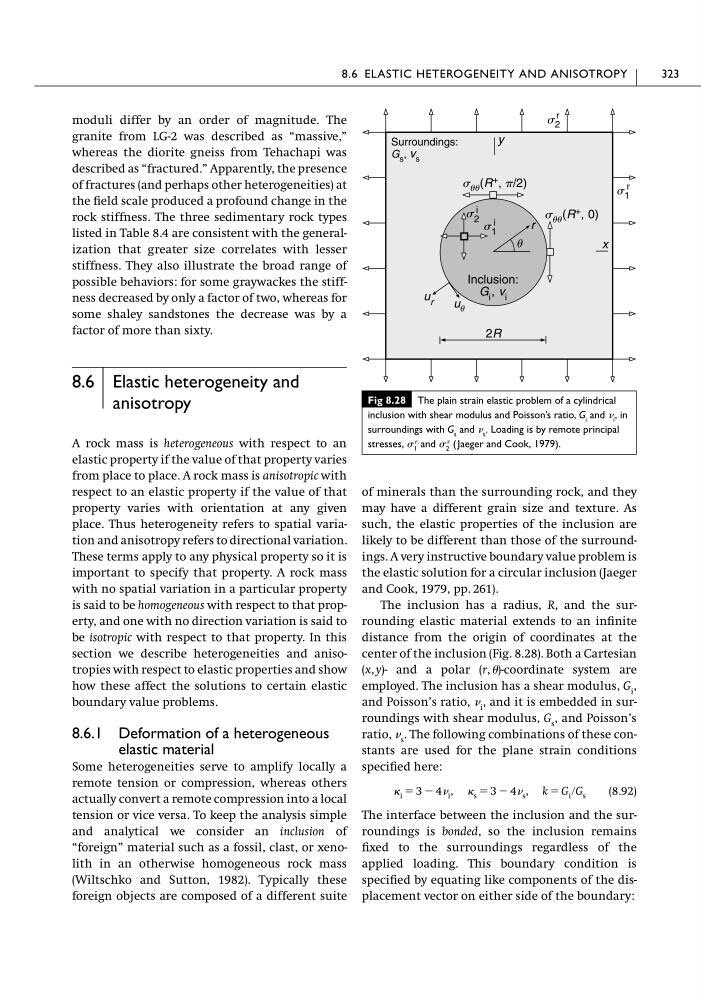
The inclusion has a radius, R, and the surrounding elastic material extends to an infinite
distance from the origin of coordinates at the
center of the inclusion (Fig. 8.28). Both a Cartesian
(x, y)- and a polar (r, )-coordinate system are
employed. The inclusion has a shear modulus, G i ,
and Poisson’s ratio, i , and it is embedded in surroundings with shear modulus, G s , and Poisson’s
ratio, s . The following combinations of these constants are used for the plane strain conditions
specified here:
(8.92)
The interface between the inclusion and the surroundings is bonded, so the inclusion remains
fixed to the surroundings regardless of the
applied loading. This boundary condition is
specified by equating like components of the displacement vector on either side of the boundary:
i ϭ 3 Ϫ 4 i , s ϭ 3 Ϫ 4 s , k ϭ G i րG s
8.6 ELASTIC HETEROGENEITY AND ANISOTROPY
323
Fig 8.28 The plain strain elastic problem of a cylindrical
inclusion with shear modulus and Poisson’s ratio, G i and i , in
surroundings with G s and s . Loading is by remote principal
stresses, 1
r and 2
r ( Jaeger and Cook, 1979).
y
x
2R
Inclusion:
G i , v i
r
u
u r
Surroundings:
G s , v s
s uu (R + , 0)
s uu (R + , p/2)
s 2 s 1
u u
s 2
r
i
i
s 1
r
granite from LG-2 was described as “massive,”
whereas the diorite gneiss from Tehachapi was
described as “fractured.” Apparently, the presence
of fractures (and perhaps other heterogeneities) at
the field scale produced a profound change in the
rock stiffness. The three sedimentary rock types
listed in Table 8.4 are consistent with the generalization that greater size correlates with lesser
stiffness. They also illustrate the broad range of
possible behaviors: for some graywackes the stiffness decreased by only a factor of two, whereas for
some shaley sandstones the decrease was by a
factor of more than sixty.
8.6 Elastic heterogeneity and
anisotropy
A rock mass is heterogeneous with respect to an
elastic property if the value of that property varies
from place to place. A rock mass is anisotropic with
respect to an elastic property if the value of that
property varies with orientation at any given
place. Thus heterogeneity refers to spatial variation and anisotropy refers to directional variation.
These terms apply to any physical property so it is
important to specify that property. A rock mass
with no spatial variation in a particular property
is said to be homogeneous with respect to that property, and one with no direction variation is said to
be isotropic with respect to that property. In this
section we describe heterogeneities and anisotropies with respect to elastic properties and show
how these affect the solutions to certain elastic
boundary value problems.
8.6.1 Deformation of a heterogeneous
elastic material
Some heterogeneities serve to amplify locally a
remote tension or compression, whereas others
actually convert a remote compression into a local
tension or vice versa. To keep the analysis simple
and analytical we consider an inclusion of
“foreign” material such as a fossil, clast, or xenolith in an otherwise homogeneous rock mass
(Wiltschko and Sutton, 1982). Typically these
foreign objects are composed of a different suite
of minerals than the surrounding rock, and they
may have a different grain size and texture. As
such, the elastic properties of the inclusion are
likely to be different than those of the surroundings. A very instructive boundary value problem is
the elastic solution for a circular inclusion (Jaeger
and Cook, 1979, pp. 261).
The inclusion has a radius, R, and the surrounding elastic material extends to an infinite
distance from the origin of coordinates at the
center of the inclusion (Fig. 8.28). Both a Cartesian
(x, y)- and a polar (r, )-coordinate system are
employed. The inclusion has a shear modulus, G i ,
and Poisson’s ratio, i , and it is embedded in surroundings with shear modulus, G s , and Poisson’s
ratio, s . The following combinations of these constants are used for the plane strain conditions
specified here:
(8.92)
The interface between the inclusion and the surroundings is bonded, so the inclusion remains
fixed to the surroundings regardless of the
applied loading. This boundary condition is
specified by equating like components of the displacement vector on either side of the boundary:
i ϭ 3 Ϫ 4 i , s ϭ 3 Ϫ 4 s , k ϭ G i րG s
8.6 ELASTIC HETEROGENEITY AND ANISOTROPY
323
Fig 8.28 The plain strain elastic problem of a cylindrical
inclusion with shear modulus and Poisson’s ratio, G i and i , in
surroundings with G s and s . Loading is by remote principal
stresses, 1
r and 2
r ( Jaeger and Cook, 1979).
y
x
2R
Inclusion:
G i , v i
r
u
u r
Surroundings:
G s , v s
s uu (R + , 0)
s uu (R + , p/2)
s 2 s 1
u u
s 2
r
i
i
s 1
r