

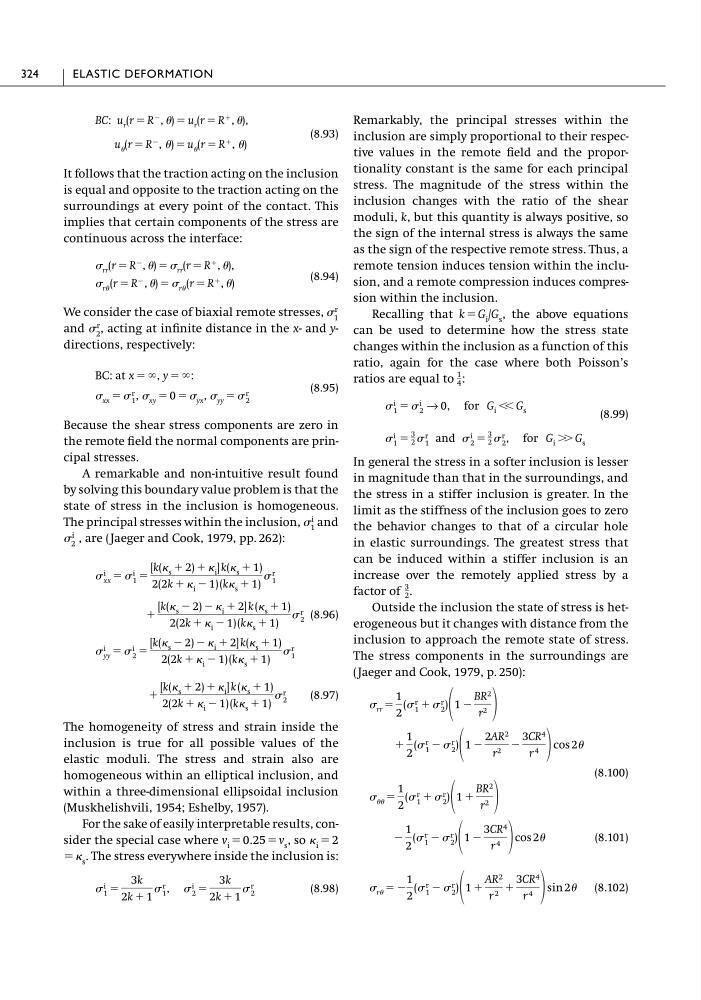
(8.93)
It follows that the traction acting on the inclusion
is equal and opposite to the traction acting on the
surroundings at every point of the contact. This
implies that certain components of the stress are
continuous across the interface:
(8.94)
We consider the case of biaxial remote stresses,
r
1
and
r
2
, acting at infinite distance in the x- and ydirections, respectively:
(8.95)
Because the shear stress components are zero in
the remote field the normal components are principal stresses.
A remarkable and non-intuitive result found
by solving this boundary value problem is that the
state of stress in the inclusion is homogeneous.
The principal stresses within the inclusion,
i
1
and
i
2
, are ( Jaeger and Cook, 1979, pp. 262):
(8.96)
(8.97)
The homogeneity of stress and strain inside the
inclusion is true for all possible values of the
elastic moduli. The stress and strain also are
homogeneous within an elliptical inclusion, and
within a three-dimensional ellipsoidal inclusion
(Muskhelishvili, 1954; Eshelby, 1957).
For the sake of easily interpretable results, consider the special case where v i ϭ 0.25 ϭ v s , so i ϭ 2
ϭ s . The stress everywhere inside the inclusion is:
(8.98)
i
1 ϭ
3k
2k ϩ 1
r
1 , i
2 ϭ
3k
2k ϩ 1
r
2
ϩ
[k( s ϩ 2) ϩ i ] k ( s ϩ 1)
2(2k ϩ i Ϫ 1) (k s ϩ 1)
r
2
i
yy ϭ i
2 ϭ
[k( s Ϫ 2) Ϫ i ϩ 2] k( s ϩ 1)
2(2k ϩ i Ϫ 1) (k s ϩ 1)
r
1
ϩ
[k( s Ϫ 2) Ϫ i ϩ 2] k ( s ϩ 1)
2(2k ϩ i Ϫ 1) (k s ϩ 1)
r
2
i
xx ϭ i
1 ϭ
[k( s ϩ 2) ϩ i ] k( s ϩ 1)
2(2k ϩ i Ϫ 1) (k s ϩ 1)
r
1
xy ϭ 0 ϭ yx , yy ϭ r
2
xx ϭ r
1 ,
BC: at x ϭ ϱ, y ϭ ϱ:
r (r ϭ R Ϫ , ) ϭ r (r ϭ R ϩ , )
rr (r ϭ R Ϫ , ) ϭ rr (r ϭ R ϩ , ),
u (r ϭ R Ϫ , ) ϭ u (r ϭ R ϩ , )
BC: u r (r ϭ R Ϫ , ) ϭ u r (r ϭ R ϩ , ),
Remarkably, the principal stresses within the
inclusion are simply proportional to their respective values in the remote field and the proportionality constant is the same for each principal
stress. The magnitude of the stress within the
inclusion changes with the ratio of the shear
moduli, k, but this quantity is always positive, so
the sign of the internal stress is always the same
as the sign of the respective remote stress. Thus, a
remote tension induces tension within the inclusion, and a remote compression induces compression within the inclusion.
Recalling that k ϭ G i /G s , the above equations
can be used to determine how the stress state
changes within the inclusion as a function of this
ratio, again for the case where both Poisson’s
ratios are equal to :
(8.99)
In general the stress in a softer inclusion is lesser
in magnitude than that in the surroundings, and
the stress in a stiffer inclusion is greater. In the
limit as the stiffness of the inclusion goes to zero
the behavior changes to that of a circular hole
in elastic surroundings. The greatest stress that
can be induced within a stiffer inclusion is an
increase over the remotely applied stress by a
factor of .
Outside the inclusion the state of stress is heterogeneous but it changes with distance from the
inclusion to approach the remote state of stress.
The stress components in the surroundings are
(Jaeger and Cook, 1979, p. 250):
(8.100)
(8.101)
(8.102)
r ϭ Ϫ
1
2
( r
1 Ϫ r
2 ) 1 ϩ
AR 2
r 2 ϩ
3CR 4
r 4 sin 2
Ϫ
1
2
( r
1 Ϫ r
2 )
1 Ϫ
3CR 4
r 4
cos 2
ϭ
1
2
( r
1 ϩ r
2 )
1 ϩ
BR 2
r 2
ϩ
1
2
( r
1 Ϫ r
2 ) 1 Ϫ
2AR 2
r 2 Ϫ
3CR 4
r 4 cos 2
rr ϭ
1
2
( r
1 ϩ r
2 ) 1 Ϫ
BR 2
r 2
3
2
i
1 ϭ
3
2 r
1 and i
2 ϭ
3
2 r
2 , for G i Ͼ Ͼ G s
i
1 ϭ i
2 → 0, for G i Ͻ Ͻ G s
1
4
324
ELASTIC DEFORMATION
It follows that the traction acting on the inclusion
is equal and opposite to the traction acting on the
surroundings at every point of the contact. This
implies that certain components of the stress are
continuous across the interface:
(8.94)
We consider the case of biaxial remote stresses,
r
1
and
r
2
, acting at infinite distance in the x- and ydirections, respectively:
(8.95)
Because the shear stress components are zero in
the remote field the normal components are principal stresses.
A remarkable and non-intuitive result found
by solving this boundary value problem is that the
state of stress in the inclusion is homogeneous.
The principal stresses within the inclusion,
i
1
and
i
2
, are ( Jaeger and Cook, 1979, pp. 262):
(8.96)
(8.97)
The homogeneity of stress and strain inside the
inclusion is true for all possible values of the
elastic moduli. The stress and strain also are
homogeneous within an elliptical inclusion, and
within a three-dimensional ellipsoidal inclusion
(Muskhelishvili, 1954; Eshelby, 1957).
For the sake of easily interpretable results, consider the special case where v i ϭ 0.25 ϭ v s , so i ϭ 2
ϭ s . The stress everywhere inside the inclusion is:
(8.98)
i
1 ϭ
3k
2k ϩ 1
r
1 , i
2 ϭ
3k
2k ϩ 1
r
2
ϩ
[k( s ϩ 2) ϩ i ] k ( s ϩ 1)
2(2k ϩ i Ϫ 1) (k s ϩ 1)
r
2
i
yy ϭ i
2 ϭ
[k( s Ϫ 2) Ϫ i ϩ 2] k( s ϩ 1)
2(2k ϩ i Ϫ 1) (k s ϩ 1)
r
1
ϩ
[k( s Ϫ 2) Ϫ i ϩ 2] k ( s ϩ 1)
2(2k ϩ i Ϫ 1) (k s ϩ 1)
r
2
i
xx ϭ i
1 ϭ
[k( s ϩ 2) ϩ i ] k( s ϩ 1)
2(2k ϩ i Ϫ 1) (k s ϩ 1)
r
1
xy ϭ 0 ϭ yx , yy ϭ r
2
xx ϭ r
1 ,
BC: at x ϭ ϱ, y ϭ ϱ:
r (r ϭ R Ϫ , ) ϭ r (r ϭ R ϩ , )
rr (r ϭ R Ϫ , ) ϭ rr (r ϭ R ϩ , ),
u (r ϭ R Ϫ , ) ϭ u (r ϭ R ϩ , )
BC: u r (r ϭ R Ϫ , ) ϭ u r (r ϭ R ϩ , ),
Remarkably, the principal stresses within the
inclusion are simply proportional to their respective values in the remote field and the proportionality constant is the same for each principal
stress. The magnitude of the stress within the
inclusion changes with the ratio of the shear
moduli, k, but this quantity is always positive, so
the sign of the internal stress is always the same
as the sign of the respective remote stress. Thus, a
remote tension induces tension within the inclusion, and a remote compression induces compression within the inclusion.
Recalling that k ϭ G i /G s , the above equations
can be used to determine how the stress state
changes within the inclusion as a function of this
ratio, again for the case where both Poisson’s
ratios are equal to :
(8.99)
In general the stress in a softer inclusion is lesser
in magnitude than that in the surroundings, and
the stress in a stiffer inclusion is greater. In the
limit as the stiffness of the inclusion goes to zero
the behavior changes to that of a circular hole
in elastic surroundings. The greatest stress that
can be induced within a stiffer inclusion is an
increase over the remotely applied stress by a
factor of .
Outside the inclusion the state of stress is heterogeneous but it changes with distance from the
inclusion to approach the remote state of stress.
The stress components in the surroundings are
(Jaeger and Cook, 1979, p. 250):
(8.100)
(8.101)
(8.102)
r ϭ Ϫ
1
2
( r
1 Ϫ r
2 ) 1 ϩ
AR 2
r 2 ϩ
3CR 4
r 4 sin 2
Ϫ
1
2
( r
1 Ϫ r
2 )
1 Ϫ
3CR 4
r 4
cos 2
ϭ
1
2
( r
1 ϩ r
2 )
1 ϩ
BR 2
r 2
ϩ
1
2
( r
1 Ϫ r
2 ) 1 Ϫ
2AR 2
r 2 Ϫ
3CR 4
r 4 cos 2
rr ϭ
1
2
( r
1 ϩ r
2 ) 1 Ϫ
BR 2
r 2
3
2
i
1 ϭ
3
2 r
1 and i
2 ϭ
3
2 r
2 , for G i Ͼ Ͼ G s
i
1 ϭ i
2 → 0, for G i Ͻ Ͻ G s
1
4
324
ELASTIC DEFORMATION