

stress trajectories to the side of the valley, with
greatest compression approximately vertical and
least compression approximately horizontal is
consistent with the normal faulting.
8.5 Elastic properties from
laboratory and engineering
field tests
The measurement of rock properties in the laboratory traditionally falls within the discipline
called rock mechanics, although a broad variety of
scientists and engineers, including geophysicists
and structural geologists as well as mining and
civil engineers, contribute to this activity. Structural geologists use the data from rock property
testing, so we review the procedures and results
while leaving aside many of the technical details.
Some of the details of experiments to determine
the elastic properties are described in textbooks
on rock mechanics (Jaeger and Cook, 1979).
Although we have referred to this activity as an
“experiment” the procedure has become routine
and is considered by some to be a standardized
engineering test. We present selected values for
Young’s modulus and Poisson’s ratio.
8.5.1 Measuring the elastic properties of
laboratory samples
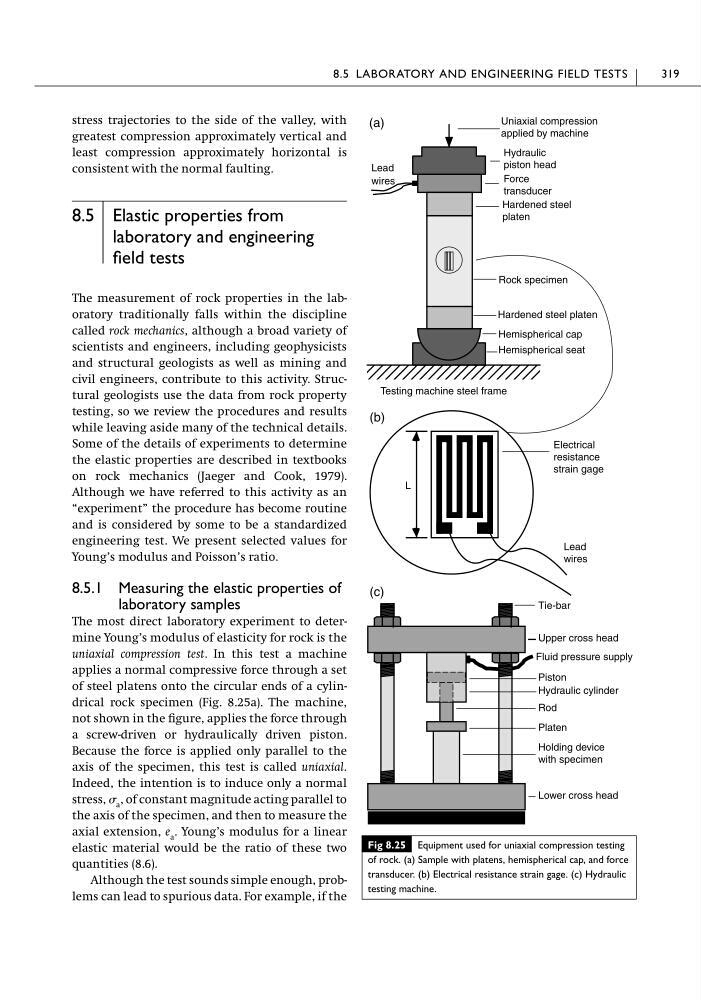
The most direct laboratory experiment to determine Young’s modulus of elasticity for rock is the
uniaxial compression test. In this test a machine
applies a normal compressive force through a set
of steel platens onto the circular ends of a cylindrical rock specimen (Fig. 8.25a). The machine,
not shown in the figure, applies the force through
a screw-driven or hydraulically driven piston.
Because the force is applied only parallel to the
axis of the specimen, this test is called uniaxial.
Indeed, the intention is to induce only a normal
stress, a , of constant magnitude acting parallel to
the axis of the specimen, and then to measure the
axial extension, e a . Young’s modulus for a linear
elastic material would be the ratio of these two
quantities (8.6).
Although the test sounds simple enough, problems can lead to spurious data. For example, if the
8.5 LABORATORY AND ENGINEERING FIELD TESTS
319
Fig 8.25 Equipment used for uniaxial compression testing
of rock. (a) Sample with platens, hemispherical cap, and force
transducer. (b) Electrical resistance strain gage. (c) Hydraulic
testing machine.
Hydraulic
piston head
Force
transducer
Hardened steel
platen
Rock specimen
Hemispherical cap
Hemispherical seat
Hardened steel platen
Lead
wires
Uniaxial compression
applied by machine
Electrical
resistance
strain gage
Lead
wires
(a)
(b)
Testing machine steel frame
L
Hydraulic cylinder
Rod
Platen
Holding device
with specimen
Upper cross head
Lower cross head
Tie-bar
Piston
(c)
Fluid pressure supply
greatest compression approximately vertical and
least compression approximately horizontal is
consistent with the normal faulting.
8.5 Elastic properties from
laboratory and engineering
field tests
The measurement of rock properties in the laboratory traditionally falls within the discipline
called rock mechanics, although a broad variety of
scientists and engineers, including geophysicists
and structural geologists as well as mining and
civil engineers, contribute to this activity. Structural geologists use the data from rock property
testing, so we review the procedures and results
while leaving aside many of the technical details.
Some of the details of experiments to determine
the elastic properties are described in textbooks
on rock mechanics (Jaeger and Cook, 1979).
Although we have referred to this activity as an
“experiment” the procedure has become routine
and is considered by some to be a standardized
engineering test. We present selected values for
Young’s modulus and Poisson’s ratio.
8.5.1 Measuring the elastic properties of
laboratory samples
The most direct laboratory experiment to determine Young’s modulus of elasticity for rock is the
uniaxial compression test. In this test a machine
applies a normal compressive force through a set
of steel platens onto the circular ends of a cylindrical rock specimen (Fig. 8.25a). The machine,
not shown in the figure, applies the force through
a screw-driven or hydraulically driven piston.
Because the force is applied only parallel to the
axis of the specimen, this test is called uniaxial.
Indeed, the intention is to induce only a normal
stress, a , of constant magnitude acting parallel to
the axis of the specimen, and then to measure the
axial extension, e a . Young’s modulus for a linear
elastic material would be the ratio of these two
quantities (8.6).
Although the test sounds simple enough, problems can lead to spurious data. For example, if the
8.5 LABORATORY AND ENGINEERING FIELD TESTS
319
Fig 8.25 Equipment used for uniaxial compression testing
of rock. (a) Sample with platens, hemispherical cap, and force
transducer. (b) Electrical resistance strain gage. (c) Hydraulic
testing machine.
Hydraulic
piston head
Force
transducer
Hardened steel
platen
Rock specimen
Hemispherical cap
Hemispherical seat
Hardened steel platen
Lead
wires
Uniaxial compression
applied by machine
Electrical
resistance
strain gage
Lead
wires
(a)
(b)
Testing machine steel frame
L
Hydraulic cylinder
Rod
Platen
Holding device
with specimen
Upper cross head
Lower cross head
Tie-bar
Piston
(c)
Fluid pressure supply