

While most geologists who have written
recently about the Meander Anticline agree that
the meandering course of the Colorado River
developed before the anticline, a number of
hypotheses have been offered to explain the
folding. For example, there is some debate about
the role of evaporites (gypsum with minor limestone and shale) from the Paradox Member of the
Pennsylvanian age Hermosa Formation that
underlies much of this region. Some have suggested that the evaporites have flowed laterally
and upward toward the canyon bottom because of
stress changes caused by the rapid incision of the
river (Potter and McGill, 1978). There is ample evidence for such flowage in the four salt plugs
located along the southern portion of the anticline (Fig. 8.23, marked A, B, C, D) where evaporites have pierced through the overlying strata to
the surface. Others have suggested that the plate
of strata overlying the evaporites is sliding toward
the canyon under the influence of gravity, while
the evaporites remain essentially in place
(Huntoon, 1982). This plate varies from about
700 m thick near the northern edge of the Needles
fault zone (Fig. 8.23) to zero near the southern
edge. There is ample evidence for gravitational
sliding of the Needles fault zone, where normal
faults bound a set of grabens that have extended
toward the river (McGill and Stromquist, 1979;
Cartwright et al., 1995; Moore and Schultz, 1999).
Huntoon (1982, Fig. 5) suggests that models for
the development of the Meander Anticline can be
discriminated by comparing the stress states
implied by the models to the stress states deduced
from geological structures at two key locations,
the Needles fault zone and the axis of the
Meander Anticline. Specifically he deduces from
the normal faults in the Needles fault zone that
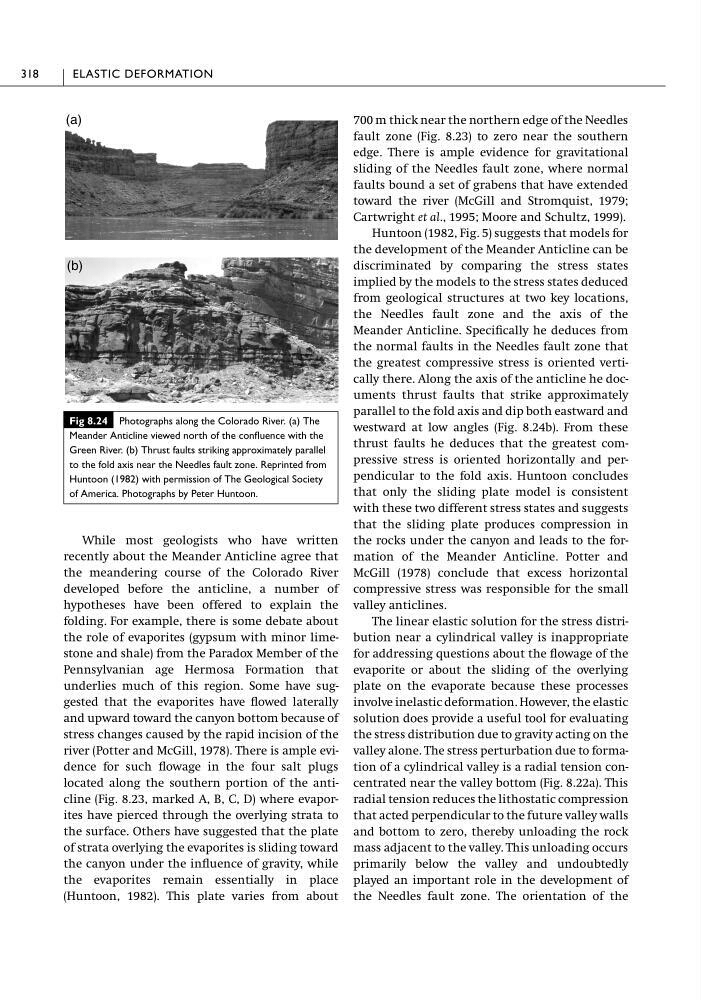
the greatest compressive stress is oriented vertically there. Along the axis of the anticline he documents thrust faults that strike approximately
parallel to the fold axis and dip both eastward and
westward at low angles (Fig. 8.24b). From these
thrust faults he deduces that the greatest compressive stress is oriented horizontally and perpendicular to the fold axis. Huntoon concludes
that only the sliding plate model is consistent
with these two different stress states and suggests
that the sliding plate produces compression in
the rocks under the canyon and leads to the formation of the Meander Anticline. Potter and
McGill (1978) conclude that excess horizontal
compressive stress was responsible for the small
valley anticlines.
The linear elastic solution for the stress distribution near a cylindrical valley is inappropriate
for addressing questions about the flowage of the
evaporite or about the sliding of the overlying
plate on the evaporate because these processes
involve inelastic deformation. However, the elastic
solution does provide a useful tool for evaluating
the stress distribution due to gravity acting on the
valley alone. The stress perturbation due to formation of a cylindrical valley is a radial tension concentrated near the valley bottom (Fig. 8.22a). This
radial tension reduces the lithostatic compression
that acted perpendicular to the future valley walls
and bottom to zero, thereby unloading the rock
mass adjacent to the valley. This unloading occurs
primarily below the valley and undoubtedly
played an important role in the development of
the Needles fault zone. The orientation of the
318
ELASTIC DEFORMATION
Fig 8.24 Photographs along the Colorado River. (a) The
Meander Anticline viewed north of the confluence with the
Green River. (b) Thrust faults striking approximately parallel
to the fold axis near the Needles fault zone. Reprinted from
Huntoon (1982) with permission of The Geological Society
of America. Photographs by Peter Huntoon.
(a)
(b)
recently about the Meander Anticline agree that
the meandering course of the Colorado River
developed before the anticline, a number of
hypotheses have been offered to explain the
folding. For example, there is some debate about
the role of evaporites (gypsum with minor limestone and shale) from the Paradox Member of the
Pennsylvanian age Hermosa Formation that
underlies much of this region. Some have suggested that the evaporites have flowed laterally
and upward toward the canyon bottom because of
stress changes caused by the rapid incision of the
river (Potter and McGill, 1978). There is ample evidence for such flowage in the four salt plugs
located along the southern portion of the anticline (Fig. 8.23, marked A, B, C, D) where evaporites have pierced through the overlying strata to
the surface. Others have suggested that the plate
of strata overlying the evaporites is sliding toward
the canyon under the influence of gravity, while
the evaporites remain essentially in place
(Huntoon, 1982). This plate varies from about
700 m thick near the northern edge of the Needles
fault zone (Fig. 8.23) to zero near the southern
edge. There is ample evidence for gravitational
sliding of the Needles fault zone, where normal
faults bound a set of grabens that have extended
toward the river (McGill and Stromquist, 1979;
Cartwright et al., 1995; Moore and Schultz, 1999).
Huntoon (1982, Fig. 5) suggests that models for
the development of the Meander Anticline can be
discriminated by comparing the stress states
implied by the models to the stress states deduced
from geological structures at two key locations,
the Needles fault zone and the axis of the
Meander Anticline. Specifically he deduces from
the normal faults in the Needles fault zone that
the greatest compressive stress is oriented vertically there. Along the axis of the anticline he documents thrust faults that strike approximately
parallel to the fold axis and dip both eastward and
westward at low angles (Fig. 8.24b). From these
thrust faults he deduces that the greatest compressive stress is oriented horizontally and perpendicular to the fold axis. Huntoon concludes
that only the sliding plate model is consistent
with these two different stress states and suggests
that the sliding plate produces compression in
the rocks under the canyon and leads to the formation of the Meander Anticline. Potter and
McGill (1978) conclude that excess horizontal
compressive stress was responsible for the small
valley anticlines.
The linear elastic solution for the stress distribution near a cylindrical valley is inappropriate
for addressing questions about the flowage of the
evaporite or about the sliding of the overlying
plate on the evaporate because these processes
involve inelastic deformation. However, the elastic
solution does provide a useful tool for evaluating
the stress distribution due to gravity acting on the
valley alone. The stress perturbation due to formation of a cylindrical valley is a radial tension concentrated near the valley bottom (Fig. 8.22a). This
radial tension reduces the lithostatic compression
that acted perpendicular to the future valley walls
and bottom to zero, thereby unloading the rock
mass adjacent to the valley. This unloading occurs
primarily below the valley and undoubtedly
played an important role in the development of
the Needles fault zone. The orientation of the
318
ELASTIC DEFORMATION
Fig 8.24 Photographs along the Colorado River. (a) The
Meander Anticline viewed north of the confluence with the
Green River. (b) Thrust faults striking approximately parallel
to the fold axis near the Needles fault zone. Reprinted from
Huntoon (1982) with permission of The Geological Society
of America. Photographs by Peter Huntoon.
(a)
(b)