

(8.85)
For example, the first three terms of (8.85) solve
the problem of symmetric loading of a hollow
cylinder (Fig. 8.20b), which is used for in-situ determination of elastic moduli in boreholes. The
fourth term is used to solve the problem of an
elastic half-space with a distributed constant
normal traction (Fig. 8.20c). This finds many applications to loading of Earth’s surface. The last term
on the first line provides a pure shear stress as in
a twisted rod (Fig. 8.20d). Terms on the second and
third lines are used to solve the problem of a point
force in an infinite body (Fig. 8.20e). Combinations
of point forces have been applied as earthquake
source mechanisms and the integration of the
point force solution over a boundary is a standard
technique for developing solutions to new problems. The first term on the third line is used below
to solve the problem of a cylindrical valley loaded
by gravity (Fig. 8.20f). The terms on the fourth line
with n ϭ 2 are the solution for a cylindrical hole in
a body with a uniform normal stress at infinity
(Fig. 8.20g). This has been called the most important problem in rock mechanics (Jaeger and Cook,
1979, pp. 249) and apparently was first obtained by
B. Kirsch (1898; Timoshenko and Goodier, 1970,
p. 90). It has been applied to the stress distribution
around boreholes and tunnels, and to a variety of
in-situ stress measurement techniques.
8.4.4 The stress state induced by gravity
near a valley
As an example of a particular solution taken from
Michell’s generalized solution (8.85), consider the
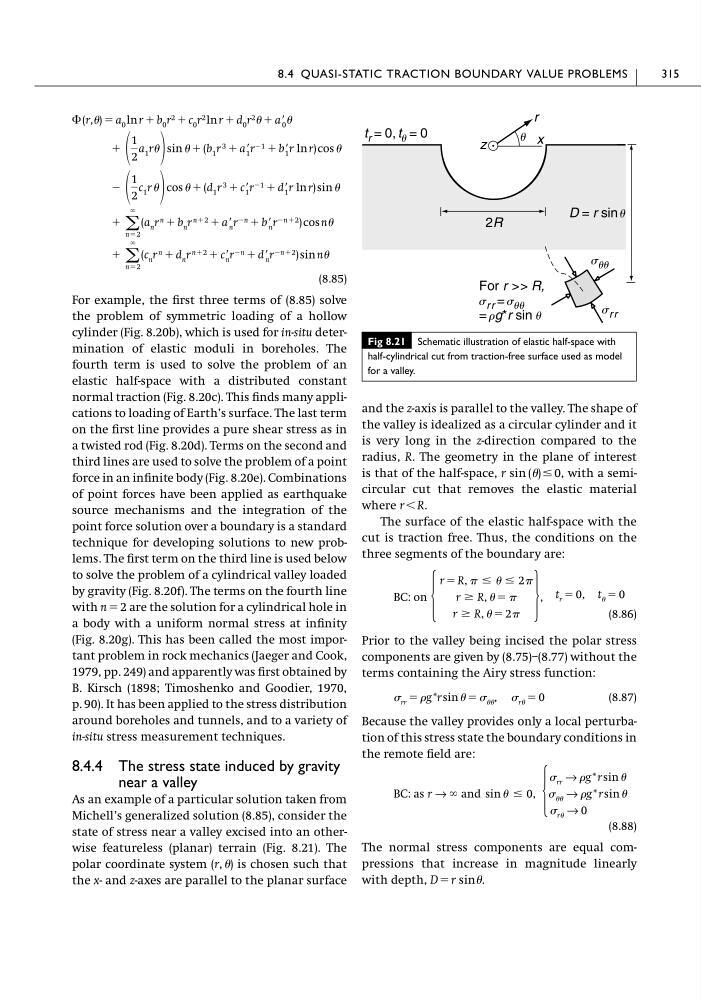
state of stress near a valley excised into an otherwise featureless (planar) terrain (Fig. 8.21). The
polar coordinate system (r, ) is chosen such that
the x- and z-axes are parallel to the planar surface
ϩ ͚
ϱ
nϭ2
(c n r n ϩ d n r nϩ2 ϩ cЈ n r Ϫn ϩ dЈ n r Ϫnϩ2 ) sin n
ϩ ͚
ϱ
nϭ2
(a n r n ϩ b n r nϩ2 ϩ aЈ n r Ϫn ϩ bЈ n r Ϫnϩ2 ) cos n
Ϫ
1
2
c 1 r cos ϩ (d 1 r 3 ϩ cЈ 1 r Ϫ1 ϩ dЈ 1 r ln r) sin
ϩ
1
2
a 1 r sin ϩ (b 1 r 3 ϩ aЈ 1 r Ϫ1 ϩ bЈ 1 r ln r) cos
⌽ (r,) ϭ a 0 ln r ϩ b 0 r 2 ϩ c 0 r 2 ln r ϩ d 0 r 2 ϩ aЈ 0
and the z-axis is parallel to the valley. The shape of
the valley is idealized as a circular cylinder and it
is very long in the z-direction compared to the
radius, R. The geometry in the plane of interest
is that of the half-space, r sin () Յ 0, with a semicircular cut that removes the elastic material
where r Ͻ R.
The surface of the elastic half-space with the
cut is traction free. Thus, the conditions on the
three segments of the boundary are:
(8.86)
Prior to the valley being incised the polar stress
components are given by (8.75)–(8.77) without the
terms containing the Airy stress function:
(8.87)
Because the valley provides only a local perturbation of this stress state the boundary conditions in
the remote field are:
(8.88)
The normal stress components are equal compressions that increase in magnitude linearly
with depth, D ϭ r sin.
BC: as r → ϱ and sin Յ 0,
Ά
rr → g * r sin
→ g * r sin
r → 0
rr ϭ g *r sin ϭ , r ϭ 0
t r ϭ 0, t ϭ 0
BC: on
Ά
r ϭ R, Յ Յ 2
r Ն R, ϭ
r Ն R, ϭ 2
·
,
8.4 QUASI-STATIC TRACTION BOUNDARY VALUE PROBLEMS
315
Fig 8.21 Schematic illustration of elastic half-space with
half-cylindrical cut from traction-free surface used as model
for a valley.
x
r
u
2R
t r = 0, t u = 0
D = r sin u
For r >> R,
s rr = s uu
= rg*r sin u
s rr
s uu
z
For example, the first three terms of (8.85) solve
the problem of symmetric loading of a hollow
cylinder (Fig. 8.20b), which is used for in-situ determination of elastic moduli in boreholes. The
fourth term is used to solve the problem of an
elastic half-space with a distributed constant
normal traction (Fig. 8.20c). This finds many applications to loading of Earth’s surface. The last term
on the first line provides a pure shear stress as in
a twisted rod (Fig. 8.20d). Terms on the second and
third lines are used to solve the problem of a point
force in an infinite body (Fig. 8.20e). Combinations
of point forces have been applied as earthquake
source mechanisms and the integration of the
point force solution over a boundary is a standard
technique for developing solutions to new problems. The first term on the third line is used below
to solve the problem of a cylindrical valley loaded
by gravity (Fig. 8.20f). The terms on the fourth line
with n ϭ 2 are the solution for a cylindrical hole in
a body with a uniform normal stress at infinity
(Fig. 8.20g). This has been called the most important problem in rock mechanics (Jaeger and Cook,
1979, pp. 249) and apparently was first obtained by
B. Kirsch (1898; Timoshenko and Goodier, 1970,
p. 90). It has been applied to the stress distribution
around boreholes and tunnels, and to a variety of
in-situ stress measurement techniques.
8.4.4 The stress state induced by gravity
near a valley
As an example of a particular solution taken from
Michell’s generalized solution (8.85), consider the
state of stress near a valley excised into an otherwise featureless (planar) terrain (Fig. 8.21). The
polar coordinate system (r, ) is chosen such that
the x- and z-axes are parallel to the planar surface
ϩ ͚
ϱ
nϭ2
(c n r n ϩ d n r nϩ2 ϩ cЈ n r Ϫn ϩ dЈ n r Ϫnϩ2 ) sin n
ϩ ͚
ϱ
nϭ2
(a n r n ϩ b n r nϩ2 ϩ aЈ n r Ϫn ϩ bЈ n r Ϫnϩ2 ) cos n
Ϫ
1
2
c 1 r cos ϩ (d 1 r 3 ϩ cЈ 1 r Ϫ1 ϩ dЈ 1 r ln r) sin
ϩ
1
2
a 1 r sin ϩ (b 1 r 3 ϩ aЈ 1 r Ϫ1 ϩ bЈ 1 r ln r) cos
⌽ (r,) ϭ a 0 ln r ϩ b 0 r 2 ϩ c 0 r 2 ln r ϩ d 0 r 2 ϩ aЈ 0
and the z-axis is parallel to the valley. The shape of
the valley is idealized as a circular cylinder and it
is very long in the z-direction compared to the
radius, R. The geometry in the plane of interest
is that of the half-space, r sin () Յ 0, with a semicircular cut that removes the elastic material
where r Ͻ R.
The surface of the elastic half-space with the
cut is traction free. Thus, the conditions on the
three segments of the boundary are:
(8.86)
Prior to the valley being incised the polar stress
components are given by (8.75)–(8.77) without the
terms containing the Airy stress function:
(8.87)
Because the valley provides only a local perturbation of this stress state the boundary conditions in
the remote field are:
(8.88)
The normal stress components are equal compressions that increase in magnitude linearly
with depth, D ϭ r sin.
BC: as r → ϱ and sin Յ 0,
Ά
rr → g * r sin
→ g * r sin
r → 0
rr ϭ g *r sin ϭ , r ϭ 0
t r ϭ 0, t ϭ 0
BC: on
Ά
r ϭ R, Յ Յ 2
r Ն R, ϭ
r Ն R, ϭ 2
·
,
8.4 QUASI-STATIC TRACTION BOUNDARY VALUE PROBLEMS
315
Fig 8.21 Schematic illustration of elastic half-space with
half-cylindrical cut from traction-free surface used as model
for a valley.
x
r
u
2R
t r = 0, t u = 0
D = r sin u
For r >> R,
s rr = s uu
= rg*r sin u
s rr
s uu
z