

(8.68)
The functions f 1 (y) and f 2 (x) are substituted into
(8.62) and (8.63), and the constants are combined
to give the displacement components:
(8.69)
(8.70)
The last two terms in each displacement equation
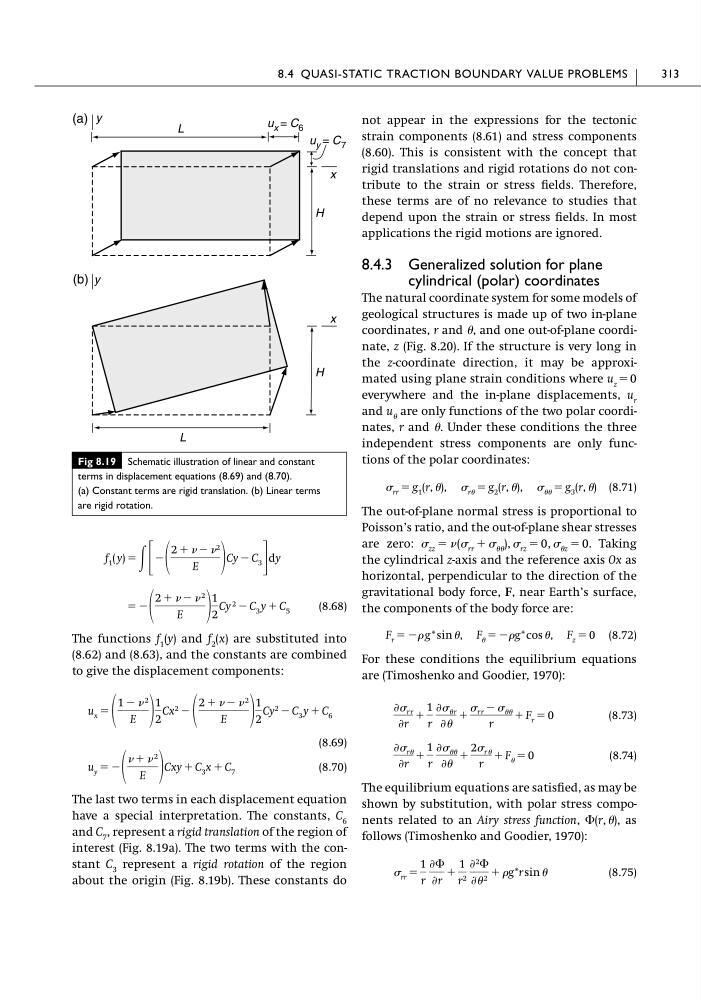
have a special interpretation. The constants, C 6
and C 7 , represent a rigid translation of the region of
interest (Fig. 8.19a). The two terms with the constant C 3 represent a rigid rotation of the region
about the origin (Fig. 8.19b). These constants do
u y ϭ Ϫ
ϩ 2
E Cxy ϩ C 3 x ϩ C 7
u x ϭ
1 Ϫ 2
E
1
2
Cx 2 Ϫ
2 ϩ Ϫ 2
E
1
2
Cy 2 Ϫ C 3 y ϩ C 6
ϭ Ϫ
2 ϩ Ϫ 2
E
1
2
Cy 2 Ϫ C 3 y ϩ C 5
f 1 ( y) ϭ ͵ ΄
Ϫ
2 ϩ Ϫ 2
E
Cy Ϫ C 3 ΅
dy
not appear in the expressions for the tectonic
strain components (8.61) and stress components
(8.60). This is consistent with the concept that
rigid translations and rigid rotations do not contribute to the strain or stress fields. Therefore,
these terms are of no relevance to studies that
depend upon the strain or stress fields. In most
applications the rigid motions are ignored.
8.4.3 Generalized solution for plane
cylindrical (polar) coordinates
The natural coordinate system for some models of
geological structures is made up of two in-plane
coordinates, r and , and one out-of-plane coordinate, z (Fig. 8.20). If the structure is very long in
the z-coordinate direction, it may be approximated using plane strain conditions where u z ϭ 0
everywhere and the in-plane displacements, u r
and u are only functions of the two polar coordinates, r and . Under these conditions the three
independent stress components are only functions of the polar coordinates:
(8.71)
The out-of-plane normal stress is proportional to
Poisson’s ratio, and the out-of-plane shear stresses
are zero:
Taking
the cylindrical z-axis and the reference axis Ox as
horizontal, perpendicular to the direction of the
gravitational body force, F, near Earth’s surface,
the components of the body force are:
(8.72)
For these conditions the equilibrium equations
are (Timoshenko and Goodier, 1970):
(8.73)
(8.74)
The equilibrium equations are satisfied, as may be
shown by substitution, with polar stress components related to an Airy stress function, ⌽(r, ), as
follows (Timoshenko and Goodier, 1970):
(8.75)
rr ϭ
1
r
Ѩ⌽
Ѩr
ϩ
1
r 2
Ѩ 2 ⌽
Ѩ 2 ϩ g*r sin
Ѩ r
Ѩr
ϩ
1
r
Ѩ
Ѩ
ϩ
2 r
r
ϩ F ϭ 0
Ѩ rr
Ѩr
ϩ
1
r
Ѩ r
Ѩ
ϩ
rr Ϫ
r
ϩ F r ϭ 0
F r ϭ Ϫ g * sin , F ϭ Ϫg* cos , F z ϭ 0
zz ϭ ( rr ϩ ), rz ϭ 0, z ϭ 0.
rr ϭ g 1 (r, ), r ϭ g 2 (r, ), ϭ g 3 (r, )
8.4 QUASI-STATIC TRACTION BOUNDARY VALUE PROBLEMS
313
Fig 8.19 Schematic illustration of linear and constant
terms in displacement equations (8.69) and (8.70).
(a) Constant terms are rigid translation. (b) Linear terms
are rigid rotation.
x
y
H
L
(a)
x
y
H
L
(b)
u y = C 7
u x = C 6
The functions f 1 (y) and f 2 (x) are substituted into
(8.62) and (8.63), and the constants are combined
to give the displacement components:
(8.69)
(8.70)
The last two terms in each displacement equation
have a special interpretation. The constants, C 6
and C 7 , represent a rigid translation of the region of
interest (Fig. 8.19a). The two terms with the constant C 3 represent a rigid rotation of the region
about the origin (Fig. 8.19b). These constants do
u y ϭ Ϫ
ϩ 2
E Cxy ϩ C 3 x ϩ C 7
u x ϭ
1 Ϫ 2
E
1
2
Cx 2 Ϫ
2 ϩ Ϫ 2
E
1
2
Cy 2 Ϫ C 3 y ϩ C 6
ϭ Ϫ
2 ϩ Ϫ 2
E
1
2
Cy 2 Ϫ C 3 y ϩ C 5
f 1 ( y) ϭ ͵ ΄
Ϫ
2 ϩ Ϫ 2
E
Cy Ϫ C 3 ΅
dy
not appear in the expressions for the tectonic
strain components (8.61) and stress components
(8.60). This is consistent with the concept that
rigid translations and rigid rotations do not contribute to the strain or stress fields. Therefore,
these terms are of no relevance to studies that
depend upon the strain or stress fields. In most
applications the rigid motions are ignored.
8.4.3 Generalized solution for plane
cylindrical (polar) coordinates
The natural coordinate system for some models of
geological structures is made up of two in-plane
coordinates, r and , and one out-of-plane coordinate, z (Fig. 8.20). If the structure is very long in
the z-coordinate direction, it may be approximated using plane strain conditions where u z ϭ 0
everywhere and the in-plane displacements, u r
and u are only functions of the two polar coordinates, r and . Under these conditions the three
independent stress components are only functions of the polar coordinates:
(8.71)
The out-of-plane normal stress is proportional to
Poisson’s ratio, and the out-of-plane shear stresses
are zero:
Taking
the cylindrical z-axis and the reference axis Ox as
horizontal, perpendicular to the direction of the
gravitational body force, F, near Earth’s surface,
the components of the body force are:
(8.72)
For these conditions the equilibrium equations
are (Timoshenko and Goodier, 1970):
(8.73)
(8.74)
The equilibrium equations are satisfied, as may be
shown by substitution, with polar stress components related to an Airy stress function, ⌽(r, ), as
follows (Timoshenko and Goodier, 1970):
(8.75)
rr ϭ
1
r
Ѩ⌽
Ѩr
ϩ
1
r 2
Ѩ 2 ⌽
Ѩ 2 ϩ g*r sin
Ѩ r
Ѩr
ϩ
1
r
Ѩ
Ѩ
ϩ
2 r
r
ϩ F ϭ 0
Ѩ rr
Ѩr
ϩ
1
r
Ѩ r
Ѩ
ϩ
rr Ϫ
r
ϩ F r ϭ 0
F r ϭ Ϫ g * sin , F ϭ Ϫg* cos , F z ϭ 0
zz ϭ ( rr ϩ ), rz ϭ 0, z ϭ 0.
rr ϭ g 1 (r, ), r ϭ g 2 (r, ), ϭ g 3 (r, )
8.4 QUASI-STATIC TRACTION BOUNDARY VALUE PROBLEMS
313
Fig 8.19 Schematic illustration of linear and constant
terms in displacement equations (8.69) and (8.70).
(a) Constant terms are rigid translation. (b) Linear terms
are rigid rotation.
x
y
H
L
(a)
x
y
H
L
(b)
u y = C 7
u x = C 6