

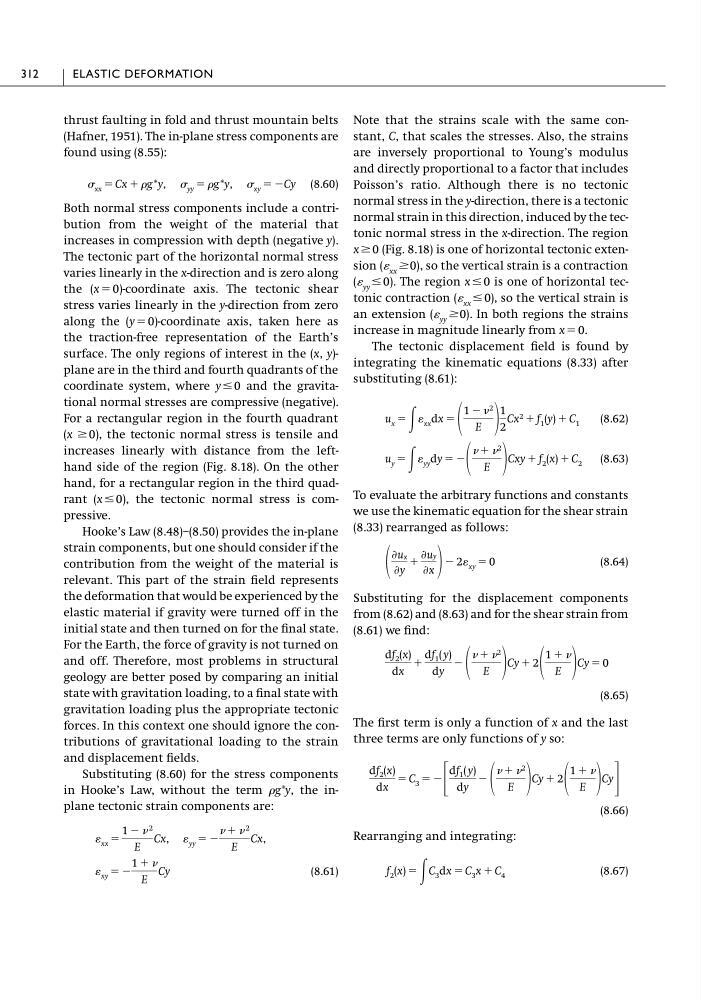
thrust faulting in fold and thrust mountain belts
(Hafner, 1951). The in-plane stress components are
found using (8.55):
(8.60)
Both normal stress components include a contribution from the weight of the material that
increases in compression with depth (negative y).
The tectonic part of the horizontal normal stress
varies linearly in the x-direction and is zero along
the (x ϭ 0)-coordinate axis. The tectonic shear
stress varies linearly in the y-direction from zero
along the (y ϭ 0)-coordinate axis, taken here as
the traction-free representation of the Earth’s
surface. The only regions of interest in the (x, y)plane are in the third and fourth quadrants of the
coordinate system, where y Յ 0 and the gravitational normal stresses are compressive (negative).
For a rectangular region in the fourth quadrant
(x Ն 0), the tectonic normal stress is tensile and
increases linearly with distance from the lefthand side of the region (Fig. 8.18). On the other
hand, for a rectangular region in the third quadrant (x Յ 0), the tectonic normal stress is compressive.
Hooke’s Law (8.48)–(8.50) provides the in-plane
strain components, but one should consider if the
contribution from the weight of the material is
relevant. This part of the strain field represents
the deformation that would be experienced by the
elastic material if gravity were turned off in the
initial state and then turned on for the final state.
For the Earth, the force of gravity is not turned on
and off. Therefore, most problems in structural
geology are better posed by comparing an initial
state with gravitation loading, to a final state with
gravitation loading plus the appropriate tectonic
forces. In this context one should ignore the contributions of gravitational loading to the strain
and displacement fields.
Substituting (8.60) for the stress components
in Hooke’s Law, without the term g*y, the inplane tectonic strain components are:
(8.61)
xy ϭ Ϫ
1 ϩ
E
Cy
xx ϭ
1 Ϫ 2
E
Cx, yy ϭ Ϫ
ϩ 2
E
Cx,
xx ϭ Cx ϩ g *y, yy ϭ g *y, xy ϭ ϪCy
Note that the strains scale with the same constant, C, that scales the stresses. Also, the strains
are inversely proportional to Young’s modulus
and directly proportional to a factor that includes
Poisson’s ratio. Although there is no tectonic
normal stress in the y-direction, there is a tectonic
normal strain in this direction, induced by the tectonic normal stress in the x-direction. The region
x Ն 0 (Fig. 8.18) is one of horizontal tectonic extension ( xx Ն0), so the vertical strain is a contraction
( yy Յ 0). The region x Յ 0 is one of horizontal tectonic contraction ( xx Յ 0), so the vertical strain is
an extension ( yy Ն0). In both regions the strains
increase in magnitude linearly from xϭ 0.
The tectonic displacement field is found by
integrating the kinematic equations (8.33) after
substituting (8.61):
(8.62)
(8.63)
To evaluate the arbitrary functions and constants
we use the kinematic equation for the shear strain
(8.33) rearranged as follows:
(8.64)
Substituting for the displacement components
from (8.62) and (8.63) and for the shear strain from
(8.61) we find:
(8.65)
The first term is only a function of x and the last
three terms are only functions of y so:
(8.66)
Rearranging and integrating:
(8.67)
f 2 (x) ϭ ͵ C 3 dx ϭ C 3 x ϩ C 4
df 2 (x)
dx
ϭ C 3 ϭ Ϫ ΄
df 1 ( y)
dy
Ϫ
ϩ 2
E Cy ϩ 2
1 ϩ
E Cy ΅
df 2 (x)
dx
ϩ
df 1 ( y)
dy
Ϫ
ϩ 2
E Cy ϩ 2
1 ϩ
E Cy ϭ 0
Ѩux
Ѩy
ϩ
Ѩuy
Ѩx Ϫ 2 xy ϭ 0
u y ϭ ͵ yy dy ϭ Ϫ
ϩ 2
E
Cxy ϩ f 2 (x) ϩ C 2
u x ϭ ͵ xx dx ϭ
1 Ϫ 2
E
1
2
Cx 2 ϩ f 1 (y) ϩ C 1
312
ELASTIC DEFORMATION
(Hafner, 1951). The in-plane stress components are
found using (8.55):
(8.60)
Both normal stress components include a contribution from the weight of the material that
increases in compression with depth (negative y).
The tectonic part of the horizontal normal stress
varies linearly in the x-direction and is zero along
the (x ϭ 0)-coordinate axis. The tectonic shear
stress varies linearly in the y-direction from zero
along the (y ϭ 0)-coordinate axis, taken here as
the traction-free representation of the Earth’s
surface. The only regions of interest in the (x, y)plane are in the third and fourth quadrants of the
coordinate system, where y Յ 0 and the gravitational normal stresses are compressive (negative).
For a rectangular region in the fourth quadrant
(x Ն 0), the tectonic normal stress is tensile and
increases linearly with distance from the lefthand side of the region (Fig. 8.18). On the other
hand, for a rectangular region in the third quadrant (x Յ 0), the tectonic normal stress is compressive.
Hooke’s Law (8.48)–(8.50) provides the in-plane
strain components, but one should consider if the
contribution from the weight of the material is
relevant. This part of the strain field represents
the deformation that would be experienced by the
elastic material if gravity were turned off in the
initial state and then turned on for the final state.
For the Earth, the force of gravity is not turned on
and off. Therefore, most problems in structural
geology are better posed by comparing an initial
state with gravitation loading, to a final state with
gravitation loading plus the appropriate tectonic
forces. In this context one should ignore the contributions of gravitational loading to the strain
and displacement fields.
Substituting (8.60) for the stress components
in Hooke’s Law, without the term g*y, the inplane tectonic strain components are:
(8.61)
xy ϭ Ϫ
1 ϩ
E
Cy
xx ϭ
1 Ϫ 2
E
Cx, yy ϭ Ϫ
ϩ 2
E
Cx,
xx ϭ Cx ϩ g *y, yy ϭ g *y, xy ϭ ϪCy
Note that the strains scale with the same constant, C, that scales the stresses. Also, the strains
are inversely proportional to Young’s modulus
and directly proportional to a factor that includes
Poisson’s ratio. Although there is no tectonic
normal stress in the y-direction, there is a tectonic
normal strain in this direction, induced by the tectonic normal stress in the x-direction. The region
x Ն 0 (Fig. 8.18) is one of horizontal tectonic extension ( xx Ն0), so the vertical strain is a contraction
( yy Յ 0). The region x Յ 0 is one of horizontal tectonic contraction ( xx Յ 0), so the vertical strain is
an extension ( yy Ն0). In both regions the strains
increase in magnitude linearly from xϭ 0.
The tectonic displacement field is found by
integrating the kinematic equations (8.33) after
substituting (8.61):
(8.62)
(8.63)
To evaluate the arbitrary functions and constants
we use the kinematic equation for the shear strain
(8.33) rearranged as follows:
(8.64)
Substituting for the displacement components
from (8.62) and (8.63) and for the shear strain from
(8.61) we find:
(8.65)
The first term is only a function of x and the last
three terms are only functions of y so:
(8.66)
Rearranging and integrating:
(8.67)
f 2 (x) ϭ ͵ C 3 dx ϭ C 3 x ϩ C 4
df 2 (x)
dx
ϭ C 3 ϭ Ϫ ΄
df 1 ( y)
dy
Ϫ
ϩ 2
E Cy ϩ 2
1 ϩ
E Cy ΅
df 2 (x)
dx
ϩ
df 1 ( y)
dy
Ϫ
ϩ 2
E Cy ϩ 2
1 ϩ
E Cy ϭ 0
Ѩux
Ѩy
ϩ
Ѩuy
Ѩx Ϫ 2 xy ϭ 0
u y ϭ ͵ yy dy ϭ Ϫ
ϩ 2
E
Cxy ϩ f 2 (x) ϩ C 2
u x ϭ ͵ xx dx ϭ
1 Ϫ 2
E
1
2
Cx 2 ϩ f 1 (y) ϩ C 1
312
ELASTIC DEFORMATION