

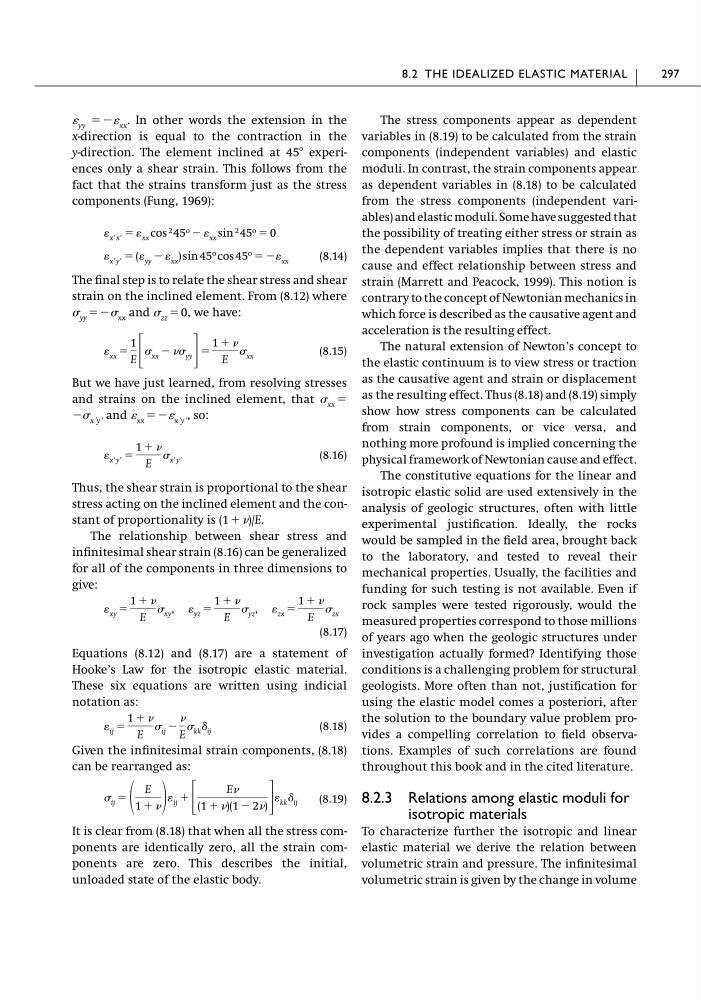
yy ϭϪ xx . In other words the extension in the
x-direction is equal to the contraction in the
y-direction. The element inclined at 45Њ experiences only a shear strain. This follows from the
fact that the strains transform just as the stress
components (Fung, 1969):
(8.14)
The final step is to relate the shear stress and shear
strain on the inclined element. From (8.12) where
yy ϭϪ xx and zz ϭ 0, we have:
(8.15)
But we have just learned, from resolving stresses
and strains on the inclined element, that xx ϭ
Ϫ xЈyЈ and xx ϭϪ xЈyЈ , so:
(8.16)
Thus, the shear strain is proportional to the shear
stress acting on the inclined element and the constant of proportionality is (1ϩ )/E.
The relationship between shear stress and
infinitesimal shear strain (8.16) can be generalized
for all of the components in three dimensions to
give:
(8.17)
Equations (8.12) and (8.17) are a statement of
Hooke’s Law for the isotropic elastic material.
These six equations are written using indicial
notation as:
(8.18)
Given the infinitesimal strain components, (8.18)
can be rearranged as:
(8.19)
It is clear from (8.18) that when all the stress components are identically zero, all the strain components are zero. This describes the initial,
unloaded state of the elastic body.
ij ϭ
E
1 ϩ ij ϩ ΄
E
(1 ϩ )(1 Ϫ 2) ΅ kk ␦ ij
ij ϭ
1 ϩ
E
ij Ϫ
E
kk ␦ ij
xy ϭ
1 ϩ
E
xy , yz ϭ
1 ϩ
E
yz , zx ϭ
1 ϩ
E
zx
xЈyЈ ϭ
1 ϩ
E
xЈyЈ
xx ϭ
1
E ΄ xx Ϫ yy ΅
ϭ
1 ϩ
E
xx
xЈyЈ ϭ ( yy Ϫ xx ) sin 45
o cos 45
o ϭ Ϫ xx
xЈxЈ ϭ xx cos 2 45 o Ϫ xx sin 2 45 o ϭ 0
The stress components appear as dependent
variables in (8.19) to be calculated from the strain
components (independent variables) and elastic
moduli. In contrast, the strain components appear
as dependent variables in (8.18) to be calculated
from the stress components (independent variables) and elastic moduli. Some have suggested that
the possibility of treating either stress or strain as
the dependent variables implies that there is no
cause and effect relationship between stress and
strain (Marrett and Peacock, 1999). This notion is
contrary to the concept of Newtonian mechanics in
which force is described as the causative agent and
acceleration is the resulting effect.
The natural extension of Newton’s concept to
the elastic continuum is to view stress or traction
as the causative agent and strain or displacement
as the resulting effect. Thus (8.18) and (8.19) simply
show how stress components can be calculated
from strain components, or vice versa, and
nothing more profound is implied concerning the
physical framework of Newtonian cause and effect.
The constitutive equations for the linear and
isotropic elastic solid are used extensively in the
analysis of geologic structures, often with little
experimental justification. Ideally, the rocks
would be sampled in the field area, brought back
to the laboratory, and tested to reveal their
mechanical properties. Usually, the facilities and
funding for such testing is not available. Even if
rock samples were tested rigorously, would the
measured properties correspond to those millions
of years ago when the geologic structures under
investigation actually formed? Identifying those
conditions is a challenging problem for structural
geologists. More often than not, justification for
using the elastic model comes a posteriori, after
the solution to the boundary value problem provides a compelling correlation to field observations. Examples of such correlations are found
throughout this book and in the cited literature.
8.2.3 Relations among elastic moduli for
isotropic materials
To characterize further the isotropic and linear
elastic material we derive the relation between
volumetric strain and pressure. The infinitesimal
volumetric strain is given by the change in volume
8.2 THE IDEALIZED ELASTIC MATERIAL
297
x-direction is equal to the contraction in the
y-direction. The element inclined at 45Њ experiences only a shear strain. This follows from the
fact that the strains transform just as the stress
components (Fung, 1969):
(8.14)
The final step is to relate the shear stress and shear
strain on the inclined element. From (8.12) where
yy ϭϪ xx and zz ϭ 0, we have:
(8.15)
But we have just learned, from resolving stresses
and strains on the inclined element, that xx ϭ
Ϫ xЈyЈ and xx ϭϪ xЈyЈ , so:
(8.16)
Thus, the shear strain is proportional to the shear
stress acting on the inclined element and the constant of proportionality is (1ϩ )/E.
The relationship between shear stress and
infinitesimal shear strain (8.16) can be generalized
for all of the components in three dimensions to
give:
(8.17)
Equations (8.12) and (8.17) are a statement of
Hooke’s Law for the isotropic elastic material.
These six equations are written using indicial
notation as:
(8.18)
Given the infinitesimal strain components, (8.18)
can be rearranged as:
(8.19)
It is clear from (8.18) that when all the stress components are identically zero, all the strain components are zero. This describes the initial,
unloaded state of the elastic body.
ij ϭ
E
1 ϩ ij ϩ ΄
E
(1 ϩ )(1 Ϫ 2) ΅ kk ␦ ij
ij ϭ
1 ϩ
E
ij Ϫ
E
kk ␦ ij
xy ϭ
1 ϩ
E
xy , yz ϭ
1 ϩ
E
yz , zx ϭ
1 ϩ
E
zx
xЈyЈ ϭ
1 ϩ
E
xЈyЈ
xx ϭ
1
E ΄ xx Ϫ yy ΅
ϭ
1 ϩ
E
xx
xЈyЈ ϭ ( yy Ϫ xx ) sin 45
o cos 45
o ϭ Ϫ xx
xЈxЈ ϭ xx cos 2 45 o Ϫ xx sin 2 45 o ϭ 0
The stress components appear as dependent
variables in (8.19) to be calculated from the strain
components (independent variables) and elastic
moduli. In contrast, the strain components appear
as dependent variables in (8.18) to be calculated
from the stress components (independent variables) and elastic moduli. Some have suggested that
the possibility of treating either stress or strain as
the dependent variables implies that there is no
cause and effect relationship between stress and
strain (Marrett and Peacock, 1999). This notion is
contrary to the concept of Newtonian mechanics in
which force is described as the causative agent and
acceleration is the resulting effect.
The natural extension of Newton’s concept to
the elastic continuum is to view stress or traction
as the causative agent and strain or displacement
as the resulting effect. Thus (8.18) and (8.19) simply
show how stress components can be calculated
from strain components, or vice versa, and
nothing more profound is implied concerning the
physical framework of Newtonian cause and effect.
The constitutive equations for the linear and
isotropic elastic solid are used extensively in the
analysis of geologic structures, often with little
experimental justification. Ideally, the rocks
would be sampled in the field area, brought back
to the laboratory, and tested to reveal their
mechanical properties. Usually, the facilities and
funding for such testing is not available. Even if
rock samples were tested rigorously, would the
measured properties correspond to those millions
of years ago when the geologic structures under
investigation actually formed? Identifying those
conditions is a challenging problem for structural
geologists. More often than not, justification for
using the elastic model comes a posteriori, after
the solution to the boundary value problem provides a compelling correlation to field observations. Examples of such correlations are found
throughout this book and in the cited literature.
8.2.3 Relations among elastic moduli for
isotropic materials
To characterize further the isotropic and linear
elastic material we derive the relation between
volumetric strain and pressure. The infinitesimal
volumetric strain is given by the change in volume
8.2 THE IDEALIZED ELASTIC MATERIAL
297