

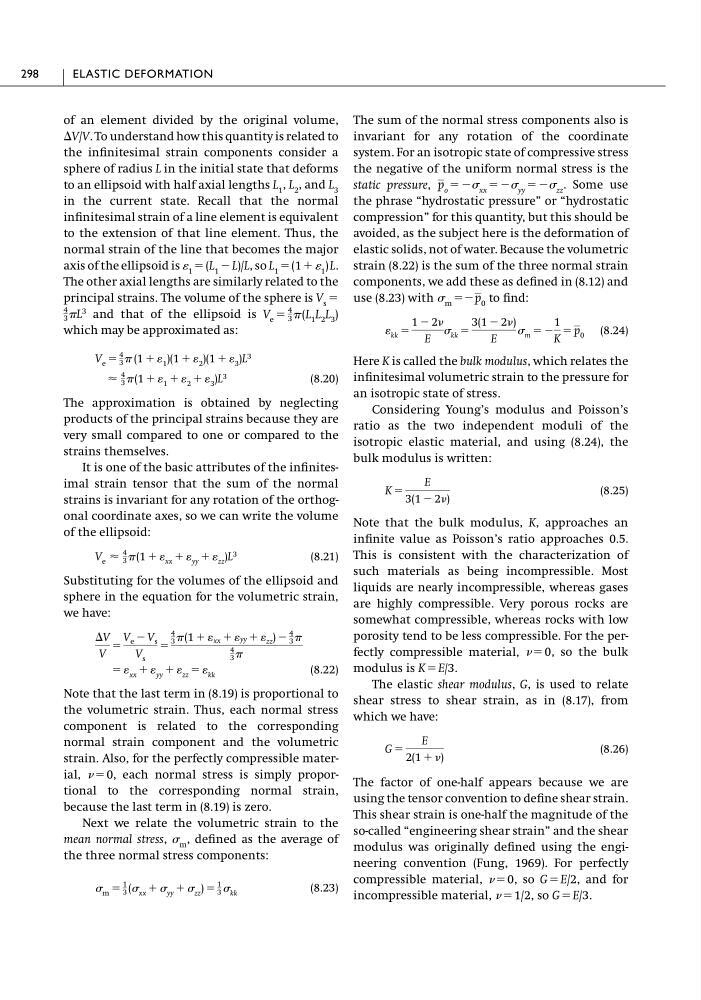
of an element divided by the original volume,
⌬V/V. To understand how this quantity is related to
the infinitesimal strain components consider a
sphere of radius L in the initial state that deforms
to an ellipsoid with half axial lengths L 1 , L 2 , and L 3
in the current state. Recall that the normal
infinitesimal strain of a line element is equivalent
to the extension of that line element. Thus, the
normal strain of the line that becomes the major
axis of the ellipsoid is 1 ϭ (L 1 Ϫ L)/L, so L 1 ϭ (1 ϩ 1 ) L.
The other axial lengths are similarly related to the
principal strains. The volume of the sphere is V s ϭ
L
3 and that of the ellipsoid is
which may be approximated as:
(8.20)
The approximation is obtained by neglecting
products of the principal strains because they are
very small compared to one or compared to the
strains themselves.
It is one of the basic attributes of the infinitesimal strain tensor that the sum of the normal
strains is invariant for any rotation of the orthogonal coordinate axes, so we can write the volume
of the ellipsoid:
(8.21)
Substituting for the volumes of the ellipsoid and
sphere in the equation for the volumetric strain,
we have:
(8.22)
Note that the last term in (8.19) is proportional to
the volumetric strain. Thus, each normal stress
component is related to the corresponding
normal strain component and the volumetric
strain. Also, for the perfectly compressible material, ϭ 0, each normal stress is simply proportional to the corresponding normal strain,
because the last term in (8.19) is zero.
Next we relate the volumetric strain to the
mean normal stress, m , defined as the average of
the three normal stress components:
(8.23)
m ϭ
1
3 ( xx ϩ yy ϩ zz ) ϭ
1
3 kk
ϭ xx ϩ yy ϩ zz ϭ kk
⌬V
V
ϭ
V e Ϫ V s
V s
ϭ
4
3 (1 ϩ xx ϩ yy ϩ zz ) Ϫ
4
3
4
3
V e Ϸ
4
3 (1 ϩ xx ϩ yy ϩ zz )L 3
Ϸ
4
3 (1 ϩ 1 ϩ 2 ϩ 3 )L 3
V e ϭ
4
3 (1 ϩ 1 )(1 ϩ 2 )(1 ϩ 3 )L 3
V e ϭ
4
3 (L 1 L 2 L 3 )
4
3
The sum of the normal stress components also is
invariant for any rotation of the coordinate
system. For an isotropic state of compressive stress
the negative of the uniform normal stress is the
static pressure, o ϭϪ xx ϭϪ yy ϭϪ zz . Some use
the phrase “hydrostatic pressure” or “hydrostatic
compression” for this quantity, but this should be
avoided, as the subject here is the deformation of
elastic solids, not of water. Because the volumetric
strain (8.22) is the sum of the three normal strain
components, we add these as defined in (8.12) and
use (8.23) with m ϭϪ 0 to find:
(8.24)
Here K is called the bulk modulus, which relates the
infinitesimal volumetric strain to the pressure for
an isotropic state of stress.
Considering Young’s modulus and Poisson’s
ratio as the two independent moduli of the
isotropic elastic material, and using (8.24), the
bulk modulus is written:
(8.25)
Note that the bulk modulus, K, approaches an
infinite value as Poisson’s ratio approaches 0.5.
This is consistent with the characterization of
such materials as being incompressible. Most
liquids are nearly incompressible, whereas gases
are highly compressible. Very porous rocks are
somewhat compressible, whereas rocks with low
porosity tend to be less compressible. For the perfectly compressible material, ϭ 0, so the bulk
modulus is K ϭ E/3.
The elastic shear modulus, G, is used to relate
shear stress to shear strain, as in (8.17), from
which we have:
(8.26)
The factor of one-half appears because we are
using the tensor convention to define shear strain.
This shear strain is one-half the magnitude of the
so-called “engineering shear strain” and the shear
modulus was originally defined using the engineering convention (Fung, 1969). For perfectly
compressible material, ϭ 0, so G ϭ E/2, and for
incompressible material, ϭ 1/2, so G ϭ E/3.
G ϭ
E
2(1 ϩ )
K ϭ
E
3(1 Ϫ 2)
kk ϭ
1 Ϫ 2
E
kk ϭ
3(1 Ϫ 2)
E
m ϭ Ϫ
1
K
ϭ p 0
p
p
298
ELASTIC DEFORMATION
⌬V/V. To understand how this quantity is related to
the infinitesimal strain components consider a
sphere of radius L in the initial state that deforms
to an ellipsoid with half axial lengths L 1 , L 2 , and L 3
in the current state. Recall that the normal
infinitesimal strain of a line element is equivalent
to the extension of that line element. Thus, the
normal strain of the line that becomes the major
axis of the ellipsoid is 1 ϭ (L 1 Ϫ L)/L, so L 1 ϭ (1 ϩ 1 ) L.
The other axial lengths are similarly related to the
principal strains. The volume of the sphere is V s ϭ
L
3 and that of the ellipsoid is
which may be approximated as:
(8.20)
The approximation is obtained by neglecting
products of the principal strains because they are
very small compared to one or compared to the
strains themselves.
It is one of the basic attributes of the infinitesimal strain tensor that the sum of the normal
strains is invariant for any rotation of the orthogonal coordinate axes, so we can write the volume
of the ellipsoid:
(8.21)
Substituting for the volumes of the ellipsoid and
sphere in the equation for the volumetric strain,
we have:
(8.22)
Note that the last term in (8.19) is proportional to
the volumetric strain. Thus, each normal stress
component is related to the corresponding
normal strain component and the volumetric
strain. Also, for the perfectly compressible material, ϭ 0, each normal stress is simply proportional to the corresponding normal strain,
because the last term in (8.19) is zero.
Next we relate the volumetric strain to the
mean normal stress, m , defined as the average of
the three normal stress components:
(8.23)
m ϭ
1
3 ( xx ϩ yy ϩ zz ) ϭ
1
3 kk
ϭ xx ϩ yy ϩ zz ϭ kk
⌬V
V
ϭ
V e Ϫ V s
V s
ϭ
4
3 (1 ϩ xx ϩ yy ϩ zz ) Ϫ
4
3
4
3
V e Ϸ
4
3 (1 ϩ xx ϩ yy ϩ zz )L 3
Ϸ
4
3 (1 ϩ 1 ϩ 2 ϩ 3 )L 3
V e ϭ
4
3 (1 ϩ 1 )(1 ϩ 2 )(1 ϩ 3 )L 3
V e ϭ
4
3 (L 1 L 2 L 3 )
4
3
The sum of the normal stress components also is
invariant for any rotation of the coordinate
system. For an isotropic state of compressive stress
the negative of the uniform normal stress is the
static pressure, o ϭϪ xx ϭϪ yy ϭϪ zz . Some use
the phrase “hydrostatic pressure” or “hydrostatic
compression” for this quantity, but this should be
avoided, as the subject here is the deformation of
elastic solids, not of water. Because the volumetric
strain (8.22) is the sum of the three normal strain
components, we add these as defined in (8.12) and
use (8.23) with m ϭϪ 0 to find:
(8.24)
Here K is called the bulk modulus, which relates the
infinitesimal volumetric strain to the pressure for
an isotropic state of stress.
Considering Young’s modulus and Poisson’s
ratio as the two independent moduli of the
isotropic elastic material, and using (8.24), the
bulk modulus is written:
(8.25)
Note that the bulk modulus, K, approaches an
infinite value as Poisson’s ratio approaches 0.5.
This is consistent with the characterization of
such materials as being incompressible. Most
liquids are nearly incompressible, whereas gases
are highly compressible. Very porous rocks are
somewhat compressible, whereas rocks with low
porosity tend to be less compressible. For the perfectly compressible material, ϭ 0, so the bulk
modulus is K ϭ E/3.
The elastic shear modulus, G, is used to relate
shear stress to shear strain, as in (8.17), from
which we have:
(8.26)
The factor of one-half appears because we are
using the tensor convention to define shear strain.
This shear strain is one-half the magnitude of the
so-called “engineering shear strain” and the shear
modulus was originally defined using the engineering convention (Fung, 1969). For perfectly
compressible material, ϭ 0, so G ϭ E/2, and for
incompressible material, ϭ 1/2, so G ϭ E/3.
G ϭ
E
2(1 ϩ )
K ϭ
E
3(1 Ϫ 2)
kk ϭ
1 Ϫ 2
E
kk ϭ
3(1 Ϫ 2)
E
m ϭ Ϫ
1
K
ϭ p 0
p
p
298
ELASTIC DEFORMATION