

without getting thicker. This property of cork
makes it possible to insert a cylindrical piece into
the neck of a bottle by pressing on its end. In contrast, a rubber stopper must be tapered. Rocks are
somewhat compressible.
8.2.2 Stress–strain relationships for the
homogeneous, isotropic, linear
elastic solid
For a homogeneous and isotropic linear elastic
bar under isothermal conditions being stretched
in the x-coordinate direction by an applied stress
� xx (Fig. 8.3) the extension in x is proportional to
the stress and the proportionality constant is the
reciprocal of Young’s modulus (8.6). The extensions in y or z are proportional to the stress and
the proportionality constant is the Poisson’s ratio
divided by Young’s modulus. That is
and
so
Consider successively applying a normal stress in
each coordinate direction and accounting for all
of the possible normal strains. A consequence of
the assumption of small strains and rotations is
that the strain state is independent of the order in
which the stresses are applied to the body.
Therefore, these strain states can be superimposed
and we have:
(8.12)
For the isotropic material these relationships do
not depend upon the orientation of the coordinate system and hold, therefore, for any choice of
orthogonal coordinate axes.
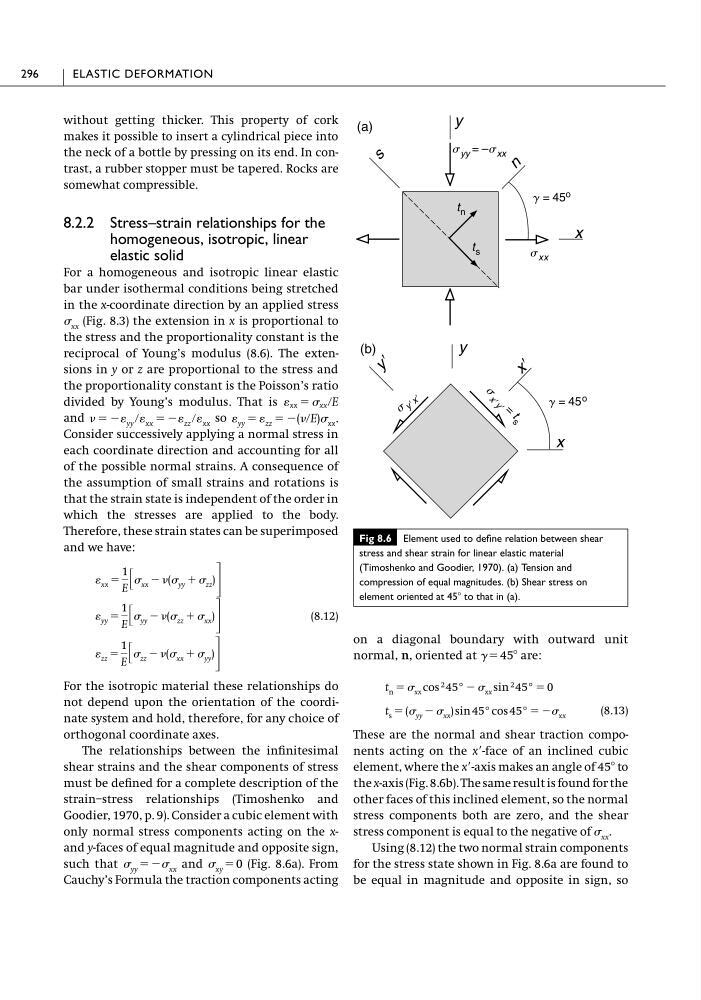
The relationships between the infinitesimal
shear strains and the shear components of stress
must be defined for a complete description of the
strain–stress relationships (Timoshenko and
Goodier, 1970, p. 9). Consider a cubic element with
only normal stress components acting on the xand y-faces of equal magnitude and opposite sign,
such that � yy ��� xx and � xy � 0 (Fig. 8.6a). From
Cauchy’s Formula the traction components acting
� zz �
1
E
΄� zz � �(� xx � � yy ) ΅
� yy �
1
E
΄� yy � �(� zz � � xx ) ΅
� xx �
1
E
΄� xx � �(� yy � � zz ) ΅
� yy � � zz � �(��E)� xx .
� � �� yy �� xx � �� zz �� xx
� xx � � xx �E
on a diagonal boundary with outward unit
normal, n, oriented at � � 45� are:
(8.13)
These are the normal and shear traction components acting on the x�-face of an inclined cubic
element, where the x�-axis makes an angle of 45� to
the x-axis (Fig. 8.6b). The same result is found for the
other faces of this inclined element, so the normal
stress components both are zero, and the shear
stress component is equal to the negative of � xx .
Using (8.12) the two normal strain components
for the stress state shown in Fig. 8.6a are found to
be equal in magnitude and opposite in sign, so
t s � (� yy � � xx ) sin 45° cos 45° � �� xx
t n � � xx cos 2 45° � � xx sin 2 45° � 0
296
ELASTIC DEFORMATION
Fig 8.6 Element used to define relation between shear
stress and shear strain for linear elastic material
(Timoshenko and Goodier, 1970). (a) Tension and
compression of equal magnitudes. (b) Shear stress on
element oriented at 45� to that in (a).
t n
x
x
y
y
n
s
(a)
(b)
s yy = –s xx
g = 45 o
s xx
t s
y
�
x �
g = 45 o
s y � x �
s
x
�
y
� =
t
s
makes it possible to insert a cylindrical piece into
the neck of a bottle by pressing on its end. In contrast, a rubber stopper must be tapered. Rocks are
somewhat compressible.
8.2.2 Stress–strain relationships for the
homogeneous, isotropic, linear
elastic solid
For a homogeneous and isotropic linear elastic
bar under isothermal conditions being stretched
in the x-coordinate direction by an applied stress
� xx (Fig. 8.3) the extension in x is proportional to
the stress and the proportionality constant is the
reciprocal of Young’s modulus (8.6). The extensions in y or z are proportional to the stress and
the proportionality constant is the Poisson’s ratio
divided by Young’s modulus. That is
and
so
Consider successively applying a normal stress in
each coordinate direction and accounting for all
of the possible normal strains. A consequence of
the assumption of small strains and rotations is
that the strain state is independent of the order in
which the stresses are applied to the body.
Therefore, these strain states can be superimposed
and we have:
(8.12)
For the isotropic material these relationships do
not depend upon the orientation of the coordinate system and hold, therefore, for any choice of
orthogonal coordinate axes.
The relationships between the infinitesimal
shear strains and the shear components of stress
must be defined for a complete description of the
strain–stress relationships (Timoshenko and
Goodier, 1970, p. 9). Consider a cubic element with
only normal stress components acting on the xand y-faces of equal magnitude and opposite sign,
such that � yy ��� xx and � xy � 0 (Fig. 8.6a). From
Cauchy’s Formula the traction components acting
� zz �
1
E
΄� zz � �(� xx � � yy ) ΅
� yy �
1
E
΄� yy � �(� zz � � xx ) ΅
� xx �
1
E
΄� xx � �(� yy � � zz ) ΅
� yy � � zz � �(��E)� xx .
� � �� yy �� xx � �� zz �� xx
� xx � � xx �E
on a diagonal boundary with outward unit
normal, n, oriented at � � 45� are:
(8.13)
These are the normal and shear traction components acting on the x�-face of an inclined cubic
element, where the x�-axis makes an angle of 45� to
the x-axis (Fig. 8.6b). The same result is found for the
other faces of this inclined element, so the normal
stress components both are zero, and the shear
stress component is equal to the negative of � xx .
Using (8.12) the two normal strain components
for the stress state shown in Fig. 8.6a are found to
be equal in magnitude and opposite in sign, so
t s � (� yy � � xx ) sin 45° cos 45° � �� xx
t n � � xx cos 2 45° � � xx sin 2 45° � 0
296
ELASTIC DEFORMATION
Fig 8.6 Element used to define relation between shear
stress and shear strain for linear elastic material
(Timoshenko and Goodier, 1970). (a) Tension and
compression of equal magnitudes. (b) Shear stress on
element oriented at 45� to that in (a).
t n
x
x
y
y
n
s
(a)
(b)
s yy = –s xx
g = 45 o
s xx
t s
y
�
x �
g = 45 o
s y � x �
s
x
�
y
� =
t
s