

ness which is also a vastness, and now in seeking in geological ages the traces of the past that attracts us
because of its remoteness (Chandrasekhar, 1979).
Once bitten by the “bug” of structural geology
it is impossible to walk up to an outcrop displaying a particularly ornate structure or complex
structural relationship (for example, as pictured
in Fig. 1.13) and not exclaim: “WOW, look at this!”
Such was the reaction of the authors of this textbook to the outcrops of Jurassic limestone
exposed at Les Matelles in the Languedoc region
of southern France (Petit and Mattauer, 1995).
Actually, our first glimpse of these structures
came by way of an article in the journal
Tectonophysics (Rispoli, 1981). We were working
at the US Geological Survey in Menlo Park,
California, when the article appeared and both of
us were immediately captivated by the systematic
geometrical relationships among the structures
illustrated on the published maps. Despite the
fact that we were working on quite different problems for the Earthquake Studies Branch of the
Survey at the time, we resolved to seek an explanation for the systematic relationships among
these small structures.
1.4.1 Cracks and anticracks
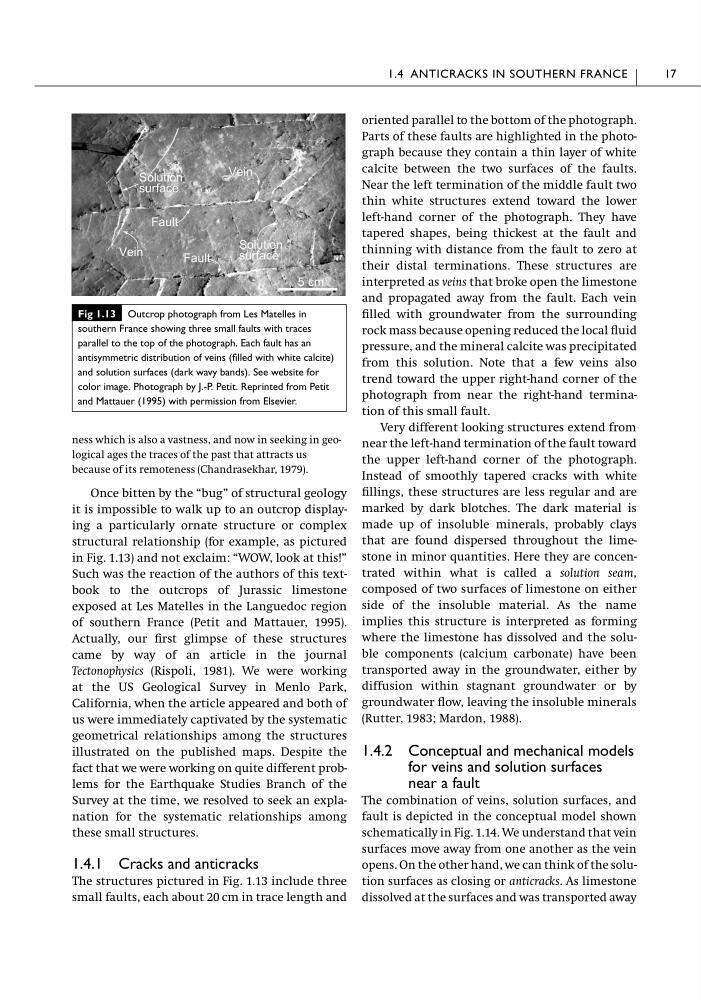
The structures pictured in Fig. 1.13 include three
small faults, each about 20 cm in trace length and
oriented parallel to the bottom of the photograph.
Parts of these faults are highlighted in the photograph because they contain a thin layer of white
calcite between the two surfaces of the faults.
Near the left termination of the middle fault two
thin white structures extend toward the lower
left-hand corner of the photograph. They have
tapered shapes, being thickest at the fault and
thinning with distance from the fault to zero at
their distal terminations. These structures are
interpreted as veins that broke open the limestone
and propagated away from the fault. Each vein
filled with groundwater from the surrounding
rock mass because opening reduced the local fluid
pressure, and the mineral calcite was precipitated
from this solution. Note that a few veins also
trend toward the upper right-hand corner of the
photograph from near the right-hand termination of this small fault.
Very different looking structures extend from
near the left-hand termination of the fault toward
the upper left-hand corner of the photograph.
Instead of smoothly tapered cracks with white
fillings, these structures are less regular and are
marked by dark blotches. The dark material is
made up of insoluble minerals, probably clays
that are found dispersed throughout the limestone in minor quantities. Here they are concentrated within what is called a solution seam,
composed of two surfaces of limestone on either
side of the insoluble material. As the name
implies this structure is interpreted as forming
where the limestone has dissolved and the soluble components (calcium carbonate) have been
transported away in the groundwater, either by
diffusion within stagnant groundwater or by
groundwater flow, leaving the insoluble minerals
(Rutter, 1983; Mardon, 1988).
1.4.2 Conceptual and mechanical models
for veins and solution surfaces
near a fault
The combination of veins, solution surfaces, and
fault is depicted in the conceptual model shown
schematically in Fig. 1.14. We understand that vein
surfaces move away from one another as the vein
opens. On the other hand, we can think of the solution surfaces as closing or anticracks. As limestone
dissolved at the surfaces and was transported away
1.4 ANTICRACKS IN SOUTHERN FRANCE
17
Solution
surface
Vein
Fault
Vein
Solution
surface
Fault
5 cm
Fig 1.13 Outcrop photograph from Les Matelles in
southern France showing three small faults with traces
parallel to the top of the photograph. Each fault has an
antisymmetric distribution of veins (filled with white calcite)
and solution surfaces (dark wavy bands). See website for
color image. Photograph by J.-P. Petit. Reprinted from Petit
and Mattauer (1995) with permission from Elsevier.
because of its remoteness (Chandrasekhar, 1979).
Once bitten by the “bug” of structural geology
it is impossible to walk up to an outcrop displaying a particularly ornate structure or complex
structural relationship (for example, as pictured
in Fig. 1.13) and not exclaim: “WOW, look at this!”
Such was the reaction of the authors of this textbook to the outcrops of Jurassic limestone
exposed at Les Matelles in the Languedoc region
of southern France (Petit and Mattauer, 1995).
Actually, our first glimpse of these structures
came by way of an article in the journal
Tectonophysics (Rispoli, 1981). We were working
at the US Geological Survey in Menlo Park,
California, when the article appeared and both of
us were immediately captivated by the systematic
geometrical relationships among the structures
illustrated on the published maps. Despite the
fact that we were working on quite different problems for the Earthquake Studies Branch of the
Survey at the time, we resolved to seek an explanation for the systematic relationships among
these small structures.
1.4.1 Cracks and anticracks
The structures pictured in Fig. 1.13 include three
small faults, each about 20 cm in trace length and
oriented parallel to the bottom of the photograph.
Parts of these faults are highlighted in the photograph because they contain a thin layer of white
calcite between the two surfaces of the faults.
Near the left termination of the middle fault two
thin white structures extend toward the lower
left-hand corner of the photograph. They have
tapered shapes, being thickest at the fault and
thinning with distance from the fault to zero at
their distal terminations. These structures are
interpreted as veins that broke open the limestone
and propagated away from the fault. Each vein
filled with groundwater from the surrounding
rock mass because opening reduced the local fluid
pressure, and the mineral calcite was precipitated
from this solution. Note that a few veins also
trend toward the upper right-hand corner of the
photograph from near the right-hand termination of this small fault.
Very different looking structures extend from
near the left-hand termination of the fault toward
the upper left-hand corner of the photograph.
Instead of smoothly tapered cracks with white
fillings, these structures are less regular and are
marked by dark blotches. The dark material is
made up of insoluble minerals, probably clays
that are found dispersed throughout the limestone in minor quantities. Here they are concentrated within what is called a solution seam,
composed of two surfaces of limestone on either
side of the insoluble material. As the name
implies this structure is interpreted as forming
where the limestone has dissolved and the soluble components (calcium carbonate) have been
transported away in the groundwater, either by
diffusion within stagnant groundwater or by
groundwater flow, leaving the insoluble minerals
(Rutter, 1983; Mardon, 1988).
1.4.2 Conceptual and mechanical models
for veins and solution surfaces
near a fault
The combination of veins, solution surfaces, and
fault is depicted in the conceptual model shown
schematically in Fig. 1.14. We understand that vein
surfaces move away from one another as the vein
opens. On the other hand, we can think of the solution surfaces as closing or anticracks. As limestone
dissolved at the surfaces and was transported away
1.4 ANTICRACKS IN SOUTHERN FRANCE
17
Solution
surface
Vein
Fault
Vein
Solution
surface
Fault
5 cm
Fig 1.13 Outcrop photograph from Les Matelles in
southern France showing three small faults with traces
parallel to the top of the photograph. Each fault has an
antisymmetric distribution of veins (filled with white calcite)
and solution surfaces (dark wavy bands). See website for
color image. Photograph by J.-P. Petit. Reprinted from Petit
and Mattauer (1995) with permission from Elsevier.