

thermodynamic pressure and a linear function of
the rate of deformation tensor. Any fluid obeying
this general linear form or simplifications of it is
referred to as a Newtonian viscous fluid because of
Newton’s insightful investigations of viscous flow.
The general linear form is simplified here for an
isotropic fluid: one in which the viscous constants
are not dependent upon direction. For such a fluid
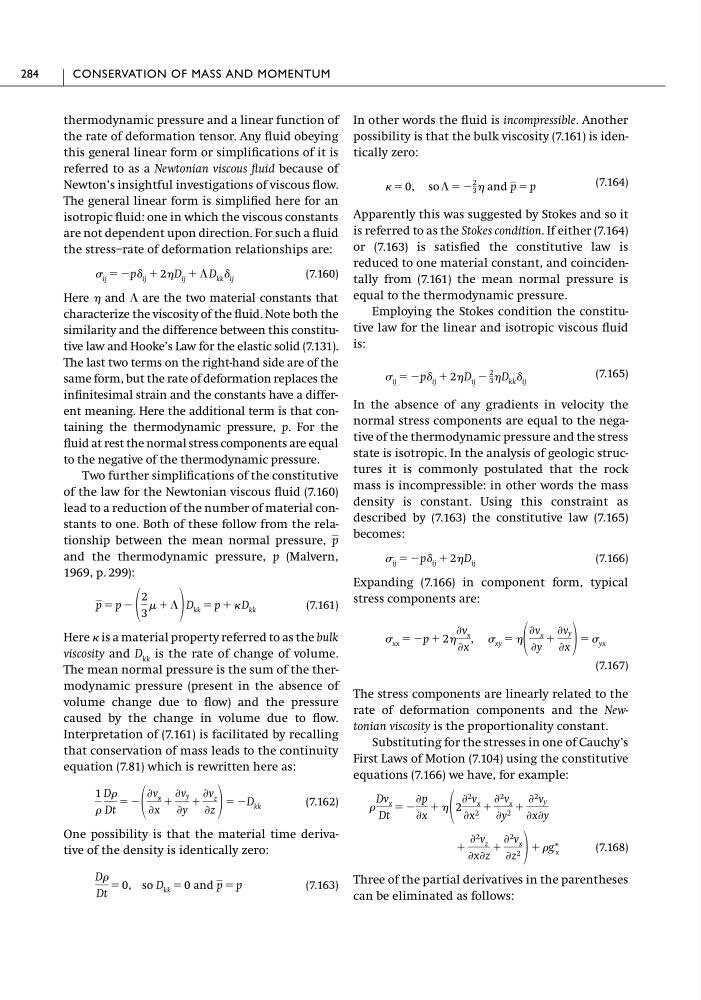
the stress–rate of deformation relationships are:
(7.160)
Here and ⌳ are the two material constants that
characterize the viscosity of the fluid. Note both the
similarity and the difference between this constitutive law and Hooke’s Law for the elastic solid (7.131).
The last two terms on the right-hand side are of the
same form, but the rate of deformation replaces the
infinitesimal strain and the constants have a different meaning. Here the additional term is that containing the thermodynamic pressure, p. For the
fluid at rest the normal stress components are equal
to the negative of the thermodynamic pressure.
Two further simplifications of the constitutive
of the law for the Newtonian viscous fluid (7.160)
lead to a reduction of the number of material constants to one. Both of these follow from the relationship between the mean normal pressure,
and the thermodynamic pressure, p (Malvern,
1969, p. 299):
(7.161)
Here is a material property referred to as the bulk
viscosity and D kk is the rate of change of volume.
The mean normal pressure is the sum of the thermodynamic pressure (present in the absence of
volume change due to flow) and the pressure
caused by the change in volume due to flow.
Interpretation of (7.161) is facilitated by recalling
that conservation of mass leads to the continuity
equation (7.81) which is rewritten here as:
(7.162)
One possibility is that the material time derivative of the density is identically zero:
(7.163)
D
Dt
ϭ 0, so D kk ϭ 0 and p ϭ p
1
D
Dt
ϭ Ϫ
Ѩv x
Ѩx
ϩ
Ѩv y
Ѩy
ϩ
Ѩv z
Ѩz ϭ ϪD kk
p ϭ p Ϫ
2
3
ϩ ⌳
D kk ϭ p ϩ D kk
p
ij ϭ Ϫp␦ ij ϩ 2D ij ϩ ⌳ D kk ␦ ij
In other words the fluid is incompressible. Another
possibility is that the bulk viscosity (7.161) is identically zero:
(7.164)
Apparently this was suggested by Stokes and so it
is referred to as the Stokes condition. If either (7.164)
or (7.163) is satisfied the constitutive law is
reduced to one material constant, and coincidentally from (7.161) the mean normal pressure is
equal to the thermodynamic pressure.
Employing the Stokes condition the constitutive law for the linear and isotropic viscous fluid
is:
(7.165)
In the absence of any gradients in velocity the
normal stress components are equal to the negative of the thermodynamic pressure and the stress
state is isotropic. In the analysis of geologic structures it is commonly postulated that the rock
mass is incompressible: in other words the mass
density is constant. Using this constraint as
described by (7.163) the constitutive law (7.165)
becomes:
(7.166)
Expanding (7.166) in component form, typical
stress components are:
(7.167)
The stress components are linearly related to the
rate of deformation components and the Newtonian viscosity is the proportionality constant.
Substituting for the stresses in one of Cauchy’s
First Laws of Motion (7.104) using the constitutive
equations (7.166) we have, for example:
(7.168)
Three of the partial derivatives in the parentheses
can be eliminated as follows:
ϩ
Ѩ 2 v z
ѨxѨz
ϩ
Ѩ 2 v x
Ѩz 2 ϩ g* x
Dv x
Dt
ϭ Ϫ
Ѩp
Ѩx
ϩ 2
Ѩ 2 v x
Ѩx 2 ϩ
Ѩ 2 v x
Ѩy 2 ϩ
Ѩ 2 v y
ѨxѨy
xx ϭ Ϫp ϩ 2
Ѩv x
Ѩx
, xy ϭ
Ѩv x
Ѩy
ϩ
Ѩv y
Ѩx ϭ yx
ij ϭ Ϫp␦ ij ϩ 2D ij
ij ϭ Ϫp␦ ij ϩ 2D ij Ϫ
2
3 D kk ␦ ij
ϭ 0, so ⌳ ϭ Ϫ
2
3 and p ϭ p
284
CONSERVATION OF MASS AND MOMENTUM
the rate of deformation tensor. Any fluid obeying
this general linear form or simplifications of it is
referred to as a Newtonian viscous fluid because of
Newton’s insightful investigations of viscous flow.
The general linear form is simplified here for an
isotropic fluid: one in which the viscous constants
are not dependent upon direction. For such a fluid
the stress–rate of deformation relationships are:
(7.160)
Here and ⌳ are the two material constants that
characterize the viscosity of the fluid. Note both the
similarity and the difference between this constitutive law and Hooke’s Law for the elastic solid (7.131).
The last two terms on the right-hand side are of the
same form, but the rate of deformation replaces the
infinitesimal strain and the constants have a different meaning. Here the additional term is that containing the thermodynamic pressure, p. For the
fluid at rest the normal stress components are equal
to the negative of the thermodynamic pressure.
Two further simplifications of the constitutive
of the law for the Newtonian viscous fluid (7.160)
lead to a reduction of the number of material constants to one. Both of these follow from the relationship between the mean normal pressure,
and the thermodynamic pressure, p (Malvern,
1969, p. 299):
(7.161)
Here is a material property referred to as the bulk
viscosity and D kk is the rate of change of volume.
The mean normal pressure is the sum of the thermodynamic pressure (present in the absence of
volume change due to flow) and the pressure
caused by the change in volume due to flow.
Interpretation of (7.161) is facilitated by recalling
that conservation of mass leads to the continuity
equation (7.81) which is rewritten here as:
(7.162)
One possibility is that the material time derivative of the density is identically zero:
(7.163)
D
Dt
ϭ 0, so D kk ϭ 0 and p ϭ p
1
D
Dt
ϭ Ϫ
Ѩv x
Ѩx
ϩ
Ѩv y
Ѩy
ϩ
Ѩv z
Ѩz ϭ ϪD kk
p ϭ p Ϫ
2
3
ϩ ⌳
D kk ϭ p ϩ D kk
p
ij ϭ Ϫp␦ ij ϩ 2D ij ϩ ⌳ D kk ␦ ij
In other words the fluid is incompressible. Another
possibility is that the bulk viscosity (7.161) is identically zero:
(7.164)
Apparently this was suggested by Stokes and so it
is referred to as the Stokes condition. If either (7.164)
or (7.163) is satisfied the constitutive law is
reduced to one material constant, and coincidentally from (7.161) the mean normal pressure is
equal to the thermodynamic pressure.
Employing the Stokes condition the constitutive law for the linear and isotropic viscous fluid
is:
(7.165)
In the absence of any gradients in velocity the
normal stress components are equal to the negative of the thermodynamic pressure and the stress
state is isotropic. In the analysis of geologic structures it is commonly postulated that the rock
mass is incompressible: in other words the mass
density is constant. Using this constraint as
described by (7.163) the constitutive law (7.165)
becomes:
(7.166)
Expanding (7.166) in component form, typical
stress components are:
(7.167)
The stress components are linearly related to the
rate of deformation components and the Newtonian viscosity is the proportionality constant.
Substituting for the stresses in one of Cauchy’s
First Laws of Motion (7.104) using the constitutive
equations (7.166) we have, for example:
(7.168)
Three of the partial derivatives in the parentheses
can be eliminated as follows:
ϩ
Ѩ 2 v z
ѨxѨz
ϩ
Ѩ 2 v x
Ѩz 2 ϩ g* x
Dv x
Dt
ϭ Ϫ
Ѩp
Ѩx
ϩ 2
Ѩ 2 v x
Ѩx 2 ϩ
Ѩ 2 v x
Ѩy 2 ϩ
Ѩ 2 v y
ѨxѨy
xx ϭ Ϫp ϩ 2
Ѩv x
Ѩx
, xy ϭ
Ѩv x
Ѩy
ϩ
Ѩv y
Ѩx ϭ yx
ij ϭ Ϫp␦ ij ϩ 2D ij
ij ϭ Ϫp␦ ij ϩ 2D ij Ϫ
2
3 D kk ␦ ij
ϭ 0, so ⌳ ϭ Ϫ
2
3 and p ϭ p
284
CONSERVATION OF MASS AND MOMENTUM