

Perhaps the most fundamental mechanical
distinction between a fluid and a solid is that the
greatest shear stress is zero everywhere within a
fluid at rest and within a fluid in a state of
uniform velocity. This property sometimes is
described by stating that a fluid at rest (or in
uniform motion) is incapable of supporting a
shear stress. Recall from Chapter 6, Table 6.1, that
the maximum shear stresses are defined in terms
of the principal normal stresses as:
(7.154)
By definition 1 Ն 2 Ն 3 , so all of the principal
shear stresses are positive or zero. If the greatest
principal shear stress is zero, then all three principal shear stresses must be zero, and the stress
state must be isotropic: 11 ϭ 22 ϭ 33 for any orientation of the coordinate axes, so principal directions are not defined. In this mechanical context,
the static pressure, p 0 , is defined as the negative of
the uniform normal stressЉ:
(7.155)
If the fluid is in motion such that the velocity is
not uniform, the mean normal pressure, , is defined
as the negative of the mean value of the principal
normal stresses:
(7.156)
In this case the greatest shear stress must be
greater than zero and the state of stress is not
isotropic.
Pressure also is defined in a thermodynamic
context. For a static fluid in thermodynamic equilibrium the pressure, absolute temperature, and
mass density are related by an equation of state
(Malvern, 1969, p. 295):
(7.157)
For investigations of fluid flow it is assumed that
the so-called thermodynamic pressure, p, is defined
using this same relationship, even when the fluid
is in motion:
(7.158)
F(p, T, ) ϭ 0
F ( p 0 , T, ) ϭ 0
p ϭ Ϫ
1
3 ( 1 ϩ 2 ϩ 3 ),
1
2 ( 1 Ϫ 3 ) Ͼ 0
p
p 0 ϭ ij ␦ ij
1
2 ( 1 Ϫ 3 ),
1
2 ( 2 Ϫ 3 ),
1
2 ( 1 Ϫ 2 )
Using (7.158) guarantees that the thermodynamic
pressure, p, reduces to the static pressure, ,
when the fluid comes to rest or to a state of
uniform velocity, but it may not be equal to the
mean normal pressure (7.156) defined as a function of the normal stress components for a fluid in
motion. In keeping with the postulates employed
earlier in this chapter we limit our attention to
barotropic flows, those in which the thermodynamic pressure is independent of temperature,
so the equation of state is of the form:
(7.159)
These thermodynamic characterizations of pressure must be reconciled with the mechanical
definitions of pressure from the preceding paragraph and this can be done by considering the
constitutive law for the fluid.
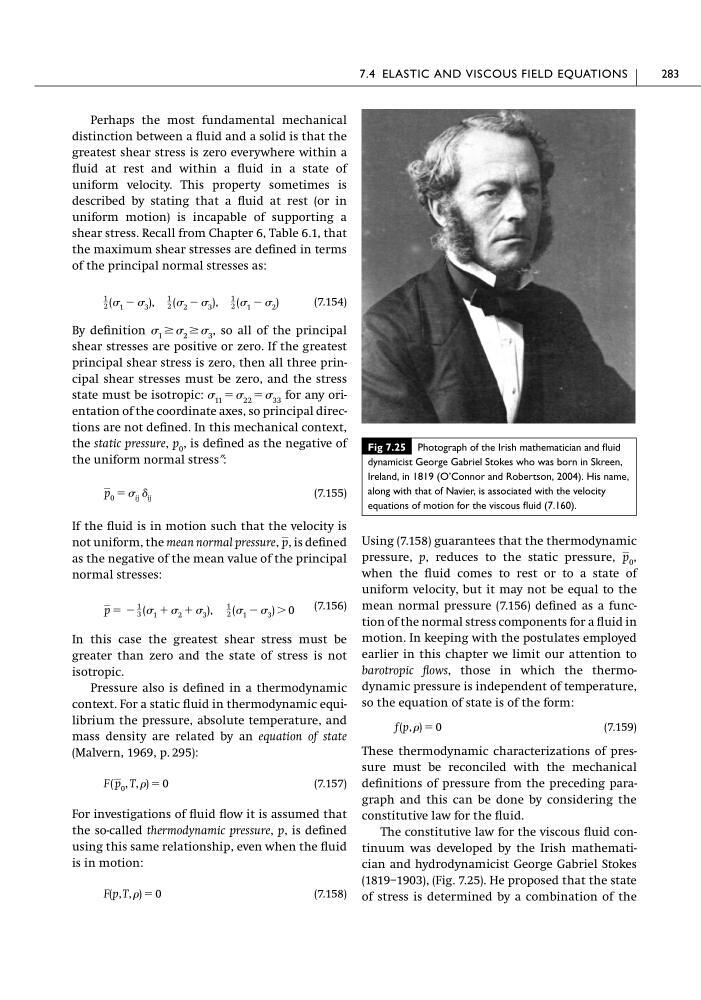
The constitutive law for the viscous fluid continuum was developed by the Irish mathematician and hydrodynamicist George Gabriel Stokes
(1819–1903), (Fig. 7.25). He proposed that the state
of stress is determined by a combination of the
f (p, ) ϭ 0
p 0
7.4 ELASTIC AND VISCOUS FIELD EQUATIONS
283
Fig 7.25 Photograph of the Irish mathematician and fluid
dynamicist George Gabriel Stokes who was born in Skreen,
Ireland, in 1819 (O’Connor and Robertson, 2004). His name,
along with that of Navier, is associated with the velocity
equations of motion for the viscous fluid (7.160).
distinction between a fluid and a solid is that the
greatest shear stress is zero everywhere within a
fluid at rest and within a fluid in a state of
uniform velocity. This property sometimes is
described by stating that a fluid at rest (or in
uniform motion) is incapable of supporting a
shear stress. Recall from Chapter 6, Table 6.1, that
the maximum shear stresses are defined in terms
of the principal normal stresses as:
(7.154)
By definition 1 Ն 2 Ն 3 , so all of the principal
shear stresses are positive or zero. If the greatest
principal shear stress is zero, then all three principal shear stresses must be zero, and the stress
state must be isotropic: 11 ϭ 22 ϭ 33 for any orientation of the coordinate axes, so principal directions are not defined. In this mechanical context,
the static pressure, p 0 , is defined as the negative of
the uniform normal stressЉ:
(7.155)
If the fluid is in motion such that the velocity is
not uniform, the mean normal pressure, , is defined
as the negative of the mean value of the principal
normal stresses:
(7.156)
In this case the greatest shear stress must be
greater than zero and the state of stress is not
isotropic.
Pressure also is defined in a thermodynamic
context. For a static fluid in thermodynamic equilibrium the pressure, absolute temperature, and
mass density are related by an equation of state
(Malvern, 1969, p. 295):
(7.157)
For investigations of fluid flow it is assumed that
the so-called thermodynamic pressure, p, is defined
using this same relationship, even when the fluid
is in motion:
(7.158)
F(p, T, ) ϭ 0
F ( p 0 , T, ) ϭ 0
p ϭ Ϫ
1
3 ( 1 ϩ 2 ϩ 3 ),
1
2 ( 1 Ϫ 3 ) Ͼ 0
p
p 0 ϭ ij ␦ ij
1
2 ( 1 Ϫ 3 ),
1
2 ( 2 Ϫ 3 ),
1
2 ( 1 Ϫ 2 )
Using (7.158) guarantees that the thermodynamic
pressure, p, reduces to the static pressure, ,
when the fluid comes to rest or to a state of
uniform velocity, but it may not be equal to the
mean normal pressure (7.156) defined as a function of the normal stress components for a fluid in
motion. In keeping with the postulates employed
earlier in this chapter we limit our attention to
barotropic flows, those in which the thermodynamic pressure is independent of temperature,
so the equation of state is of the form:
(7.159)
These thermodynamic characterizations of pressure must be reconciled with the mechanical
definitions of pressure from the preceding paragraph and this can be done by considering the
constitutive law for the fluid.
The constitutive law for the viscous fluid continuum was developed by the Irish mathematician and hydrodynamicist George Gabriel Stokes
(1819–1903), (Fig. 7.25). He proposed that the state
of stress is determined by a combination of the
f (p, ) ϭ 0
p 0
7.4 ELASTIC AND VISCOUS FIELD EQUATIONS
283
Fig 7.25 Photograph of the Irish mathematician and fluid
dynamicist George Gabriel Stokes who was born in Skreen,
Ireland, in 1819 (O’Connor and Robertson, 2004). His name,
along with that of Navier, is associated with the velocity
equations of motion for the viscous fluid (7.160).