

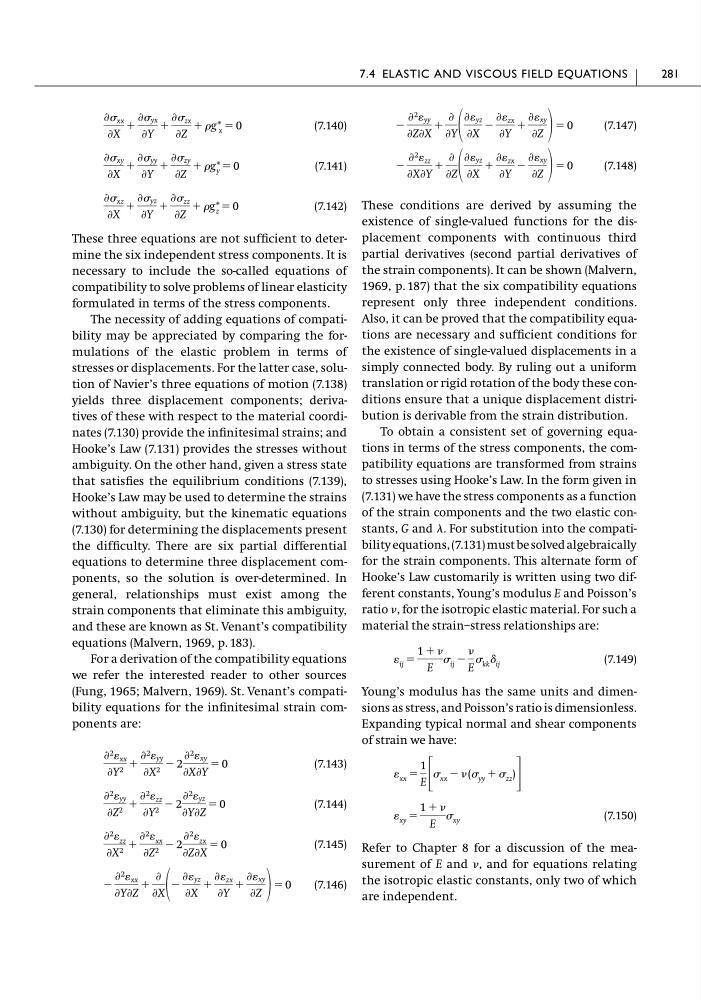
(7.140)
(7.141)
(7.142)
These three equations are not sufficient to determine the six independent stress components. It is
necessary to include the so-called equations of
compatibility to solve problems of linear elasticity
formulated in terms of the stress components.
The necessity of adding equations of compatibility may be appreciated by comparing the formulations of the elastic problem in terms of
stresses or displacements. For the latter case, solution of Navier’s three equations of motion (7.138)
yields three displacement components; derivatives of these with respect to the material coordinates (7.130) provide the infinitesimal strains; and
Hooke’s Law (7.131) provides the stresses without
ambiguity. On the other hand, given a stress state
that satisfies the equilibrium conditions (7.139),
Hooke’s Law may be used to determine the strains
without ambiguity, but the kinematic equations
(7.130) for determining the displacements present
the difficulty. There are six partial differential
equations to determine three displacement components, so the solution is over-determined. In
general, relationships must exist among the
strain components that eliminate this ambiguity,
and these are known as St. Venant’s compatibility
equations (Malvern, 1969, p. 183).
For a derivation of the compatibility equations
we refer the interested reader to other sources
(Fung, 1965; Malvern, 1969). St. Venant’s compatibility equations for the infinitesimal strain components are:
(7.143)
(7.144)
(7.145)
(7.146)
Ϫ
Ѩ 2 xx
ѨYѨZ
ϩ
Ѩ
ѨX
Ϫ
Ѩ yz
ѨX
ϩ
Ѩ zx
ѨY
ϩ
Ѩ xy
ѨZ
ϭ 0
Ѩ 2 zz
ѨX 2 ϩ
Ѩ 2 xx
ѨZ 2 Ϫ 2
Ѩ 2 zx
ѨZѨX
ϭ 0
Ѩ 2 yy
ѨZ 2 ϩ
Ѩ 2 zz
ѨY 2 Ϫ 2
Ѩ 2 yz
ѨYѨZ
ϭ 0
Ѩ 2 xx
ѨY 2 ϩ
Ѩ 2 yy
ѨX 2 Ϫ 2
Ѩ 2 xy
ѨXѨY
ϭ 0
Ѩ xz
ѨX
ϩ
Ѩ yz
ѨY
ϩ
Ѩ zz
ѨZ
ϩ g* z ϭ 0
Ѩ xy
ѨX
ϩ
Ѩ yy
ѨY
ϩ
Ѩ zy
ѨZ
ϩ g* y ϭ 0
Ѩ xx
ѨX
ϩ
Ѩ yx
ѨY
ϩ
Ѩ zx
ѨZ
ϩ g* x ϭ 0
(7.147)
(7.148)
These conditions are derived by assuming the
existence of single-valued functions for the displacement components with continuous third
partial derivatives (second partial derivatives of
the strain components). It can be shown (Malvern,
1969, p. 187) that the six compatibility equations
represent only three independent conditions.
Also, it can be proved that the compatibility equations are necessary and sufficient conditions for
the existence of single-valued displacements in a
simply connected body. By ruling out a uniform
translation or rigid rotation of the body these conditions ensure that a unique displacement distribution is derivable from the strain distribution.
To obtain a consistent set of governing equations in terms of the stress components, the compatibility equations are transformed from strains
to stresses using Hooke’s Law. In the form given in
(7.131) we have the stress components as a function
of the strain components and the two elastic constants, G and . For substitution into the compatibility equations, (7.131) must be solved algebraically
for the strain components. This alternate form of
Hooke’s Law customarily is written using two different constants, Young’s modulus E and Poisson’s
ratio , for the isotropic elastic material. For such a
material the strain–stress relationships are:
(7.149)
Young’s modulus has the same units and dimensions as stress, and Poisson’s ratio is dimensionless.
Expanding typical normal and shear components
of strain we have:
(7.150)
Refer to Chapter 8 for a discussion of the measurement of E and , and for equations relating
the isotropic elastic constants, only two of which
are independent.
xy ϭ
1 ϩ
E
xy
xx ϭ
1
E ΄ xx Ϫ ( yy ϩ zz ) ΅
ij ϭ
1 ϩ
E
ij Ϫ
E
kk ␦ ij
Ϫ
Ѩ 2 zz
ѨXѨY
ϩ
Ѩ
ѨZ
Ѩ yz
ѨX
ϩ
Ѩ zx
ѨY
Ϫ
Ѩ xy
ѨZ
ϭ 0
Ϫ
Ѩ 2 yy
ѨZѨX
ϩ
Ѩ
ѨY
Ѩ yz
ѨX
Ϫ
Ѩ zx
ѨY
ϩ
Ѩ xy
ѨZ
ϭ 0
7.4 ELASTIC AND VISCOUS FIELD EQUATIONS
281
(7.141)
(7.142)
These three equations are not sufficient to determine the six independent stress components. It is
necessary to include the so-called equations of
compatibility to solve problems of linear elasticity
formulated in terms of the stress components.
The necessity of adding equations of compatibility may be appreciated by comparing the formulations of the elastic problem in terms of
stresses or displacements. For the latter case, solution of Navier’s three equations of motion (7.138)
yields three displacement components; derivatives of these with respect to the material coordinates (7.130) provide the infinitesimal strains; and
Hooke’s Law (7.131) provides the stresses without
ambiguity. On the other hand, given a stress state
that satisfies the equilibrium conditions (7.139),
Hooke’s Law may be used to determine the strains
without ambiguity, but the kinematic equations
(7.130) for determining the displacements present
the difficulty. There are six partial differential
equations to determine three displacement components, so the solution is over-determined. In
general, relationships must exist among the
strain components that eliminate this ambiguity,
and these are known as St. Venant’s compatibility
equations (Malvern, 1969, p. 183).
For a derivation of the compatibility equations
we refer the interested reader to other sources
(Fung, 1965; Malvern, 1969). St. Venant’s compatibility equations for the infinitesimal strain components are:
(7.143)
(7.144)
(7.145)
(7.146)
Ϫ
Ѩ 2 xx
ѨYѨZ
ϩ
Ѩ
ѨX
Ϫ
Ѩ yz
ѨX
ϩ
Ѩ zx
ѨY
ϩ
Ѩ xy
ѨZ
ϭ 0
Ѩ 2 zz
ѨX 2 ϩ
Ѩ 2 xx
ѨZ 2 Ϫ 2
Ѩ 2 zx
ѨZѨX
ϭ 0
Ѩ 2 yy
ѨZ 2 ϩ
Ѩ 2 zz
ѨY 2 Ϫ 2
Ѩ 2 yz
ѨYѨZ
ϭ 0
Ѩ 2 xx
ѨY 2 ϩ
Ѩ 2 yy
ѨX 2 Ϫ 2
Ѩ 2 xy
ѨXѨY
ϭ 0
Ѩ xz
ѨX
ϩ
Ѩ yz
ѨY
ϩ
Ѩ zz
ѨZ
ϩ g* z ϭ 0
Ѩ xy
ѨX
ϩ
Ѩ yy
ѨY
ϩ
Ѩ zy
ѨZ
ϩ g* y ϭ 0
Ѩ xx
ѨX
ϩ
Ѩ yx
ѨY
ϩ
Ѩ zx
ѨZ
ϩ g* x ϭ 0
(7.147)
(7.148)
These conditions are derived by assuming the
existence of single-valued functions for the displacement components with continuous third
partial derivatives (second partial derivatives of
the strain components). It can be shown (Malvern,
1969, p. 187) that the six compatibility equations
represent only three independent conditions.
Also, it can be proved that the compatibility equations are necessary and sufficient conditions for
the existence of single-valued displacements in a
simply connected body. By ruling out a uniform
translation or rigid rotation of the body these conditions ensure that a unique displacement distribution is derivable from the strain distribution.
To obtain a consistent set of governing equations in terms of the stress components, the compatibility equations are transformed from strains
to stresses using Hooke’s Law. In the form given in
(7.131) we have the stress components as a function
of the strain components and the two elastic constants, G and . For substitution into the compatibility equations, (7.131) must be solved algebraically
for the strain components. This alternate form of
Hooke’s Law customarily is written using two different constants, Young’s modulus E and Poisson’s
ratio , for the isotropic elastic material. For such a
material the strain–stress relationships are:
(7.149)
Young’s modulus has the same units and dimensions as stress, and Poisson’s ratio is dimensionless.
Expanding typical normal and shear components
of strain we have:
(7.150)
Refer to Chapter 8 for a discussion of the measurement of E and , and for equations relating
the isotropic elastic constants, only two of which
are independent.
xy ϭ
1 ϩ
E
xy
xx ϭ
1
E ΄ xx Ϫ ( yy ϩ zz ) ΅
ij ϭ
1 ϩ
E
ij Ϫ
E
kk ␦ ij
Ϫ
Ѩ 2 zz
ѨXѨY
ϩ
Ѩ
ѨZ
Ѩ yz
ѨX
ϩ
Ѩ zx
ѨY
Ϫ
Ѩ xy
ѨZ
ϭ 0
Ϫ
Ѩ 2 yy
ѨZѨX
ϩ
Ѩ
ѨY
Ѩ yz
ѨX
Ϫ
Ѩ zx
ѨY
ϩ
Ѩ xy
ѨZ
ϭ 0
7.4 ELASTIC AND VISCOUS FIELD EQUATIONS
281