

7.4.1 Field equations for the linear
isotropic elastic solid
The Lagrangian (material) coordinates X are
taken as independent variables. Because there are
only two states to compare, and it is the displacement that measures the change in position of any
particle from the reference to the current state,
the equations of motion (7.103) must be written in
terms of the displacement u rather than the
velocity v. Because the equations of motion (7.103)
are written in terms of a spatial description of
motion, conservation of momentum is satisfied
in the current configuration of the deforming
body. To evaluate the conditions under which
conservation of momentum would be satisfied in
the reference state, the stress tensor is written in
a form other than that introduced by Cauchy.
Consideration of this so-called Piola–Kirchhoff
stress tensor is beyond the scope of this text so we
refer the interested reader to other sources for
the details of the evaluation (Fung, 1965;
Malvern, 1969). In summary, equations of motion
of the same form as (7.103) are written for the reference state using the Piola–Kirchhoff stress
tensor. There equations may be transformed to
those using the Cauchy stress tensor, but terms
appear that may be approximated, for example,
as:
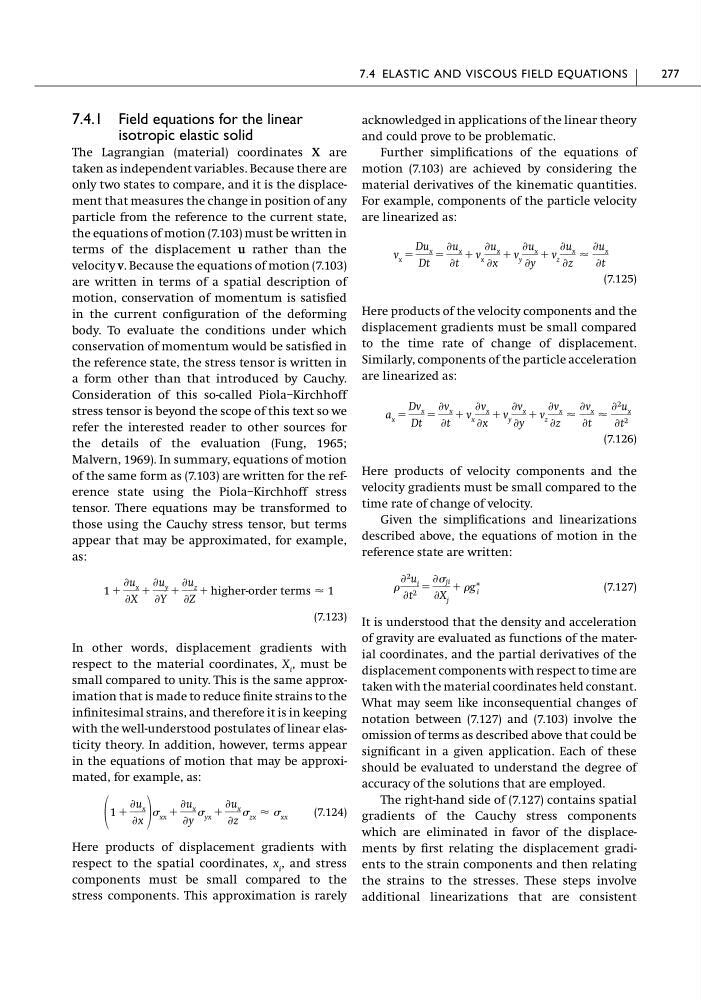
(7.123)
In other words, displacement gradients with
respect to the material coordinates, X i , must be
small compared to unity. This is the same approximation that is made to reduce finite strains to the
infinitesimal strains, and therefore it is in keeping
with the well-understood postulates of linear elasticity theory. In addition, however, terms appear
in the equations of motion that may be approximated, for example, as:
(7.124)
Here products of displacement gradients with
respect to the spatial coordinates, x i , and stress
components must be small compared to the
stress components. This approximation is rarely
1 ϩ
Ѩu x
Ѩx xx ϩ
Ѩu x
Ѩy
yx ϩ
Ѩu x
Ѩz
zx Ϸ xx
1 ϩ
Ѩu x
ѨX
ϩ
Ѩu y
ѨY
ϩ
Ѩu z
ѨZ
ϩ higher-order terms Ϸ 1
acknowledged in applications of the linear theory
and could prove to be problematic.
Further simplifications of the equations of
motion (7.103) are achieved by considering the
material derivatives of the kinematic quantities.
For example, components of the particle velocity
are linearized as:
(7.125)
Here products of the velocity components and the
displacement gradients must be small compared
to the time rate of change of displacement.
Similarly, components of the particle acceleration
are linearized as:
(7.126)
Here products of velocity components and the
velocity gradients must be small compared to the
time rate of change of velocity.
Given the simplifications and linearizations
described above, the equations of motion in the
reference state are written:
(7.127)
It is understood that the density and acceleration
of gravity are evaluated as functions of the material coordinates, and the partial derivatives of the
displacement components with respect to time are
taken with the material coordinates held constant.
What may seem like inconsequential changes of
notation between (7.127) and (7.103) involve the
omission of terms as described above that could be
significant in a given application. Each of these
should be evaluated to understand the degree of
accuracy of the solutions that are employed.
The right-hand side of (7.127) contains spatial
gradients of the Cauchy stress components
which are eliminated in favor of the displacements by first relating the displacement gradients to the strain components and then relating
the strains to the stresses. These steps involve
additional linearizations that are consistent
Ѩ 2 u i
Ѩt 2 ϭ
Ѩ ji
ѨX j
ϩ g* i
a x ϭ
Dv x
Dt
ϭ
Ѩv x
Ѩt
ϩ v x
Ѩv x
Ѩx
ϩ v y
Ѩv x
Ѩy
ϩ v z
Ѩv x
Ѩz
Ϸ
Ѩv x
Ѩt
Ϸ
Ѩ 2 u x
Ѩt 2
v x ϭ
Du x
Dt
ϭ
Ѩu x
Ѩt
ϩ v x
Ѩu x
Ѩx
ϩ v y
Ѩu x
Ѩy
ϩ v z
Ѩu x
Ѩz
Ϸ
Ѩu x
Ѩt
7.4 ELASTIC AND VISCOUS FIELD EQUATIONS
277
isotropic elastic solid
The Lagrangian (material) coordinates X are
taken as independent variables. Because there are
only two states to compare, and it is the displacement that measures the change in position of any
particle from the reference to the current state,
the equations of motion (7.103) must be written in
terms of the displacement u rather than the
velocity v. Because the equations of motion (7.103)
are written in terms of a spatial description of
motion, conservation of momentum is satisfied
in the current configuration of the deforming
body. To evaluate the conditions under which
conservation of momentum would be satisfied in
the reference state, the stress tensor is written in
a form other than that introduced by Cauchy.
Consideration of this so-called Piola–Kirchhoff
stress tensor is beyond the scope of this text so we
refer the interested reader to other sources for
the details of the evaluation (Fung, 1965;
Malvern, 1969). In summary, equations of motion
of the same form as (7.103) are written for the reference state using the Piola–Kirchhoff stress
tensor. There equations may be transformed to
those using the Cauchy stress tensor, but terms
appear that may be approximated, for example,
as:
(7.123)
In other words, displacement gradients with
respect to the material coordinates, X i , must be
small compared to unity. This is the same approximation that is made to reduce finite strains to the
infinitesimal strains, and therefore it is in keeping
with the well-understood postulates of linear elasticity theory. In addition, however, terms appear
in the equations of motion that may be approximated, for example, as:
(7.124)
Here products of displacement gradients with
respect to the spatial coordinates, x i , and stress
components must be small compared to the
stress components. This approximation is rarely
1 ϩ
Ѩu x
Ѩx xx ϩ
Ѩu x
Ѩy
yx ϩ
Ѩu x
Ѩz
zx Ϸ xx
1 ϩ
Ѩu x
ѨX
ϩ
Ѩu y
ѨY
ϩ
Ѩu z
ѨZ
ϩ higher-order terms Ϸ 1
acknowledged in applications of the linear theory
and could prove to be problematic.
Further simplifications of the equations of
motion (7.103) are achieved by considering the
material derivatives of the kinematic quantities.
For example, components of the particle velocity
are linearized as:
(7.125)
Here products of the velocity components and the
displacement gradients must be small compared
to the time rate of change of displacement.
Similarly, components of the particle acceleration
are linearized as:
(7.126)
Here products of velocity components and the
velocity gradients must be small compared to the
time rate of change of velocity.
Given the simplifications and linearizations
described above, the equations of motion in the
reference state are written:
(7.127)
It is understood that the density and acceleration
of gravity are evaluated as functions of the material coordinates, and the partial derivatives of the
displacement components with respect to time are
taken with the material coordinates held constant.
What may seem like inconsequential changes of
notation between (7.127) and (7.103) involve the
omission of terms as described above that could be
significant in a given application. Each of these
should be evaluated to understand the degree of
accuracy of the solutions that are employed.
The right-hand side of (7.127) contains spatial
gradients of the Cauchy stress components
which are eliminated in favor of the displacements by first relating the displacement gradients to the strain components and then relating
the strains to the stresses. These steps involve
additional linearizations that are consistent
Ѩ 2 u i
Ѩt 2 ϭ
Ѩ ji
ѨX j
ϩ g* i
a x ϭ
Dv x
Dt
ϭ
Ѩv x
Ѩt
ϩ v x
Ѩv x
Ѩx
ϩ v y
Ѩv x
Ѩy
ϩ v z
Ѩv x
Ѩz
Ϸ
Ѩv x
Ѩt
Ϸ
Ѩ 2 u x
Ѩt 2
v x ϭ
Du x
Dt
ϭ
Ѩu x
Ѩt
ϩ v x
Ѩu x
Ѩx
ϩ v y
Ѩu x
Ѩy
ϩ v z
Ѩu x
Ѩz
Ϸ
Ѩu x
Ѩt
7.4 ELASTIC AND VISCOUS FIELD EQUATIONS
277