

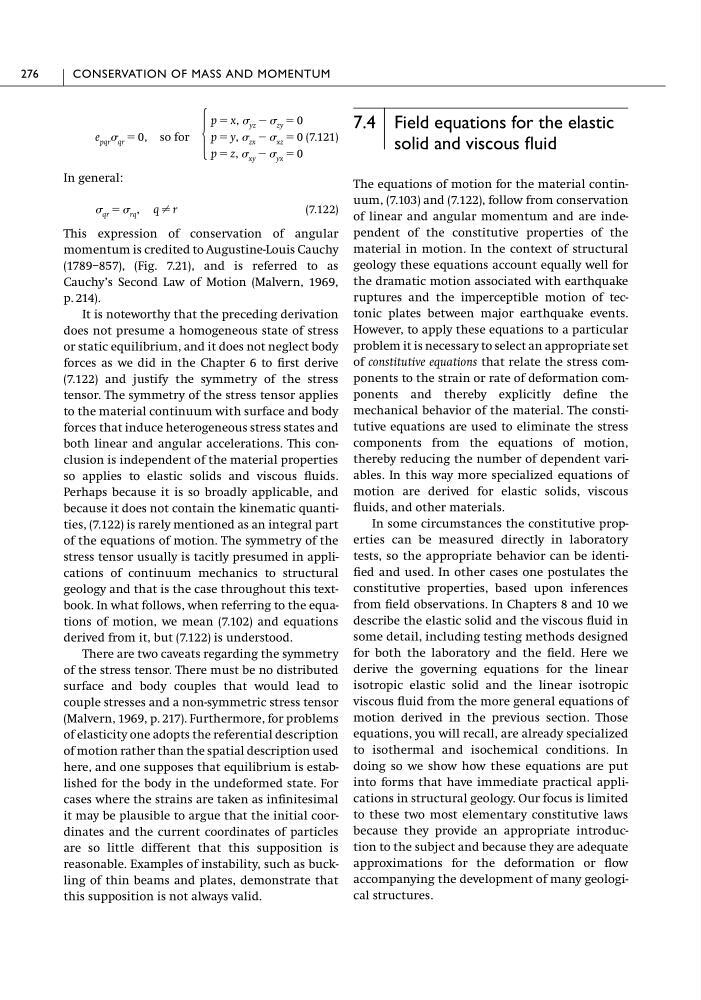
(7.121)
In general:
(7.122)
This expression of conservation of angular
momentum is credited to Augustine-Louis Cauchy
(1789–857), (Fig. 7.21), and is referred to as
Cauchy’s Second Law of Motion (Malvern, 1969,
p. 214).
It is noteworthy that the preceding derivation
does not presume a homogeneous state of stress
or static equilibrium, and it does not neglect body
forces as we did in the Chapter 6 to first derive
(7.122) and justify the symmetry of the stress
tensor. The symmetry of the stress tensor applies
to the material continuum with surface and body
forces that induce heterogeneous stress states and
both linear and angular accelerations. This conclusion is independent of the material properties
so applies to elastic solids and viscous fluids.
Perhaps because it is so broadly applicable, and
because it does not contain the kinematic quantities, (7.122) is rarely mentioned as an integral part
of the equations of motion. The symmetry of the
stress tensor usually is tacitly presumed in applications of continuum mechanics to structural
geology and that is the case throughout this textbook. In what follows, when referring to the equations of motion, we mean (7.102) and equations
derived from it, but (7.122) is understood.
There are two caveats regarding the symmetry
of the stress tensor. There must be no distributed
surface and body couples that would lead to
couple stresses and a non-symmetric stress tensor
(Malvern, 1969, p. 217). Furthermore, for problems
of elasticity one adopts the referential description
of motion rather than the spatial description used
here, and one supposes that equilibrium is established for the body in the undeformed state. For
cases where the strains are taken as infinitesimal
it may be plausible to argue that the initial coordinates and the current coordinates of particles
are so little different that this supposition is
reasonable. Examples of instability, such as buckling of thin beams and plates, demonstrate that
this supposition is not always valid.
qr ϭ rq ,q ϶ r
e pqr qr ϭ 0, so for
Ά
p ϭ x, yz Ϫ zy ϭ 0
p ϭ y, zx Ϫ xz ϭ 0
p ϭ z, xy Ϫ yx ϭ 0
7.4 Field equations for the elastic
solid and viscous fluid
The equations of motion for the material continuum, (7.103) and (7.122), follow from conservation
of linear and angular momentum and are independent of the constitutive properties of the
material in motion. In the context of structural
geology these equations account equally well for
the dramatic motion associated with earthquake
ruptures and the imperceptible motion of tectonic plates between major earthquake events.
However, to apply these equations to a particular
problem it is necessary to select an appropriate set
of constitutive equations that relate the stress components to the strain or rate of deformation components and thereby explicitly define the
mechanical behavior of the material. The constitutive equations are used to eliminate the stress
components from the equations of motion,
thereby reducing the number of dependent variables. In this way more specialized equations of
motion are derived for elastic solids, viscous
fluids, and other materials.
In some circumstances the constitutive properties can be measured directly in laboratory
tests, so the appropriate behavior can be identified and used. In other cases one postulates the
constitutive properties, based upon inferences
from field observations. In Chapters 8 and 10 we
describe the elastic solid and the viscous fluid in
some detail, including testing methods designed
for both the laboratory and the field. Here we
derive the governing equations for the linear
isotropic elastic solid and the linear isotropic
viscous fluid from the more general equations of
motion derived in the previous section. Those
equations, you will recall, are already specialized
to isothermal and isochemical conditions. In
doing so we show how these equations are put
into forms that have immediate practical applications in structural geology. Our focus is limited
to these two most elementary constitutive laws
because they provide an appropriate introduction to the subject and because they are adequate
approximations for the deformation or flow
accompanying the development of many geological structures.
276
CONSERVATION OF MASS AND MOMENTUM
In general:
(7.122)
This expression of conservation of angular
momentum is credited to Augustine-Louis Cauchy
(1789–857), (Fig. 7.21), and is referred to as
Cauchy’s Second Law of Motion (Malvern, 1969,
p. 214).
It is noteworthy that the preceding derivation
does not presume a homogeneous state of stress
or static equilibrium, and it does not neglect body
forces as we did in the Chapter 6 to first derive
(7.122) and justify the symmetry of the stress
tensor. The symmetry of the stress tensor applies
to the material continuum with surface and body
forces that induce heterogeneous stress states and
both linear and angular accelerations. This conclusion is independent of the material properties
so applies to elastic solids and viscous fluids.
Perhaps because it is so broadly applicable, and
because it does not contain the kinematic quantities, (7.122) is rarely mentioned as an integral part
of the equations of motion. The symmetry of the
stress tensor usually is tacitly presumed in applications of continuum mechanics to structural
geology and that is the case throughout this textbook. In what follows, when referring to the equations of motion, we mean (7.102) and equations
derived from it, but (7.122) is understood.
There are two caveats regarding the symmetry
of the stress tensor. There must be no distributed
surface and body couples that would lead to
couple stresses and a non-symmetric stress tensor
(Malvern, 1969, p. 217). Furthermore, for problems
of elasticity one adopts the referential description
of motion rather than the spatial description used
here, and one supposes that equilibrium is established for the body in the undeformed state. For
cases where the strains are taken as infinitesimal
it may be plausible to argue that the initial coordinates and the current coordinates of particles
are so little different that this supposition is
reasonable. Examples of instability, such as buckling of thin beams and plates, demonstrate that
this supposition is not always valid.
qr ϭ rq ,q ϶ r
e pqr qr ϭ 0, so for
Ά
p ϭ x, yz Ϫ zy ϭ 0
p ϭ y, zx Ϫ xz ϭ 0
p ϭ z, xy Ϫ yx ϭ 0
7.4 Field equations for the elastic
solid and viscous fluid
The equations of motion for the material continuum, (7.103) and (7.122), follow from conservation
of linear and angular momentum and are independent of the constitutive properties of the
material in motion. In the context of structural
geology these equations account equally well for
the dramatic motion associated with earthquake
ruptures and the imperceptible motion of tectonic plates between major earthquake events.
However, to apply these equations to a particular
problem it is necessary to select an appropriate set
of constitutive equations that relate the stress components to the strain or rate of deformation components and thereby explicitly define the
mechanical behavior of the material. The constitutive equations are used to eliminate the stress
components from the equations of motion,
thereby reducing the number of dependent variables. In this way more specialized equations of
motion are derived for elastic solids, viscous
fluids, and other materials.
In some circumstances the constitutive properties can be measured directly in laboratory
tests, so the appropriate behavior can be identified and used. In other cases one postulates the
constitutive properties, based upon inferences
from field observations. In Chapters 8 and 10 we
describe the elastic solid and the viscous fluid in
some detail, including testing methods designed
for both the laboratory and the field. Here we
derive the governing equations for the linear
isotropic elastic solid and the linear isotropic
viscous fluid from the more general equations of
motion derived in the previous section. Those
equations, you will recall, are already specialized
to isothermal and isochemical conditions. In
doing so we show how these equations are put
into forms that have immediate practical applications in structural geology. Our focus is limited
to these two most elementary constitutive laws
because they provide an appropriate introduction to the subject and because they are adequate
approximations for the deformation or flow
accompanying the development of many geological structures.
276
CONSERVATION OF MASS AND MOMENTUM