

the right-hand side imply summation over that
range. Each component of u is composed of nine
terms but eight of these are reduced to zero by
(7.110) and the remaining terms are those found in
(7.109).
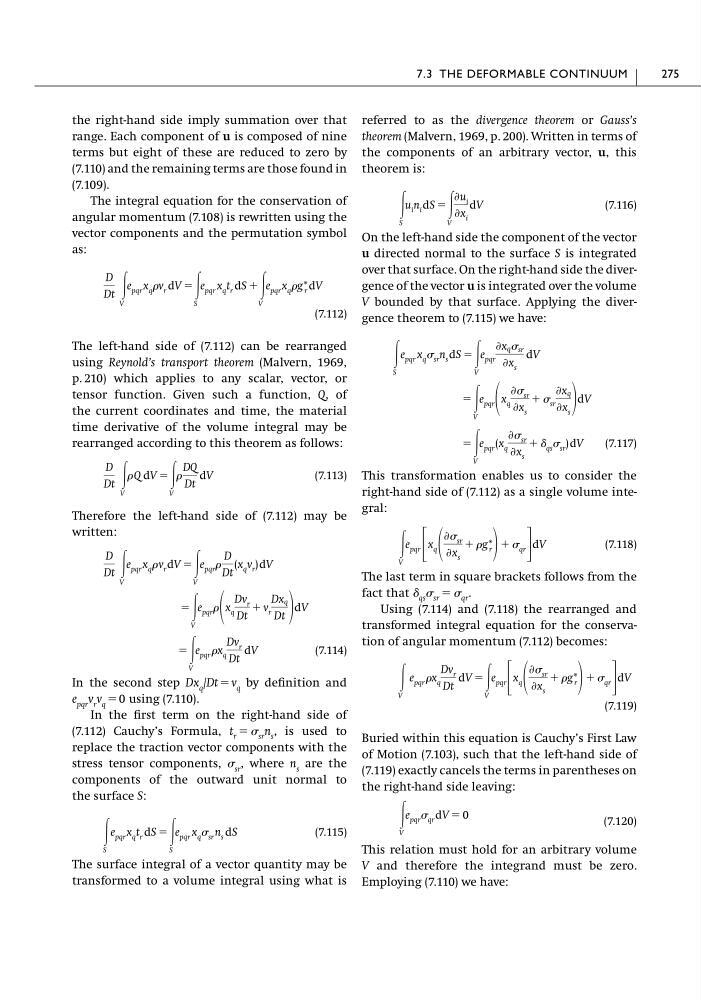
The integral equation for the conservation of
angular momentum (7.108) is rewritten using the
vector components and the permutation symbol
as:
(7.112)
The left-hand side of (7.112) can be rearranged
using Reynold’s transport theorem (Malvern, 1969,
p. 210) which applies to any scalar, vector, or
tensor function. Given such a function, Q, of
the current coordinates and time, the material
time derivative of the volume integral may be
rearranged according to this theorem as follows:
(7.113)
Therefore the left-hand side of (7.112) may be
written:
(7.114)
In the second step Dx q /Dt ϭ v q by definition and
e pqr v r v q ϭ 0 using (7.110).
In the first term on the right-hand side of
(7.112) Cauchy’s Formula,
is used to
replace the traction vector components with the
stress tensor components, sr , where n s are the
components of the outward unit normal to
the surface S:
(7.115)
The surface integral of a vector quantity may be
transformed to a volume integral using what is
Ύ
S
e pqr x q t r dS ϭ Ύ
S
e pqr x q sr n s dS
t r ϭ sr n s ,
ϭ Ύ
V
e pqr x q
Dv r
Dt
dV
ϭ Ύ
V
e pqr x q
Dv r
Dt
ϩ v r
Dx q
Dt dV
D
Dt Ύ
V
e pqr x q v r dV ϭ Ύ
V
e pqr
D
Dt
(x q v r ) dV
D
Dt Ύ
V
Q dV ϭ Ύ
V
DQ
Dt
dV
D
Dt Ύ
V
e pqr x q v r dV ϭ Ύ
S
e pqr x q t r dS ϩ Ύ
V
e pqr x q g* r dV
referred to as the divergence theorem or Gauss’s
theorem (Malvern, 1969, p. 200). Written in terms of
the components of an arbitrary vector, u, this
theorem is:
(7.116)
On the left-hand side the component of the vector
u directed normal to the surface S is integrated
over that surface. On the right-hand side the divergence of the vector u is integrated over the volume
V bounded by that surface. Applying the divergence theorem to (7.115) we have:
(7.117)
This transformation enables us to consider the
right-hand side of (7.112) as a single volume integral:
(7.118)
The last term in square brackets follows from the
fact that
Using (7.114) and (7.118) the rearranged and
transformed integral equation for the conservation of angular momentum (7.112) becomes:
(7.119)
Buried within this equation is Cauchy’s First Law
of Motion (7.103), such that the left-hand side of
(7.119) exactly cancels the terms in parentheses on
the right-hand side leaving:
(7.120)
This relation must hold for an arbitrary volume
V and therefore the integrand must be zero.
Employing (7.110) we have:
Ύ
V
e pqr qr dV ϭ 0
Ύ
V
e pqr x q
Dv r
Dt
dV ϭ Ύ
V
e pqr ΄ x q
Ѩ sr
Ѩx s
ϩ g* r ϩ qr ΅ dV
␦ qs sr ϭ qr .
Ύ
V
e pqr ΄ x q
Ѩ sr
Ѩx s
ϩ g* r ϩ qr ΅ dV
ϭ Ύ
V
e pqr (x q
Ѩ sr
Ѩx s
ϩ ␦ qs sr ) dV
ϭ Ύ
V
e pqr
x q
Ѩ sr
Ѩx s
ϩ sr
Ѩx q
Ѩx s
dV
Ύ
S
e pqr x q sr n s dS ϭ Ύ
V
e pqr
Ѩx q sr
Ѩx s
dV
Ύ
S
u i n i dS ϭ Ύ
V
Ѩu i
Ѩx i
dV
7.3 THE DEFORMABLE CONTINUUM
275
range. Each component of u is composed of nine
terms but eight of these are reduced to zero by
(7.110) and the remaining terms are those found in
(7.109).
The integral equation for the conservation of
angular momentum (7.108) is rewritten using the
vector components and the permutation symbol
as:
(7.112)
The left-hand side of (7.112) can be rearranged
using Reynold’s transport theorem (Malvern, 1969,
p. 210) which applies to any scalar, vector, or
tensor function. Given such a function, Q, of
the current coordinates and time, the material
time derivative of the volume integral may be
rearranged according to this theorem as follows:
(7.113)
Therefore the left-hand side of (7.112) may be
written:
(7.114)
In the second step Dx q /Dt ϭ v q by definition and
e pqr v r v q ϭ 0 using (7.110).
In the first term on the right-hand side of
(7.112) Cauchy’s Formula,
is used to
replace the traction vector components with the
stress tensor components, sr , where n s are the
components of the outward unit normal to
the surface S:
(7.115)
The surface integral of a vector quantity may be
transformed to a volume integral using what is
Ύ
S
e pqr x q t r dS ϭ Ύ
S
e pqr x q sr n s dS
t r ϭ sr n s ,
ϭ Ύ
V
e pqr x q
Dv r
Dt
dV
ϭ Ύ
V
e pqr x q
Dv r
Dt
ϩ v r
Dx q
Dt dV
D
Dt Ύ
V
e pqr x q v r dV ϭ Ύ
V
e pqr
D
Dt
(x q v r ) dV
D
Dt Ύ
V
Q dV ϭ Ύ
V
DQ
Dt
dV
D
Dt Ύ
V
e pqr x q v r dV ϭ Ύ
S
e pqr x q t r dS ϩ Ύ
V
e pqr x q g* r dV
referred to as the divergence theorem or Gauss’s
theorem (Malvern, 1969, p. 200). Written in terms of
the components of an arbitrary vector, u, this
theorem is:
(7.116)
On the left-hand side the component of the vector
u directed normal to the surface S is integrated
over that surface. On the right-hand side the divergence of the vector u is integrated over the volume
V bounded by that surface. Applying the divergence theorem to (7.115) we have:
(7.117)
This transformation enables us to consider the
right-hand side of (7.112) as a single volume integral:
(7.118)
The last term in square brackets follows from the
fact that
Using (7.114) and (7.118) the rearranged and
transformed integral equation for the conservation of angular momentum (7.112) becomes:
(7.119)
Buried within this equation is Cauchy’s First Law
of Motion (7.103), such that the left-hand side of
(7.119) exactly cancels the terms in parentheses on
the right-hand side leaving:
(7.120)
This relation must hold for an arbitrary volume
V and therefore the integrand must be zero.
Employing (7.110) we have:
Ύ
V
e pqr qr dV ϭ 0
Ύ
V
e pqr x q
Dv r
Dt
dV ϭ Ύ
V
e pqr ΄ x q
Ѩ sr
Ѩx s
ϩ g* r ϩ qr ΅ dV
␦ qs sr ϭ qr .
Ύ
V
e pqr ΄ x q
Ѩ sr
Ѩx s
ϩ g* r ϩ qr ΅ dV
ϭ Ύ
V
e pqr (x q
Ѩ sr
Ѩx s
ϩ ␦ qs sr ) dV
ϭ Ύ
V
e pqr
x q
Ѩ sr
Ѩx s
ϩ sr
Ѩx q
Ѩx s
dV
Ύ
S
e pqr x q sr n s dS ϭ Ύ
V
e pqr
Ѩx q sr
Ѩx s
dV
Ύ
S
u i n i dS ϭ Ύ
V
Ѩu i
Ѩx i
dV
7.3 THE DEFORMABLE CONTINUUM
275