

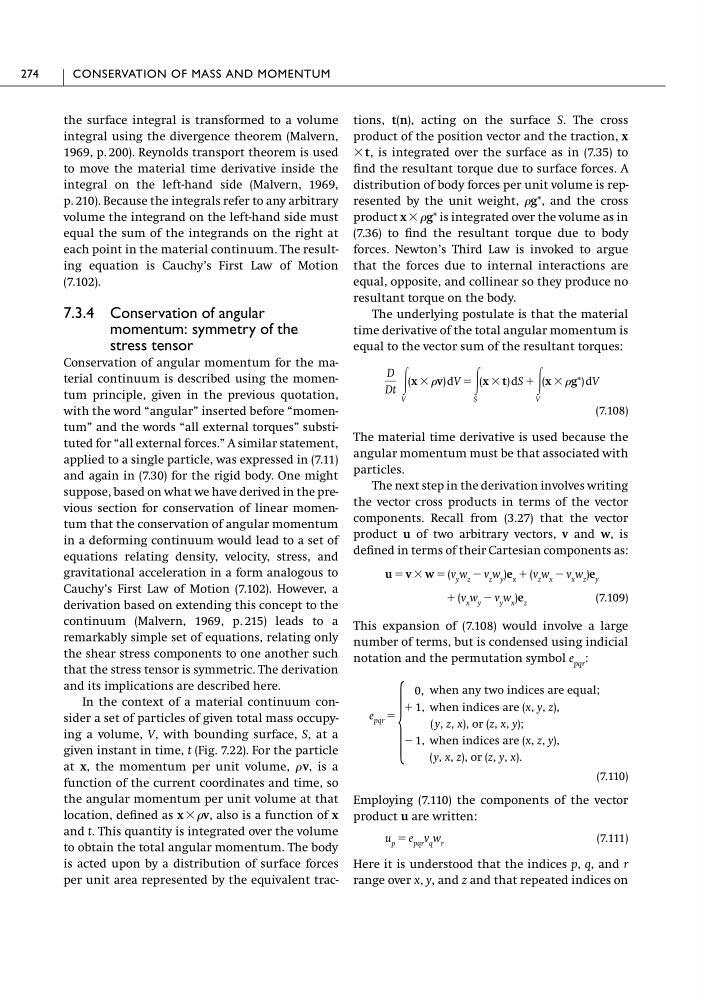
the surface integral is transformed to a volume
integral using the divergence theorem (Malvern,
1969, p. 200). Reynolds transport theorem is used
to move the material time derivative inside the
integral on the left-hand side (Malvern, 1969,
p. 210). Because the integrals refer to any arbitrary
volume the integrand on the left-hand side must
equal the sum of the integrands on the right at
each point in the material continuum. The resulting equation is Cauchy’s First Law of Motion
(7.102).
7.3.4 Conservation of angular
momentum: symmetry of the
stress tensor
Conservation of angular momentum for the material continuum is described using the momentum principle, given in the previous quotation,
with the word “angular” inserted before “momentum” and the words “all external torques” substituted for “all external forces.” A similar statement,
applied to a single particle, was expressed in (7.11)
and again in (7.30) for the rigid body. One might
suppose, based on what we have derived in the previous section for conservation of linear momentum that the conservation of angular momentum
in a deforming continuum would lead to a set of
equations relating density, velocity, stress, and
gravitational acceleration in a form analogous to
Cauchy’s First Law of Motion (7.102). However, a
derivation based on extending this concept to the
continuum (Malvern, 1969, p. 215) leads to a
remarkably simple set of equations, relating only
the shear stress components to one another such
that the stress tensor is symmetric. The derivation
and its implications are described here.
In the context of a material continuum consider a set of particles of given total mass occupying a volume, V, with bounding surface, S, at a
given instant in time, t (Fig. 7.22). For the particle
at x, the momentum per unit volume, v, is a
function of the current coordinates and time, so
the angular momentum per unit volume at that
location, defined as x ϫ v, also is a function of x
and t. This quantity is integrated over the volume
to obtain the total angular momentum. The body
is acted upon by a distribution of surface forces
per unit area represented by the equivalent tractions, t(n), acting on the surface S. The cross
product of the position vector and the traction, x
ϫ t, is integrated over the surface as in (7.35) to
find the resultant torque due to surface forces. A
distribution of body forces per unit volume is represented by the unit weight, g*, and the cross
product x ϫ g* is integrated over the volume as in
(7.36) to find the resultant torque due to body
forces. Newton’s Third Law is invoked to argue
that the forces due to internal interactions are
equal, opposite, and collinear so they produce no
resultant torque on the body.
The underlying postulate is that the material
time derivative of the total angular momentum is
equal to the vector sum of the resultant torques:
(7.108)
The material time derivative is used because the
angular momentum must be that associated with
particles.
The next step in the derivation involves writing
the vector cross products in terms of the vector
components. Recall from (3.27) that the vector
product u of two arbitrary vectors, v and w, is
defined in terms of their Cartesian components as:
(7.109)
This expansion of (7.108) would involve a large
number of terms, but is condensed using indicial
notation and the permutation symbol e pqr :
(7.110)
Employing (7.110) the components of the vector
product u are written:
(7.111)
Here it is understood that the indices p, q, and r
range over x, y, and z and that repeated indices on
u p ϭ e pqr v q w r
e pqr ϭ
Ά
0,
ϩ 1,
Ϫ 1,
when any two indices are equal;
when indices are (x, y, z),
( y, z, x), or (z, x, y);
when indices are (x, z, y),
(y, x, z), or (z, y, x).
ϩ (v x w y Ϫ v y w x )e z
u ϭ v ϫ w ϭ (v y w z Ϫ v z w y )e x ϩ (v z w x Ϫ v x w z )e y
D
Dt
Ύ
V
(x ϫ v) dV ϭ Ύ
S
(x ϫ t) dS ϩ Ύ
V
(x ϫ g*) dV
274
CONSERVATION OF MASS AND MOMENTUM
integral using the divergence theorem (Malvern,
1969, p. 200). Reynolds transport theorem is used
to move the material time derivative inside the
integral on the left-hand side (Malvern, 1969,
p. 210). Because the integrals refer to any arbitrary
volume the integrand on the left-hand side must
equal the sum of the integrands on the right at
each point in the material continuum. The resulting equation is Cauchy’s First Law of Motion
(7.102).
7.3.4 Conservation of angular
momentum: symmetry of the
stress tensor
Conservation of angular momentum for the material continuum is described using the momentum principle, given in the previous quotation,
with the word “angular” inserted before “momentum” and the words “all external torques” substituted for “all external forces.” A similar statement,
applied to a single particle, was expressed in (7.11)
and again in (7.30) for the rigid body. One might
suppose, based on what we have derived in the previous section for conservation of linear momentum that the conservation of angular momentum
in a deforming continuum would lead to a set of
equations relating density, velocity, stress, and
gravitational acceleration in a form analogous to
Cauchy’s First Law of Motion (7.102). However, a
derivation based on extending this concept to the
continuum (Malvern, 1969, p. 215) leads to a
remarkably simple set of equations, relating only
the shear stress components to one another such
that the stress tensor is symmetric. The derivation
and its implications are described here.
In the context of a material continuum consider a set of particles of given total mass occupying a volume, V, with bounding surface, S, at a
given instant in time, t (Fig. 7.22). For the particle
at x, the momentum per unit volume, v, is a
function of the current coordinates and time, so
the angular momentum per unit volume at that
location, defined as x ϫ v, also is a function of x
and t. This quantity is integrated over the volume
to obtain the total angular momentum. The body
is acted upon by a distribution of surface forces
per unit area represented by the equivalent tractions, t(n), acting on the surface S. The cross
product of the position vector and the traction, x
ϫ t, is integrated over the surface as in (7.35) to
find the resultant torque due to surface forces. A
distribution of body forces per unit volume is represented by the unit weight, g*, and the cross
product x ϫ g* is integrated over the volume as in
(7.36) to find the resultant torque due to body
forces. Newton’s Third Law is invoked to argue
that the forces due to internal interactions are
equal, opposite, and collinear so they produce no
resultant torque on the body.
The underlying postulate is that the material
time derivative of the total angular momentum is
equal to the vector sum of the resultant torques:
(7.108)
The material time derivative is used because the
angular momentum must be that associated with
particles.
The next step in the derivation involves writing
the vector cross products in terms of the vector
components. Recall from (3.27) that the vector
product u of two arbitrary vectors, v and w, is
defined in terms of their Cartesian components as:
(7.109)
This expansion of (7.108) would involve a large
number of terms, but is condensed using indicial
notation and the permutation symbol e pqr :
(7.110)
Employing (7.110) the components of the vector
product u are written:
(7.111)
Here it is understood that the indices p, q, and r
range over x, y, and z and that repeated indices on
u p ϭ e pqr v q w r
e pqr ϭ
Ά
0,
ϩ 1,
Ϫ 1,
when any two indices are equal;
when indices are (x, y, z),
( y, z, x), or (z, x, y);
when indices are (x, z, y),
(y, x, z), or (z, y, x).
ϩ (v x w y Ϫ v y w x )e z
u ϭ v ϫ w ϭ (v y w z Ϫ v z w y )e x ϩ (v z w x Ϫ v x w z )e y
D
Dt
Ύ
V
(x ϫ v) dV ϭ Ύ
S
(x ϫ t) dS ϩ Ύ
V
(x ϫ g*) dV
274
CONSERVATION OF MASS AND MOMENTUM