

the mass per unit volume times the particle acceleration. The terms on the right-hand side are the
resultant surface and body forces per unit volume.
Therefore one can interpret (7.102) as a statement
of Newton’s Second Law, ma ϭ F, set here in the
context of a deformable continuum. Again it is
important to emphasize that these equations of
motion are independent of constitutive properties so they apply to any material that can be idealized as a continuum.
One of the basic postulates of continuum
mechanics is the momentum principle (Malvern,
1969, p. 213):
the time rate of change of the total momentum of a
given set of particles equals the vector sum of all the
external forces acting on the particles of the set, provided Newton’s Third Law of action and reaction
governs the internal forces.
Recall that a similar statement, applied to a single
particle, was expressed in (7.6) and again in (7.20)
for the rigid body. In the context of a material
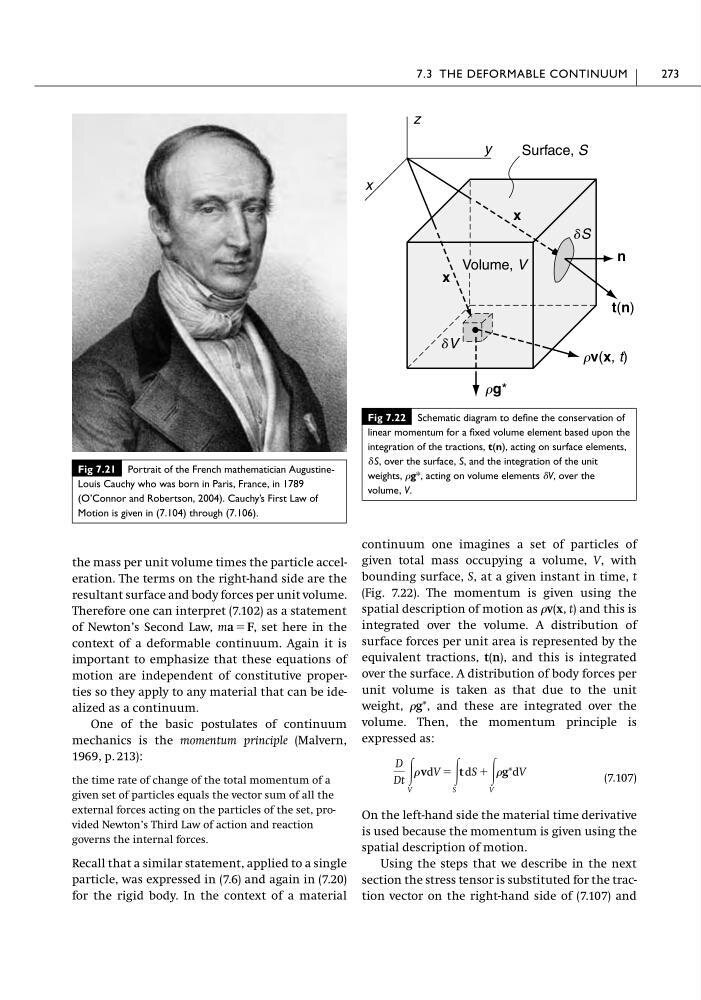
continuum one imagines a set of particles of
given total mass occupying a volume, V, with
bounding surface, S, at a given instant in time, t
(Fig. 7.22). The momentum is given using the
spatial description of motion as v(x, t) and this is
integrated over the volume. A distribution of
surface forces per unit area is represented by the
equivalent tractions, t(n), and this is integrated
over the surface. A distribution of body forces per
unit volume is taken as that due to the unit
weight, g*, and these are integrated over the
volume. Then, the momentum principle is
expressed as:
(7.107)
On the left-hand side the material time derivative
is used because the momentum is given using the
spatial description of motion.
Using the steps that we describe in the next
section the stress tensor is substituted for the traction vector on the right-hand side of (7.107) and
D
Dt Ύ
V
vdV ϭ Ύ
S
t dS ϩ Ύ
V
g*dV
7.3 THE DEFORMABLE CONTINUUM
273
Fig 7.21 Portrait of the French mathematician AugustineLouis Cauchy who was born in Paris, France, in 1789
(O’Connor and Robertson, 2004). Cauchy’s First Law of
Motion is given in (7.104) through (7.106).
Fig 7.22 Schematic diagram to define the conservation of
linear momentum for a fixed volume element based upon the
integration of the tractions, t(n), acting on surface elements,
␦S, over the surface, S, and the integration of the unit
weights, g*, acting on volume elements ␦V, over the
volume, V.
x
y
z
Surface, S
n
x
x
dS
t(n)
dV
rg*
rv(x, t)
Volume, V
resultant surface and body forces per unit volume.
Therefore one can interpret (7.102) as a statement
of Newton’s Second Law, ma ϭ F, set here in the
context of a deformable continuum. Again it is
important to emphasize that these equations of
motion are independent of constitutive properties so they apply to any material that can be idealized as a continuum.
One of the basic postulates of continuum
mechanics is the momentum principle (Malvern,
1969, p. 213):
the time rate of change of the total momentum of a
given set of particles equals the vector sum of all the
external forces acting on the particles of the set, provided Newton’s Third Law of action and reaction
governs the internal forces.
Recall that a similar statement, applied to a single
particle, was expressed in (7.6) and again in (7.20)
for the rigid body. In the context of a material
continuum one imagines a set of particles of
given total mass occupying a volume, V, with
bounding surface, S, at a given instant in time, t
(Fig. 7.22). The momentum is given using the
spatial description of motion as v(x, t) and this is
integrated over the volume. A distribution of
surface forces per unit area is represented by the
equivalent tractions, t(n), and this is integrated
over the surface. A distribution of body forces per
unit volume is taken as that due to the unit
weight, g*, and these are integrated over the
volume. Then, the momentum principle is
expressed as:
(7.107)
On the left-hand side the material time derivative
is used because the momentum is given using the
spatial description of motion.
Using the steps that we describe in the next
section the stress tensor is substituted for the traction vector on the right-hand side of (7.107) and
D
Dt Ύ
V
vdV ϭ Ύ
S
t dS ϩ Ύ
V
g*dV
7.3 THE DEFORMABLE CONTINUUM
273
Fig 7.21 Portrait of the French mathematician AugustineLouis Cauchy who was born in Paris, France, in 1789
(O’Connor and Robertson, 2004). Cauchy’s First Law of
Motion is given in (7.104) through (7.106).
Fig 7.22 Schematic diagram to define the conservation of
linear momentum for a fixed volume element based upon the
integration of the tractions, t(n), acting on surface elements,
␦S, over the surface, S, and the integration of the unit
weights, g*, acting on volume elements ␦V, over the
volume, V.
x
y
z
Surface, S
n
x
x
dS
t(n)
dV
rg*
rv(x, t)
Volume, V