

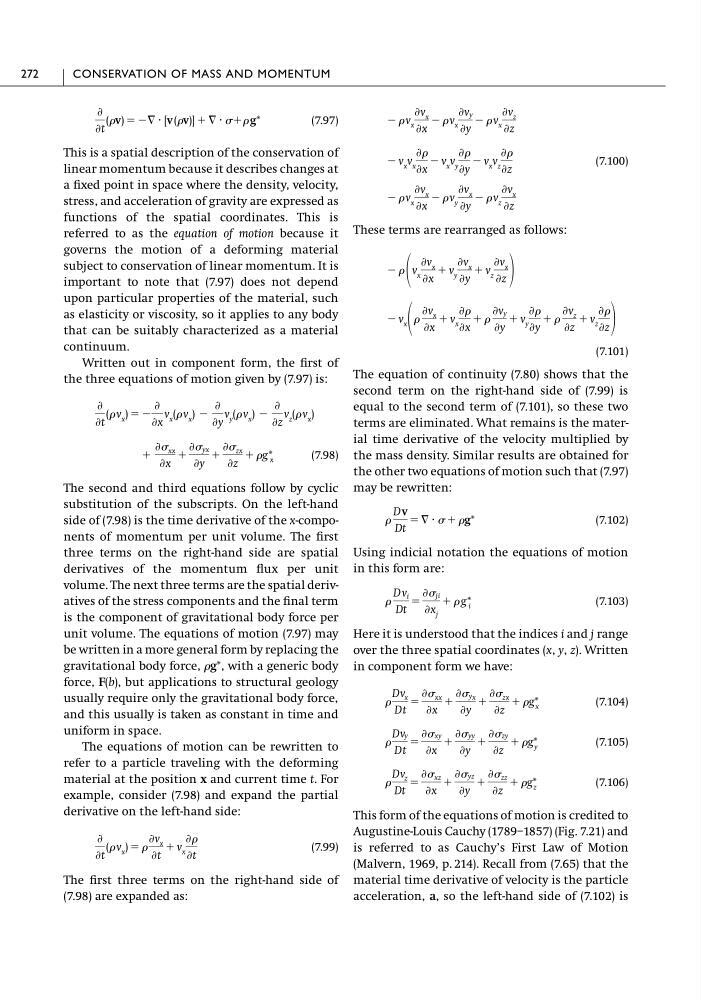
(7.97)
This is a spatial description of the conservation of
linear momentum because it describes changes at
a fixed point in space where the density, velocity,
stress, and acceleration of gravity are expressed as
functions of the spatial coordinates. This is
referred to as the equation of motion because it
governs the motion of a deforming material
subject to conservation of linear momentum. It is
important to note that (7.97) does not depend
upon particular properties of the material, such
as elasticity or viscosity, so it applies to any body
that can be suitably characterized as a material
continuum.
Written out in component form, the first of
the three equations of motion given by (7.97) is:
(7.98)
The second and third equations follow by cyclic
substitution of the subscripts. On the left-hand
side of (7.98) is the time derivative of the x-components of momentum per unit volume. The first
three terms on the right-hand side are spatial
derivatives of the momentum flux per unit
volume. The next three terms are the spatial derivatives of the stress components and the final term
is the component of gravitational body force per
unit volume. The equations of motion (7.97) may
be written in a more general form by replacing the
gravitational body force, g*, with a generic body
force, F(b), but applications to structural geology
usually require only the gravitational body force,
and this usually is taken as constant in time and
uniform in space.
The equations of motion can be rewritten to
refer to a particle traveling with the deforming
material at the position x and current time t. For
example, consider (7.98) and expand the partial
derivative on the left-hand side:
(7.99)
The first three terms on the right-hand side of
(7.98) are expanded as:
Ѩ
Ѩt
( v x ) ϭ
Ѩv x
Ѩt
ϩ v x
Ѩ
Ѩt
ϩ
Ѩ xx
Ѩx
ϩ
Ѩ yx
Ѩy
ϩ
Ѩ zx
Ѩz
ϩ g* x
Ѩ
Ѩt
( v x ) ϭ Ϫ
Ѩ
Ѩx
v x ( v x ) Ϫ
Ѩ
Ѩy
v y ( v x ) Ϫ
Ѩ
Ѩz
v z ( v x )
Ѩ
Ѩt
(v) ϭ Ϫٌ · [v (v)] ϩ ٌ · ϩ g*
(7.100)
These terms are rearranged as follows:
(7.101)
The equation of continuity (7.80) shows that the
second term on the right-hand side of (7.99) is
equal to the second term of (7.101), so these two
terms are eliminated. What remains is the material time derivative of the velocity multiplied by
the mass density. Similar results are obtained for
the other two equations of motion such that (7.97)
may be rewritten:
(7.102)
Using indicial notation the equations of motion
in this form are:
(7.103)
Here it is understood that the indices i and j range
over the three spatial coordinates (x, y, z). Written
in component form we have:
(7.104)
(7.105)
(7.106)
This form of the equations of motion is credited to
Augustine-Louis Cauchy (1789–1857) (Fig. 7.21) and
is referred to as Cauchy’s First Law of Motion
(Malvern, 1969, p. 214). Recall from (7.65) that the
material time derivative of velocity is the particle
acceleration, a, so the left-hand side of (7.102) is
Dv z
Dt
ϭ
Ѩ xz
Ѩx
ϩ
Ѩyz
Ѩy
ϩ
Ѩ zz
Ѩz
ϩ g* z
Dvy
Dt
ϭ
Ѩxy
Ѩx
ϩ
Ѩyy
Ѩy
ϩ
Ѩzy
Ѩz
ϩ g* y
Dv x
Dt
ϭ
Ѩ xx
Ѩx
ϩ
Ѩ yx
Ѩy
ϩ
Ѩ zx
Ѩz
ϩ g* x
D v i
Dt
ϭ
Ѩ ji
Ѩx j
ϩ g* i
D v
Dt
ϭ ٌ · ϩ g*
Ϫ v x
Ѩv x
Ѩx
ϩ v x
Ѩ
Ѩx
ϩ
Ѩv y
Ѩy
ϩ v y
Ѩ
Ѩy
ϩ
Ѩv z
Ѩz
ϩ v z
Ѩ
Ѩz
Ϫ
v x
Ѩv x
Ѩx
ϩ v y
Ѩv x
Ѩy
ϩ v z
Ѩv x
Ѩz
Ϫ v x
Ѩv x
Ѩx
Ϫ v y
Ѩv x
Ѩy
Ϫ v z
Ѩv x
Ѩz
Ϫ v x v x
Ѩ
Ѩx
Ϫ v x v y
Ѩ
Ѩy
Ϫ v x v z
Ѩ
Ѩz
Ϫ v x
Ѩv x
Ѩx
Ϫ v x
Ѩv y
Ѩy
Ϫ v x
Ѩv z
Ѩz
272
CONSERVATION OF MASS AND MOMENTUM
This is a spatial description of the conservation of
linear momentum because it describes changes at
a fixed point in space where the density, velocity,
stress, and acceleration of gravity are expressed as
functions of the spatial coordinates. This is
referred to as the equation of motion because it
governs the motion of a deforming material
subject to conservation of linear momentum. It is
important to note that (7.97) does not depend
upon particular properties of the material, such
as elasticity or viscosity, so it applies to any body
that can be suitably characterized as a material
continuum.
Written out in component form, the first of
the three equations of motion given by (7.97) is:
(7.98)
The second and third equations follow by cyclic
substitution of the subscripts. On the left-hand
side of (7.98) is the time derivative of the x-components of momentum per unit volume. The first
three terms on the right-hand side are spatial
derivatives of the momentum flux per unit
volume. The next three terms are the spatial derivatives of the stress components and the final term
is the component of gravitational body force per
unit volume. The equations of motion (7.97) may
be written in a more general form by replacing the
gravitational body force, g*, with a generic body
force, F(b), but applications to structural geology
usually require only the gravitational body force,
and this usually is taken as constant in time and
uniform in space.
The equations of motion can be rewritten to
refer to a particle traveling with the deforming
material at the position x and current time t. For
example, consider (7.98) and expand the partial
derivative on the left-hand side:
(7.99)
The first three terms on the right-hand side of
(7.98) are expanded as:
Ѩ
Ѩt
( v x ) ϭ
Ѩv x
Ѩt
ϩ v x
Ѩ
Ѩt
ϩ
Ѩ xx
Ѩx
ϩ
Ѩ yx
Ѩy
ϩ
Ѩ zx
Ѩz
ϩ g* x
Ѩ
Ѩt
( v x ) ϭ Ϫ
Ѩ
Ѩx
v x ( v x ) Ϫ
Ѩ
Ѩy
v y ( v x ) Ϫ
Ѩ
Ѩz
v z ( v x )
Ѩ
Ѩt
(v) ϭ Ϫٌ · [v (v)] ϩ ٌ · ϩ g*
(7.100)
These terms are rearranged as follows:
(7.101)
The equation of continuity (7.80) shows that the
second term on the right-hand side of (7.99) is
equal to the second term of (7.101), so these two
terms are eliminated. What remains is the material time derivative of the velocity multiplied by
the mass density. Similar results are obtained for
the other two equations of motion such that (7.97)
may be rewritten:
(7.102)
Using indicial notation the equations of motion
in this form are:
(7.103)
Here it is understood that the indices i and j range
over the three spatial coordinates (x, y, z). Written
in component form we have:
(7.104)
(7.105)
(7.106)
This form of the equations of motion is credited to
Augustine-Louis Cauchy (1789–1857) (Fig. 7.21) and
is referred to as Cauchy’s First Law of Motion
(Malvern, 1969, p. 214). Recall from (7.65) that the
material time derivative of velocity is the particle
acceleration, a, so the left-hand side of (7.102) is
Dv z
Dt
ϭ
Ѩ xz
Ѩx
ϩ
Ѩyz
Ѩy
ϩ
Ѩ zz
Ѩz
ϩ g* z
Dvy
Dt
ϭ
Ѩxy
Ѩx
ϩ
Ѩyy
Ѩy
ϩ
Ѩzy
Ѩz
ϩ g* y
Dv x
Dt
ϭ
Ѩ xx
Ѩx
ϩ
Ѩ yx
Ѩy
ϩ
Ѩ zx
Ѩz
ϩ g* x
D v i
Dt
ϭ
Ѩ ji
Ѩx j
ϩ g* i
D v
Dt
ϭ ٌ · ϩ g*
Ϫ v x
Ѩv x
Ѩx
ϩ v x
Ѩ
Ѩx
ϩ
Ѩv y
Ѩy
ϩ v y
Ѩ
Ѩy
ϩ
Ѩv z
Ѩz
ϩ v z
Ѩ
Ѩz
Ϫ
v x
Ѩv x
Ѩx
ϩ v y
Ѩv x
Ѩy
ϩ v z
Ѩv x
Ѩz
Ϫ v x
Ѩv x
Ѩx
Ϫ v y
Ѩv x
Ѩy
Ϫ v z
Ѩv x
Ѩz
Ϫ v x v x
Ѩ
Ѩx
Ϫ v x v y
Ѩ
Ѩy
Ϫ v x v z
Ѩ
Ѩz
Ϫ v x
Ѩv x
Ѩx
Ϫ v x
Ѩv y
Ѩy
Ϫ v x
Ѩv z
Ѩz
272
CONSERVATION OF MASS AND MOMENTUM