

terparts by the volume of the element and using
the del operator:
(7.91)
This vector accounts for the first and second terms
on the right-hand side of (7.84).
The final term to evaluate in (7.84) is the
resultant force. The resultant surface force in
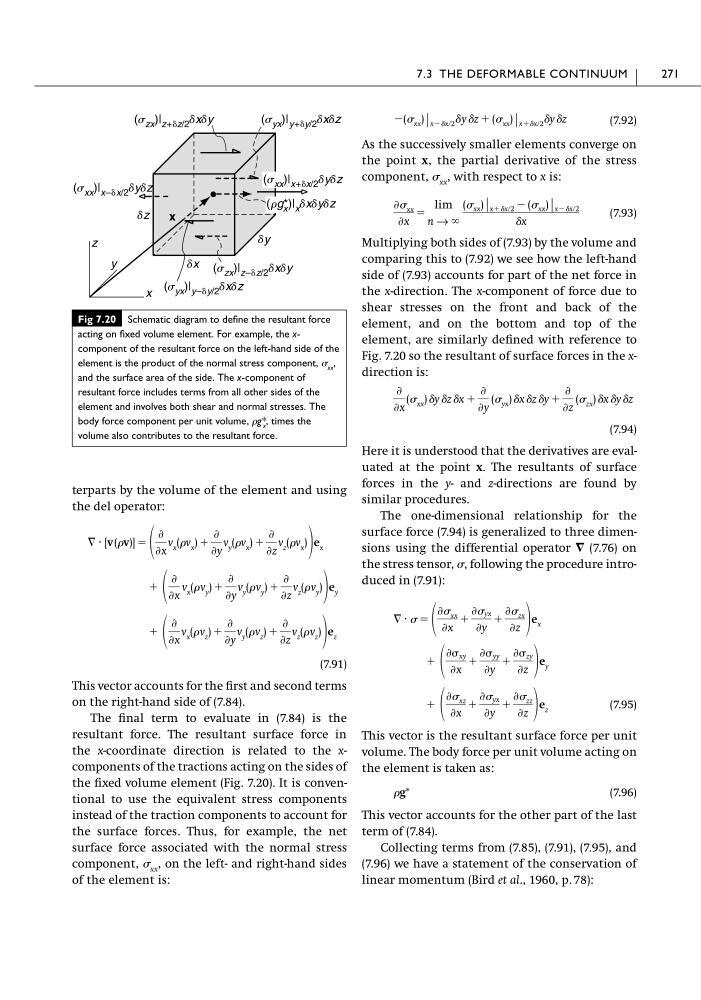
the x-coordinate direction is related to the xcomponents of the tractions acting on the sides of
the fixed volume element (Fig. 7.20). It is conventional to use the equivalent stress components
instead of the traction components to account for
the surface forces. Thus, for example, the net
surface force associated with the normal stress
component, xx , on the left- and right-hand sides
of the element is:
ϩ
Ѩ
Ѩx
v x (v z ) ϩ
Ѩ
Ѩy
v y (v z ) ϩ
Ѩ
Ѩz
v z (v z ) e z
ϩ
Ѩ
Ѩx
v x (v y ) ϩ
Ѩ
Ѩy
v y (v y ) ϩ
Ѩ
Ѩz
v z (v y )
e y
ٌ · [v (v)] ϭ
Ѩ
Ѩx
v x (v x ) ϩ
Ѩ
Ѩy
v y (v x ) ϩ
Ѩ
Ѩz
v z (v x )
e x
(7.92)
As the successively smaller elements converge on
the point x, the partial derivative of the stress
component, xx , with respect to x is:
(7.93)
Multiplying both sides of (7.93) by the volume and
comparing this to (7.92) we see how the left-hand
side of (7.93) accounts for part of the net force in
the x-direction. The x-component of force due to
shear stresses on the front and back of the
element, and on the bottom and top of the
element, are similarly defined with reference to
Fig. 7.20 so the resultant of surface forces in the xdirection is:
(7.94)
Here it is understood that the derivatives are evaluated at the point x. The resultants of surface
forces in the y- and z-directions are found by
similar procedures.
The one-dimensional relationship for the
surface force (7.94) is generalized to three dimensions using the differential operator ١ (7.76) on
the stress tensor, , following the procedure introduced in (7.91):
(7.95)
This vector is the resultant surface force per unit
volume. The body force per unit volume acting on
the element is taken as:
(7.96)
This vector accounts for the other part of the last
term of (7.84).
Collecting terms from (7.85), (7.91), (7.95), and
(7.96) we have a statement of the conservation of
linear momentum (Bird et al., 1960, p. 78):
g*
ϩ
Ѩ xz
Ѩx
ϩ
Ѩ yx
Ѩy
ϩ
Ѩ zz
Ѩz e z
ϩ
Ѩ xy
Ѩx
ϩ
Ѩ yy
Ѩy
ϩ
Ѩ zy
Ѩz e y
ٌ · ϭ
Ѩ xx
Ѩx
ϩ
Ѩ yx
Ѩy
ϩ
Ѩ zx
Ѩz
e x
Ѩ
Ѩx
( xx ) ␦y ␦z ␦x ϩ
Ѩ
Ѩy
( yx ) ␦x ␦z ␦y ϩ
Ѩ
Ѩz
( zx ) ␦x ␦y ␦z
Ѩ xx
Ѩx
ϭ
lim
n → ϱ
( xx ) | xϩ␦xր2 Ϫ ( xx ) | xϪ␦xր2
␦x
Ϫ( xx ) | xϪ␦xր2 ␦y ␦z ϩ ( xx ) | xϩ␦xր2 ␦y ␦z
7.3 THE DEFORMABLE CONTINUUM
271
Fig 7.20 Schematic diagram to define the resultant force
acting on fixed volume element. For example, the xcomponent of the resultant force on the left-hand side of the
element is the product of the normal stress component, xx ,
and the surface area of the side. The x-component of
resultant force includes terms from all other sides of the
element and involves both shear and normal stresses. The
body force component per unit volume, g* x , times the
volume also contributes to the resultant force.
(s xx )| x–␦x/2 dydz
(s zx )| z–␦z/2 dxdy
(s zx )| z+␦z/2 dxdy
(s yx )| y+␦y/2 dxdz
(s yx )| y–␦y/2 dxdz
x
y
z
dy
x
dz
dx
(s xx )| x+␦x/2 dydz
(rg*)| x dxdydz
x
the del operator:
(7.91)
This vector accounts for the first and second terms
on the right-hand side of (7.84).
The final term to evaluate in (7.84) is the
resultant force. The resultant surface force in
the x-coordinate direction is related to the xcomponents of the tractions acting on the sides of
the fixed volume element (Fig. 7.20). It is conventional to use the equivalent stress components
instead of the traction components to account for
the surface forces. Thus, for example, the net
surface force associated with the normal stress
component, xx , on the left- and right-hand sides
of the element is:
ϩ
Ѩ
Ѩx
v x (v z ) ϩ
Ѩ
Ѩy
v y (v z ) ϩ
Ѩ
Ѩz
v z (v z ) e z
ϩ
Ѩ
Ѩx
v x (v y ) ϩ
Ѩ
Ѩy
v y (v y ) ϩ
Ѩ
Ѩz
v z (v y )
e y
ٌ · [v (v)] ϭ
Ѩ
Ѩx
v x (v x ) ϩ
Ѩ
Ѩy
v y (v x ) ϩ
Ѩ
Ѩz
v z (v x )
e x
(7.92)
As the successively smaller elements converge on
the point x, the partial derivative of the stress
component, xx , with respect to x is:
(7.93)
Multiplying both sides of (7.93) by the volume and
comparing this to (7.92) we see how the left-hand
side of (7.93) accounts for part of the net force in
the x-direction. The x-component of force due to
shear stresses on the front and back of the
element, and on the bottom and top of the
element, are similarly defined with reference to
Fig. 7.20 so the resultant of surface forces in the xdirection is:
(7.94)
Here it is understood that the derivatives are evaluated at the point x. The resultants of surface
forces in the y- and z-directions are found by
similar procedures.
The one-dimensional relationship for the
surface force (7.94) is generalized to three dimensions using the differential operator ١ (7.76) on
the stress tensor, , following the procedure introduced in (7.91):
(7.95)
This vector is the resultant surface force per unit
volume. The body force per unit volume acting on
the element is taken as:
(7.96)
This vector accounts for the other part of the last
term of (7.84).
Collecting terms from (7.85), (7.91), (7.95), and
(7.96) we have a statement of the conservation of
linear momentum (Bird et al., 1960, p. 78):
g*
ϩ
Ѩ xz
Ѩx
ϩ
Ѩ yx
Ѩy
ϩ
Ѩ zz
Ѩz e z
ϩ
Ѩ xy
Ѩx
ϩ
Ѩ yy
Ѩy
ϩ
Ѩ zy
Ѩz e y
ٌ · ϭ
Ѩ xx
Ѩx
ϩ
Ѩ yx
Ѩy
ϩ
Ѩ zx
Ѩz
e x
Ѩ
Ѩx
( xx ) ␦y ␦z ␦x ϩ
Ѩ
Ѩy
( yx ) ␦x ␦z ␦y ϩ
Ѩ
Ѩz
( zx ) ␦x ␦y ␦z
Ѩ xx
Ѩx
ϭ
lim
n → ϱ
( xx ) | xϩ␦xր2 Ϫ ( xx ) | xϪ␦xր2
␦x
Ϫ( xx ) | xϪ␦xր2 ␦y ␦z ϩ ( xx ) | xϩ␦xր2 ␦y ␦z
7.3 THE DEFORMABLE CONTINUUM
271
Fig 7.20 Schematic diagram to define the resultant force
acting on fixed volume element. For example, the xcomponent of the resultant force on the left-hand side of the
element is the product of the normal stress component, xx ,
and the surface area of the side. The x-component of
resultant force includes terms from all other sides of the
element and involves both shear and normal stresses. The
body force component per unit volume, g* x , times the
volume also contributes to the resultant force.
(s xx )| x–␦x/2 dydz
(s zx )| z–␦z/2 dxdy
(s zx )| z+␦z/2 dxdy
(s yx )| y+␦y/2 dxdz
(s yx )| y–␦y/2 dxdz
x
y
z
dy
x
dz
dx
(s xx )| x+␦x/2 dydz
(rg*)| x dxdydz
x