

(b)
0
y
(x, y)
v
x
x
(a)
In contrast to the referential description of
motion, particle paths are not a primary feature
of the spatial description, and the initial positions
of particles usually are not defined. For example,
the initial positions of the phenocrysts in the
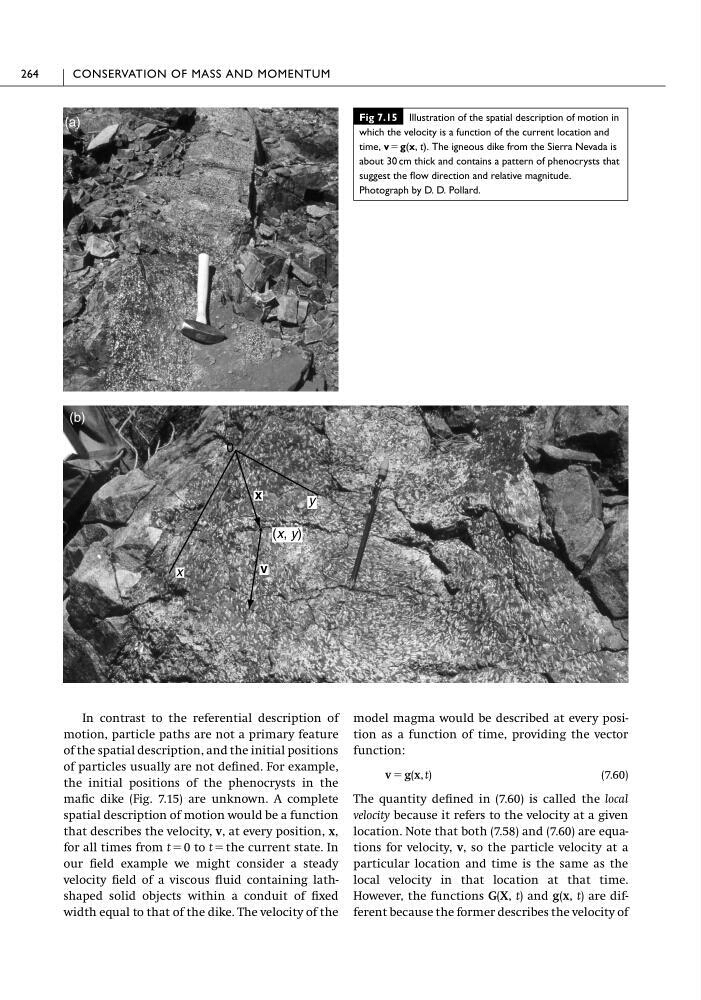
mafic dike (Fig. 7.15) are unknown. A complete
spatial description of motion would be a function
that describes the velocity, v, at every position, x,
for all times from t ϭ 0 to t ϭ the current state. In
our field example we might consider a steady
velocity field of a viscous fluid containing lathshaped solid objects within a conduit of fixed
width equal to that of the dike. The velocity of the
model magma would be described at every position as a function of time, providing the vector
function:
(7.60)
The quantity defined in (7.60) is called the local
velocity because it refers to the velocity at a given
location. Note that both (7.58) and (7.60) are equations for velocity, v, so the particle velocity at a
particular location and time is the same as the
local velocity in that location at that time.
However, the functions G(X, t) and g(x, t) are different because the former describes the velocity of
v ϭ g(x, t)
264
CONSERVATION OF MASS AND MOMENTUM
Fig 7.15 Illustration of the spatial description of motion in
which the velocity is a function of the current location and
time, vϭg(x, t). The igneous dike from the Sierra Nevada is
about 30 cm thick and contains a pattern of phenocrysts that
suggest the flow direction and relative magnitude.
Photograph by D. D. Pollard.
0
y
(x, y)
v
x
x
(a)
In contrast to the referential description of
motion, particle paths are not a primary feature
of the spatial description, and the initial positions
of particles usually are not defined. For example,
the initial positions of the phenocrysts in the
mafic dike (Fig. 7.15) are unknown. A complete
spatial description of motion would be a function
that describes the velocity, v, at every position, x,
for all times from t ϭ 0 to t ϭ the current state. In
our field example we might consider a steady
velocity field of a viscous fluid containing lathshaped solid objects within a conduit of fixed
width equal to that of the dike. The velocity of the
model magma would be described at every position as a function of time, providing the vector
function:
(7.60)
The quantity defined in (7.60) is called the local
velocity because it refers to the velocity at a given
location. Note that both (7.58) and (7.60) are equations for velocity, v, so the particle velocity at a
particular location and time is the same as the
local velocity in that location at that time.
However, the functions G(X, t) and g(x, t) are different because the former describes the velocity of
v ϭ g(x, t)
264
CONSERVATION OF MASS AND MOMENTUM
Fig 7.15 Illustration of the spatial description of motion in
which the velocity is a function of the current location and
time, vϭg(x, t). The igneous dike from the Sierra Nevada is
about 30 cm thick and contains a pattern of phenocrysts that
suggest the flow direction and relative magnitude.
Photograph by D. D. Pollard.