

mechanical inference is that the faulting can be
described by elastic deformation, specifically the
displacement field relating the initial and current
states. We do not suppose that the offset aplite
dike would return to its initial configuration if
the rock mass were excised from the Sierra
Nevada today and all external loads relaxed. This
supposition ignores the loading that existed
before faulting and the mechanical behavior of
the rock mass over the ϳ80 million years since the
faulting event. Rather, we suppose that the deformation at the time of faulting is adequately
described as elastic. This supposition is supported
by modern studies of deformation associated with
active faulting and by laboratory studies of the
constitutive properties of rock.
Taking the coordinates (X, Y, Z) and time, t, as
the independent variables, we develop the socalled referential description of motion (Malvern,
1969). At the time just prior to t ϭ 0 the particles
of rock are in their initial configuration around
the un-slipped fault (Fig. 7.13b), which is in
mechanical equilibrium with respect to the preexisting loads. Under the prescribed change in
surface and/or body forces initiated at time t ϭ 0,
the particles displace to their current coordinates
such that:
(7.57)
Recall that the x (or x, y, and z) on the left-hand
sides of these equations is the value of the function whereas the same symbols on the right-hand
sides signify the function itself. After some
unknown duration of time, slip ceased on the fault
and the configuration of particles attained that
seen in the exposure today (Fig. 7.13a). The position
vector x locates the particle in the current state
that was located by the position vector X in the
initial state. This is called the referential description of motion because it refers back to the initial
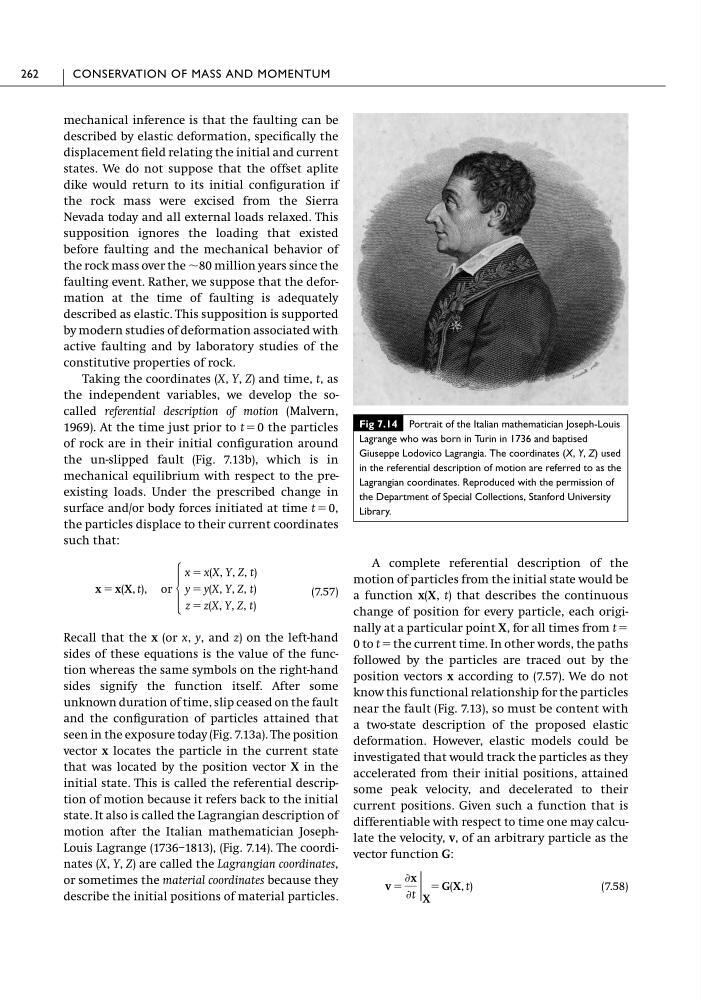
state. It also is called the Lagrangian description of
motion after the Italian mathematician JosephLouis Lagrange (1736–1813), (Fig. 7.14). The coordinates (X, Y, Z) are called the Lagrangian coordinates,
or sometimes the material coordinates because they
describe the initial positions of material particles.
x ϭ x(X, t), or
Ά
x ϭ x(X, Y, Z, t)
y ϭ y(X, Y, Z, t)
z ϭ z(X, Y, Z, t)
A complete referential description of the
motion of particles from the initial state would be
a function x(X, t) that describes the continuous
change of position for every particle, each originally at a particular point X, for all times from t ϭ
0 to t ϭ the current time. In other words, the paths
followed by the particles are traced out by the
position vectors x according to (7.57). We do not
know this functional relationship for the particles
near the fault (Fig. 7.13), so must be content with
a two-state description of the proposed elastic
deformation. However, elastic models could be
investigated that would track the particles as they
accelerated from their initial positions, attained
some peak velocity, and decelerated to their
current positions. Given such a function that is
differentiable with respect to time one may calculate the velocity, v, of an arbitrary particle as the
vector function G:
(7.58)
v ϭ
Ѩx
Ѩt | X
ϭ G(X, t)
262
CONSERVATION OF MASS AND MOMENTUM
Fig 7.14 Portrait of the Italian mathematician Joseph-Louis
Lagrange who was born in Turin in 1736 and baptised
Giuseppe Lodovico Lagrangia. The coordinates (X, Y, Z) used
in the referential description of motion are referred to as the
Lagrangian coordinates. Reproduced with the permission of
the Department of Special Collections, Stanford University
Library.
described by elastic deformation, specifically the
displacement field relating the initial and current
states. We do not suppose that the offset aplite
dike would return to its initial configuration if
the rock mass were excised from the Sierra
Nevada today and all external loads relaxed. This
supposition ignores the loading that existed
before faulting and the mechanical behavior of
the rock mass over the ϳ80 million years since the
faulting event. Rather, we suppose that the deformation at the time of faulting is adequately
described as elastic. This supposition is supported
by modern studies of deformation associated with
active faulting and by laboratory studies of the
constitutive properties of rock.
Taking the coordinates (X, Y, Z) and time, t, as
the independent variables, we develop the socalled referential description of motion (Malvern,
1969). At the time just prior to t ϭ 0 the particles
of rock are in their initial configuration around
the un-slipped fault (Fig. 7.13b), which is in
mechanical equilibrium with respect to the preexisting loads. Under the prescribed change in
surface and/or body forces initiated at time t ϭ 0,
the particles displace to their current coordinates
such that:
(7.57)
Recall that the x (or x, y, and z) on the left-hand
sides of these equations is the value of the function whereas the same symbols on the right-hand
sides signify the function itself. After some
unknown duration of time, slip ceased on the fault
and the configuration of particles attained that
seen in the exposure today (Fig. 7.13a). The position
vector x locates the particle in the current state
that was located by the position vector X in the
initial state. This is called the referential description of motion because it refers back to the initial
state. It also is called the Lagrangian description of
motion after the Italian mathematician JosephLouis Lagrange (1736–1813), (Fig. 7.14). The coordinates (X, Y, Z) are called the Lagrangian coordinates,
or sometimes the material coordinates because they
describe the initial positions of material particles.
x ϭ x(X, t), or
Ά
x ϭ x(X, Y, Z, t)
y ϭ y(X, Y, Z, t)
z ϭ z(X, Y, Z, t)
A complete referential description of the
motion of particles from the initial state would be
a function x(X, t) that describes the continuous
change of position for every particle, each originally at a particular point X, for all times from t ϭ
0 to t ϭ the current time. In other words, the paths
followed by the particles are traced out by the
position vectors x according to (7.57). We do not
know this functional relationship for the particles
near the fault (Fig. 7.13), so must be content with
a two-state description of the proposed elastic
deformation. However, elastic models could be
investigated that would track the particles as they
accelerated from their initial positions, attained
some peak velocity, and decelerated to their
current positions. Given such a function that is
differentiable with respect to time one may calculate the velocity, v, of an arbitrary particle as the
vector function G:
(7.58)
v ϭ
Ѩx
Ѩt | X
ϭ G(X, t)
262
CONSERVATION OF MASS AND MOMENTUM
Fig 7.14 Portrait of the Italian mathematician Joseph-Louis
Lagrange who was born in Turin in 1736 and baptised
Giuseppe Lodovico Lagrangia. The coordinates (X, Y, Z) used
in the referential description of motion are referred to as the
Lagrangian coordinates. Reproduced with the permission of
the Department of Special Collections, Stanford University
Library.