

of a particle in the initial state, and (x, y, z) are the
coordinates of a particle in the current state (Fig. 5.6).
The coordinates (X, Y, Z) are components of the position vector X and (x, y, z) are components of x. The
two sets of coordinates usually are measured with
respect to the same origin and axes. Each coordinate in the current state is given by the sum of the
respective coordinate in the initial state and the
corresponding component of the displacement
vector, u:
(7.56)
In this and subsequent chapters we consider
deformation primarily in the context of either an
elastic solid or a viscous fluid. While the chosen
coordinates are independent of material properties, the theories of elastic solid mechanics and
viscous fluid mechanics have been developed
from quite different points of view. In this section
we consider how these different points of view
impact the analytical descriptions of motion and
develop concepts that are used in subsequent sections to apply the principles of conservation of
mass and momentum to a material continuum.
The deformation of an elastic solid is viewed
with the initial state taken as the reference. In an
engineering context this state usually is associated with zero external loads. In other words
there are no surface or body forces acting on the
elastic solid. Then, a given loading is applied, and
the particles displace to the current positions: it is
understood that they return to the initial positions when all the loads are removed. Because the
configuration of particles changes with time as
the loading changes, but always returns to the
initial state upon unloading, this unloaded condition is thought of as the natural state of the
elastic body. In the geological context the initial
state may be quite arbitrarily chosen and usually
is associated with a pre-existing loading condition
involving both surface and body forces. Displacements corresponding to this loading condition
are undefined. One then considers some change
of loading and the corresponding displacement
of particles to their current positions. If the
loading reverts to that of the initial state these
x ϭ X ϩ u,or
Ά
x ϭ X ϩ u x
y ϭ Y ϩ u y
z ϭ Z ϩ u z
displacements go to zero and the particles return
to the initial positions.
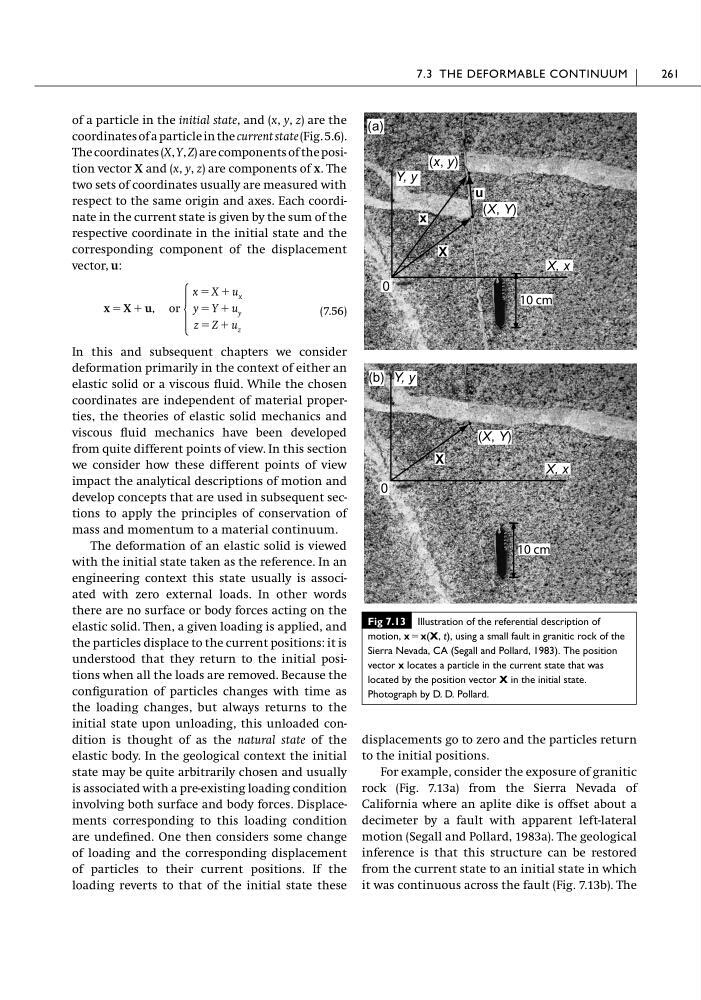
For example, consider the exposure of granitic
rock (Fig. 7.13a) from the Sierra Nevada of
California where an aplite dike is offset about a
decimeter by a fault with apparent left-lateral
motion (Segall and Pollard, 1983a). The geological
inference is that this structure can be restored
from the current state to an initial state in which
it was continuous across the fault (Fig. 7.13b). The
7.3 THE DEFORMABLE CONTINUUM
261
Fig 7.13 Illustration of the referential description of
motion, xϭx(X, t), using a small fault in granitic rock of the
Sierra Nevada, CA (Segall and Pollard, 1983). The position
vector x locates a particle in the current state that was
located by the position vector X in the initial state.
Photograph by D. D. Pollard.
(b) Y, y
X, x
X
10 cm
(a)
X
(X, Y)
x
u
10 cm
(x, y)
(X, Y)
X, x
Y, y
0
0
coordinates of a particle in the current state (Fig. 5.6).
The coordinates (X, Y, Z) are components of the position vector X and (x, y, z) are components of x. The
two sets of coordinates usually are measured with
respect to the same origin and axes. Each coordinate in the current state is given by the sum of the
respective coordinate in the initial state and the
corresponding component of the displacement
vector, u:
(7.56)
In this and subsequent chapters we consider
deformation primarily in the context of either an
elastic solid or a viscous fluid. While the chosen
coordinates are independent of material properties, the theories of elastic solid mechanics and
viscous fluid mechanics have been developed
from quite different points of view. In this section
we consider how these different points of view
impact the analytical descriptions of motion and
develop concepts that are used in subsequent sections to apply the principles of conservation of
mass and momentum to a material continuum.
The deformation of an elastic solid is viewed
with the initial state taken as the reference. In an
engineering context this state usually is associated with zero external loads. In other words
there are no surface or body forces acting on the
elastic solid. Then, a given loading is applied, and
the particles displace to the current positions: it is
understood that they return to the initial positions when all the loads are removed. Because the
configuration of particles changes with time as
the loading changes, but always returns to the
initial state upon unloading, this unloaded condition is thought of as the natural state of the
elastic body. In the geological context the initial
state may be quite arbitrarily chosen and usually
is associated with a pre-existing loading condition
involving both surface and body forces. Displacements corresponding to this loading condition
are undefined. One then considers some change
of loading and the corresponding displacement
of particles to their current positions. If the
loading reverts to that of the initial state these
x ϭ X ϩ u,or
Ά
x ϭ X ϩ u x
y ϭ Y ϩ u y
z ϭ Z ϩ u z
displacements go to zero and the particles return
to the initial positions.
For example, consider the exposure of granitic
rock (Fig. 7.13a) from the Sierra Nevada of
California where an aplite dike is offset about a
decimeter by a fault with apparent left-lateral
motion (Segall and Pollard, 1983a). The geological
inference is that this structure can be restored
from the current state to an initial state in which
it was continuous across the fault (Fig. 7.13b). The
7.3 THE DEFORMABLE CONTINUUM
261
Fig 7.13 Illustration of the referential description of
motion, xϭx(X, t), using a small fault in granitic rock of the
Sierra Nevada, CA (Segall and Pollard, 1983). The position
vector x locates a particle in the current state that was
located by the position vector X in the initial state.
Photograph by D. D. Pollard.
(b) Y, y
X, x
X
10 cm
(a)
X
(X, Y)
x
u
10 cm
(x, y)
(X, Y)
X, x
Y, y
0
0