

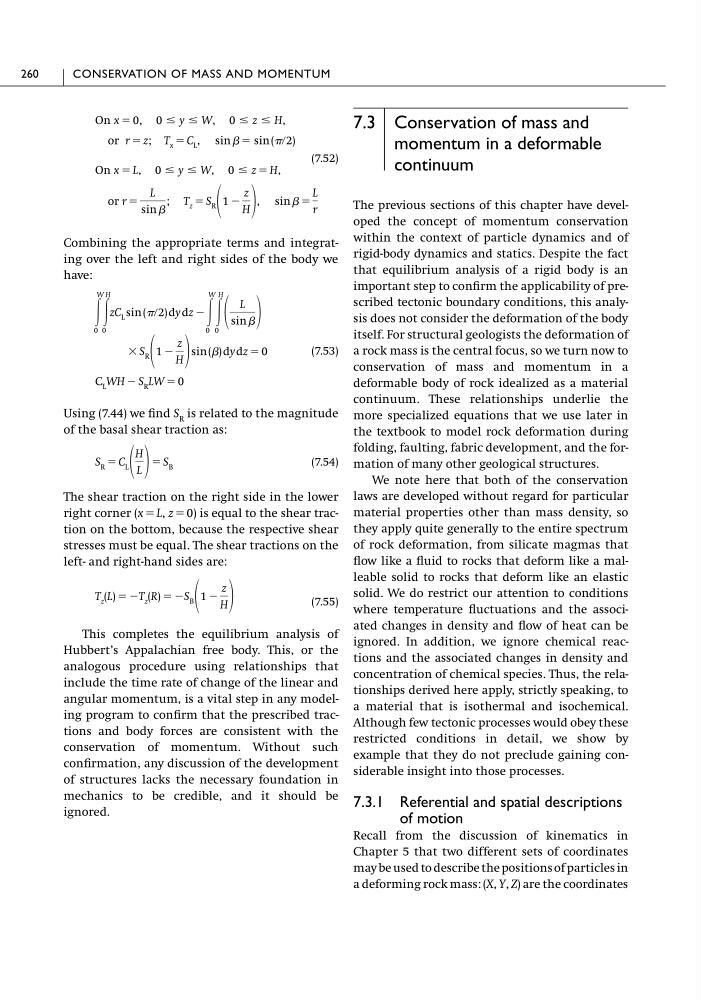
(7.52)
Combining the appropriate terms and integrating over the left and right sides of the body we
have:
(7.53)
Using (7.44) we find S R is related to the magnitude
of the basal shear traction as:
(7.54)
The shear traction on the right side in the lower
right corner (x ϭ L, z ϭ 0) is equal to the shear traction on the bottom, because the respective shear
stresses must be equal. The shear tractions on the
left- and right-hand sides are:
(7.55)
This completes the equilibrium analysis of
Hubbert’s Appalachian free body. This, or the
analogous procedure using relationships that
include the time rate of change of the linear and
angular momentum, is a vital step in any modeling program to confirm that the prescribed tractions and body forces are consistent with the
conservation of momentum. Without such
confirmation, any discussion of the development
of structures lacks the necessary foundation in
mechanics to be credible, and it should be
ignored.
T z (L) ϭ ϪT z (R) ϭ ϪS B 1 Ϫ
z
H
S R ϭ C L
H
L
ϭ S B
C L WH Ϫ S R LW ϭ 0
ϫ S R
1 Ϫ
z
H
sin () dy dz ϭ 0
Ύ
W
0
Ύ
H
0
zC L sin (ր2) dy dz Ϫ Ύ
W
0
Ύ
H
0
L
sin 
or r ϭ
L
sin 
; T z ϭ S R 1 Ϫ
z
H , sin  ϭ
L
r
On x ϭ L, 0 Յ y Յ W, 0 Յ z ϭ H,
or r ϭ z; T x ϭ C L , sin  ϭ sin (ր2)
On x ϭ 0, 0 Յ y Յ W, 0 Յ z Յ H,
7.3 Conservation of mass and
momentum in a deformable
continuum
The previous sections of this chapter have developed the concept of momentum conservation
within the context of particle dynamics and of
rigid-body dynamics and statics. Despite the fact
that equilibrium analysis of a rigid body is an
important step to confirm the applicability of prescribed tectonic boundary conditions, this analysis does not consider the deformation of the body
itself. For structural geologists the deformation of
a rock mass is the central focus, so we turn now to
conservation of mass and momentum in a
deformable body of rock idealized as a material
continuum. These relationships underlie the
more specialized equations that we use later in
the textbook to model rock deformation during
folding, faulting, fabric development, and the formation of many other geological structures.
We note here that both of the conservation
laws are developed without regard for particular
material properties other than mass density, so
they apply quite generally to the entire spectrum
of rock deformation, from silicate magmas that
flow like a fluid to rocks that deform like a malleable solid to rocks that deform like an elastic
solid. We do restrict our attention to conditions
where temperature fluctuations and the associated changes in density and flow of heat can be
ignored. In addition, we ignore chemical reactions and the associated changes in density and
concentration of chemical species. Thus, the relationships derived here apply, strictly speaking, to
a material that is isothermal and isochemical.
Although few tectonic processes would obey these
restricted conditions in detail, we show by
example that they do not preclude gaining considerable insight into those processes.
7.3.1 Referential and spatial descriptions
of motion
Recall from the discussion of kinematics in
Chapter 5 that two different sets of coordinates
may be used to describe the positions of particles in
a deforming rock mass: (X, Y, Z) are the coordinates
260
CONSERVATION OF MASS AND MOMENTUM
Combining the appropriate terms and integrating over the left and right sides of the body we
have:
(7.53)
Using (7.44) we find S R is related to the magnitude
of the basal shear traction as:
(7.54)
The shear traction on the right side in the lower
right corner (x ϭ L, z ϭ 0) is equal to the shear traction on the bottom, because the respective shear
stresses must be equal. The shear tractions on the
left- and right-hand sides are:
(7.55)
This completes the equilibrium analysis of
Hubbert’s Appalachian free body. This, or the
analogous procedure using relationships that
include the time rate of change of the linear and
angular momentum, is a vital step in any modeling program to confirm that the prescribed tractions and body forces are consistent with the
conservation of momentum. Without such
confirmation, any discussion of the development
of structures lacks the necessary foundation in
mechanics to be credible, and it should be
ignored.
T z (L) ϭ ϪT z (R) ϭ ϪS B 1 Ϫ
z
H
S R ϭ C L
H
L
ϭ S B
C L WH Ϫ S R LW ϭ 0
ϫ S R
1 Ϫ
z
H
sin () dy dz ϭ 0
Ύ
W
0
Ύ
H
0
zC L sin (ր2) dy dz Ϫ Ύ
W
0
Ύ
H
0
L
sin 
or r ϭ
L
sin 
; T z ϭ S R 1 Ϫ
z
H , sin  ϭ
L
r
On x ϭ L, 0 Յ y Յ W, 0 Յ z ϭ H,
or r ϭ z; T x ϭ C L , sin  ϭ sin (ր2)
On x ϭ 0, 0 Յ y Յ W, 0 Յ z Յ H,
7.3 Conservation of mass and
momentum in a deformable
continuum
The previous sections of this chapter have developed the concept of momentum conservation
within the context of particle dynamics and of
rigid-body dynamics and statics. Despite the fact
that equilibrium analysis of a rigid body is an
important step to confirm the applicability of prescribed tectonic boundary conditions, this analysis does not consider the deformation of the body
itself. For structural geologists the deformation of
a rock mass is the central focus, so we turn now to
conservation of mass and momentum in a
deformable body of rock idealized as a material
continuum. These relationships underlie the
more specialized equations that we use later in
the textbook to model rock deformation during
folding, faulting, fabric development, and the formation of many other geological structures.
We note here that both of the conservation
laws are developed without regard for particular
material properties other than mass density, so
they apply quite generally to the entire spectrum
of rock deformation, from silicate magmas that
flow like a fluid to rocks that deform like a malleable solid to rocks that deform like an elastic
solid. We do restrict our attention to conditions
where temperature fluctuations and the associated changes in density and flow of heat can be
ignored. In addition, we ignore chemical reactions and the associated changes in density and
concentration of chemical species. Thus, the relationships derived here apply, strictly speaking, to
a material that is isothermal and isochemical.
Although few tectonic processes would obey these
restricted conditions in detail, we show by
example that they do not preclude gaining considerable insight into those processes.
7.3.1 Referential and spatial descriptions
of motion
Recall from the discussion of kinematics in
Chapter 5 that two different sets of coordinates
may be used to describe the positions of particles in
a deforming rock mass: (X, Y, Z) are the coordinates
260
CONSERVATION OF MASS AND MOMENTUM