

(7.48)
We postulate that T z (L) and T z (R) produce net
surface forces that are equal in magnitude and
oppositely directed, so they exactly balance and
the first two integrals cancel one another.
Carrying out the integration, we have:
(7.49)
The normal traction on the bottom of the free
body is the product of the density, the uniform
acceleration of gravity, and the height of the
body.
The distributions of shear tractions on the left
and right sides of the free body are constrained
using conservation of angular momentum (7.38).
Because of the two-dimensional nature of the
body we only consider the torques produced by
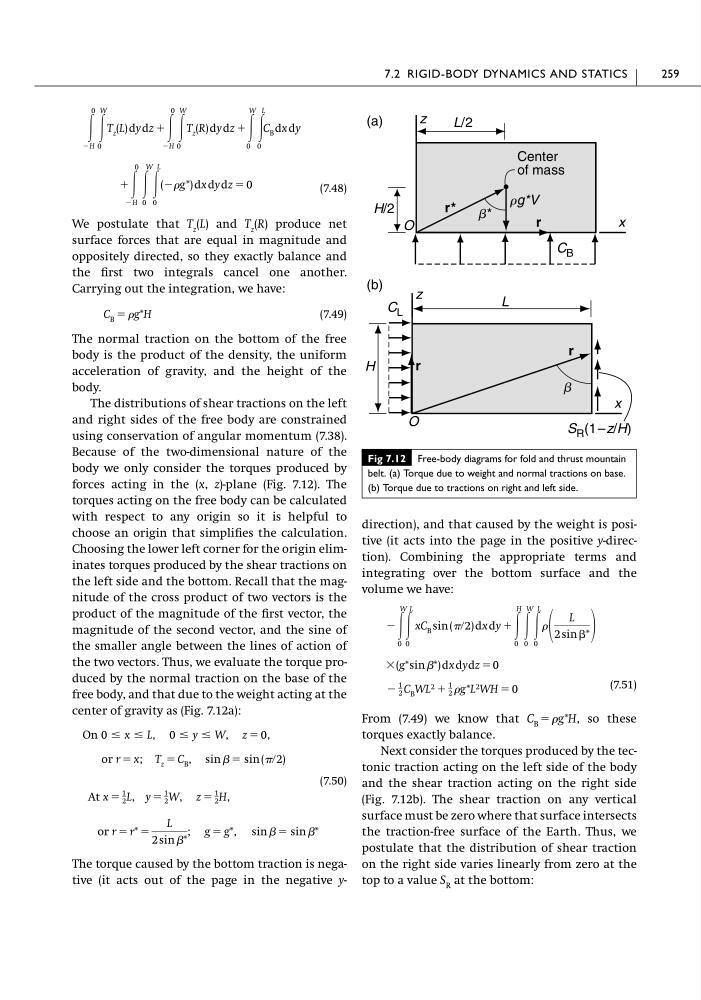
forces acting in the (x, z)-plane (Fig. 7.12). The
torques acting on the free body can be calculated
with respect to any origin so it is helpful to
choose an origin that simplifies the calculation.
Choosing the lower left corner for the origin eliminates torques produced by the shear tractions on
the left side and the bottom. Recall that the magnitude of the cross product of two vectors is the
product of the magnitude of the first vector, the
magnitude of the second vector, and the sine of
the smaller angle between the lines of action of
the two vectors. Thus, we evaluate the torque produced by the normal traction on the base of the
free body, and that due to the weight acting at the
center of gravity as (Fig. 7.12a):
(7.50)
The torque caused by the bottom traction is negative (it acts out of the page in the negative yor r ϭ r* ϭ
L
2 sin *
; g ϭ g*, sin  ϭ sin *
At x ϭ
1
2 L, y ϭ
1
2 W, z ϭ
1
2 H,
or r ϭ x; T z ϭ C B , sin  ϭ sin (ր2)
On 0 Յ x Յ L, 0 Յ y Յ W, z ϭ 0,
C B ϭ g*H
ϩ Ύ
0
ϪH
Ύ
W
0
Ύ
L
0
(Ϫg*) dx dy dz ϭ 0
Ύ
0
ϪH
Ύ
W
0
T z (L) dy dz ϩ Ύ
0
ϪH
Ύ
W
0
T z (R) dy dz ϩ Ύ
W
0
Ύ
L
0
C B dx dy
direction), and that caused by the weight is positive (it acts into the page in the positive y-direction). Combining the appropriate terms and
integrating over the bottom surface and the
volume we have:
(7.51)
From (7.49) we know that C B ϭ g*H, so these
torques exactly balance.
Next consider the torques produced by the tectonic traction acting on the left side of the body
and the shear traction acting on the right side
(Fig. 7.12b). The shear traction on any vertical
surface must be zero where that surface intersects
the traction-free surface of the Earth. Thus, we
postulate that the distribution of shear traction
on the right side varies linearly from zero at the
top to a value S R at the bottom:
Ϫ
1
2 C B WL 2 ϩ
1
2 g*L 2 WH ϭ 0
ϫ(g* sin *) dx dy dz ϭ0
Ϫ Ύ
W
0
Ύ
L
0
xC B sin (ր2) dx dy ϩ Ύ
H
0
Ύ
W
0
Ύ
L
0
L
2 sin *
7.2 RIGID-BODY DYNAMICS AND STATICS
259
Fig 7.12 Free-body diagrams for fold and thrust mountain
belt. (a) Torque due to weight and normal tractions on base.
(b) Torque due to tractions on right and left side.
x
z
O
H/2
L/2
(a)
(b)
r
Center
of mass
x
z
O
H
L
r
b
r
r*
b*
rg*V
C B
C L
S R (1– z/H)
We postulate that T z (L) and T z (R) produce net
surface forces that are equal in magnitude and
oppositely directed, so they exactly balance and
the first two integrals cancel one another.
Carrying out the integration, we have:
(7.49)
The normal traction on the bottom of the free
body is the product of the density, the uniform
acceleration of gravity, and the height of the
body.
The distributions of shear tractions on the left
and right sides of the free body are constrained
using conservation of angular momentum (7.38).
Because of the two-dimensional nature of the
body we only consider the torques produced by
forces acting in the (x, z)-plane (Fig. 7.12). The
torques acting on the free body can be calculated
with respect to any origin so it is helpful to
choose an origin that simplifies the calculation.
Choosing the lower left corner for the origin eliminates torques produced by the shear tractions on
the left side and the bottom. Recall that the magnitude of the cross product of two vectors is the
product of the magnitude of the first vector, the
magnitude of the second vector, and the sine of
the smaller angle between the lines of action of
the two vectors. Thus, we evaluate the torque produced by the normal traction on the base of the
free body, and that due to the weight acting at the
center of gravity as (Fig. 7.12a):
(7.50)
The torque caused by the bottom traction is negative (it acts out of the page in the negative yor r ϭ r* ϭ
L
2 sin *
; g ϭ g*, sin  ϭ sin *
At x ϭ
1
2 L, y ϭ
1
2 W, z ϭ
1
2 H,
or r ϭ x; T z ϭ C B , sin  ϭ sin (ր2)
On 0 Յ x Յ L, 0 Յ y Յ W, z ϭ 0,
C B ϭ g*H
ϩ Ύ
0
ϪH
Ύ
W
0
Ύ
L
0
(Ϫg*) dx dy dz ϭ 0
Ύ
0
ϪH
Ύ
W
0
T z (L) dy dz ϩ Ύ
0
ϪH
Ύ
W
0
T z (R) dy dz ϩ Ύ
W
0
Ύ
L
0
C B dx dy
direction), and that caused by the weight is positive (it acts into the page in the positive y-direction). Combining the appropriate terms and
integrating over the bottom surface and the
volume we have:
(7.51)
From (7.49) we know that C B ϭ g*H, so these
torques exactly balance.
Next consider the torques produced by the tectonic traction acting on the left side of the body
and the shear traction acting on the right side
(Fig. 7.12b). The shear traction on any vertical
surface must be zero where that surface intersects
the traction-free surface of the Earth. Thus, we
postulate that the distribution of shear traction
on the right side varies linearly from zero at the
top to a value S R at the bottom:
Ϫ
1
2 C B WL 2 ϩ
1
2 g*L 2 WH ϭ 0
ϫ(g* sin *) dx dy dz ϭ0
Ϫ Ύ
W
0
Ύ
L
0
xC B sin (ր2) dx dy ϩ Ύ
H
0
Ύ
W
0
Ύ
L
0
L
2 sin *
7.2 RIGID-BODY DYNAMICS AND STATICS
259
Fig 7.12 Free-body diagrams for fold and thrust mountain
belt. (a) Torque due to weight and normal tractions on base.
(b) Torque due to tractions on right and left side.
x
z
O
H/2
L/2
(a)
(b)
r
Center
of mass
x
z
O
H
L
r
b
r
r*
b*
rg*V
C B
C L
S R (1– z/H)