

proposed by Hubbert is taken as uniform with a
magnitude, S B :
(7.40)
On the front and back sides of the free body we
follow Hubbert’s suggestion that there are no
shear tractions:
(7.41)
These conditions would apply for a linear mountain belt.
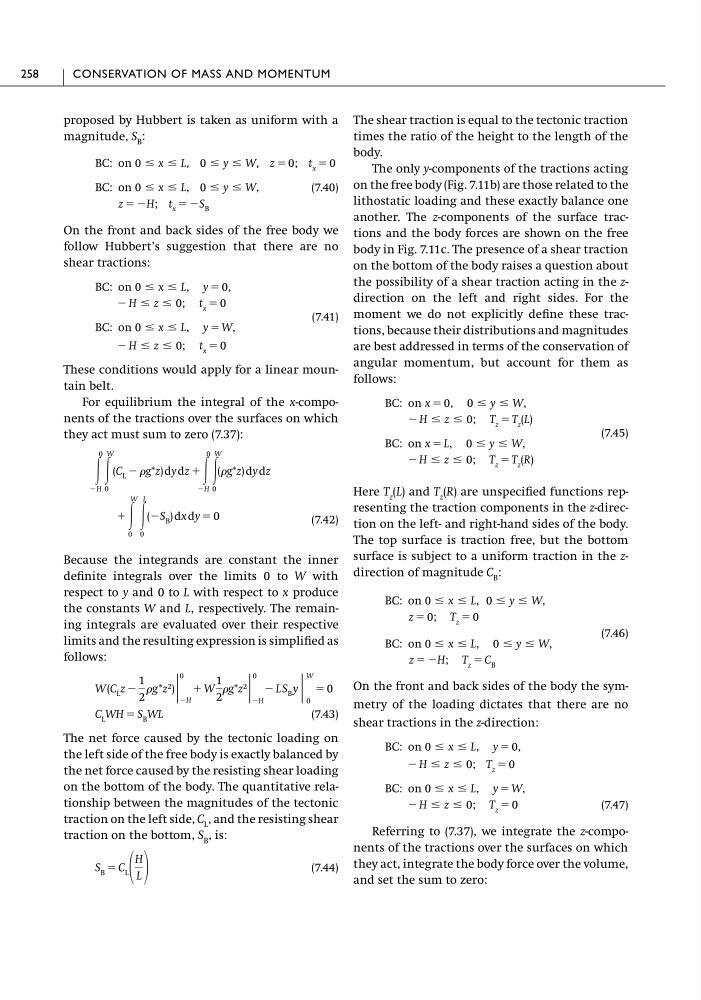
For equilibrium the integral of the x-components of the tractions over the surfaces on which
they act must sum to zero (7.37):
(7.42)
Because the integrands are constant the inner
definite integrals over the limits 0 to W with
respect to y and 0 to L with respect to x produce
the constants W and L, respectively. The remaining integrals are evaluated over their respective
limits and the resulting expression is simplified as
follows:
(7.43)
The net force caused by the tectonic loading on
the left side of the free body is exactly balanced by
the net force caused by the resisting shear loading
on the bottom of the body. The quantitative relationship between the magnitudes of the tectonic
traction on the left side, C L , and the resisting shear
traction on the bottom, S B , is:
(7.44)
S B ϭ C L
H
L
C L WH ϭ S B WL
W (C L z Ϫ
1
2
g*z 2 ) |
0
ϪH
ϩ W
1
2
g*z 2
|
0
ϪH
Ϫ L S B y |
W
0
ϭ 0
ϩ Ύ
W
0
Ύ
L
0
(ϪS B ) dx dy ϭ 0
Ύ
0
ϪH
Ύ
W
0
(C L Ϫ g*z) dy dz ϩ Ύ
0
ϪH
Ύ
W
0
(g*z) dy dz
Ϫ H Յ z Յ 0; t x ϭ 0
BC: on 0 Յ x Յ L, y ϭ W,
Ϫ H Յ z Յ 0; t x ϭ 0
BC: on 0 Յ x Յ L, y ϭ 0,
z ϭ ϪH; t x ϭ ϪS B
BC: on 0 Յ x Յ L, 0 Յ y Յ W,
BC: on 0 Յ x Յ L, 0 Յ y Յ W, z ϭ 0; t x ϭ 0
The shear traction is equal to the tectonic traction
times the ratio of the height to the length of the
body.
The only y-components of the tractions acting
on the free body (Fig. 7.11b) are those related to the
lithostatic loading and these exactly balance one
another. The z-components of the surface tractions and the body forces are shown on the free
body in Fig. 7.11c. The presence of a shear traction
on the bottom of the body raises a question about
the possibility of a shear traction acting in the zdirection on the left and right sides. For the
moment we do not explicitly define these tractions, because their distributions and magnitudes
are best addressed in terms of the conservation of
angular momentum, but account for them as
follows:
(7.45)
Here T z (L) and T z (R) are unspecified functions representing the traction components in the z-direction on the left- and right-hand sides of the body.
The top surface is traction free, but the bottom
surface is subject to a uniform traction in the zdirection of magnitude C B :
(7.46)
On the front and back sides of the body the symmetry of the loading dictates that there are no
shear tractions in the z-direction:
(7.47)
Referring to (7.37), we integrate the z-components of the tractions over the surfaces on which
they act, integrate the body force over the volume,
and set the sum to zero:
Ϫ H Յ z Յ 0; T z ϭ 0
BC: on 0 Յ x Յ L, y ϭ W,
Ϫ H Յ z Յ 0; T z ϭ 0
BC: on 0 Յ x Յ L, y ϭ 0,
z ϭ ϪH; T z ϭ C B
BC: on 0 Յ x Յ L, 0 Յ y Յ W,
z ϭ 0; T z ϭ 0
BC: on 0 Յ x Յ L, 0 Յ y Յ W,
Ϫ H Յ z Յ 0; T z ϭ T z (R)
BC: on x ϭ L, 0 Յ y Յ W,
Ϫ H Յ z Յ 0; T z ϭ T z (L)
BC: on x ϭ 0, 0 Յ y Յ W,
258
CONSERVATION OF MASS AND MOMENTUM
magnitude, S B :
(7.40)
On the front and back sides of the free body we
follow Hubbert’s suggestion that there are no
shear tractions:
(7.41)
These conditions would apply for a linear mountain belt.
For equilibrium the integral of the x-components of the tractions over the surfaces on which
they act must sum to zero (7.37):
(7.42)
Because the integrands are constant the inner
definite integrals over the limits 0 to W with
respect to y and 0 to L with respect to x produce
the constants W and L, respectively. The remaining integrals are evaluated over their respective
limits and the resulting expression is simplified as
follows:
(7.43)
The net force caused by the tectonic loading on
the left side of the free body is exactly balanced by
the net force caused by the resisting shear loading
on the bottom of the body. The quantitative relationship between the magnitudes of the tectonic
traction on the left side, C L , and the resisting shear
traction on the bottom, S B , is:
(7.44)
S B ϭ C L
H
L
C L WH ϭ S B WL
W (C L z Ϫ
1
2
g*z 2 ) |
0
ϪH
ϩ W
1
2
g*z 2
|
0
ϪH
Ϫ L S B y |
W
0
ϭ 0
ϩ Ύ
W
0
Ύ
L
0
(ϪS B ) dx dy ϭ 0
Ύ
0
ϪH
Ύ
W
0
(C L Ϫ g*z) dy dz ϩ Ύ
0
ϪH
Ύ
W
0
(g*z) dy dz
Ϫ H Յ z Յ 0; t x ϭ 0
BC: on 0 Յ x Յ L, y ϭ W,
Ϫ H Յ z Յ 0; t x ϭ 0
BC: on 0 Յ x Յ L, y ϭ 0,
z ϭ ϪH; t x ϭ ϪS B
BC: on 0 Յ x Յ L, 0 Յ y Յ W,
BC: on 0 Յ x Յ L, 0 Յ y Յ W, z ϭ 0; t x ϭ 0
The shear traction is equal to the tectonic traction
times the ratio of the height to the length of the
body.
The only y-components of the tractions acting
on the free body (Fig. 7.11b) are those related to the
lithostatic loading and these exactly balance one
another. The z-components of the surface tractions and the body forces are shown on the free
body in Fig. 7.11c. The presence of a shear traction
on the bottom of the body raises a question about
the possibility of a shear traction acting in the zdirection on the left and right sides. For the
moment we do not explicitly define these tractions, because their distributions and magnitudes
are best addressed in terms of the conservation of
angular momentum, but account for them as
follows:
(7.45)
Here T z (L) and T z (R) are unspecified functions representing the traction components in the z-direction on the left- and right-hand sides of the body.
The top surface is traction free, but the bottom
surface is subject to a uniform traction in the zdirection of magnitude C B :
(7.46)
On the front and back sides of the body the symmetry of the loading dictates that there are no
shear tractions in the z-direction:
(7.47)
Referring to (7.37), we integrate the z-components of the tractions over the surfaces on which
they act, integrate the body force over the volume,
and set the sum to zero:
Ϫ H Յ z Յ 0; T z ϭ 0
BC: on 0 Յ x Յ L, y ϭ W,
Ϫ H Յ z Յ 0; T z ϭ 0
BC: on 0 Յ x Յ L, y ϭ 0,
z ϭ ϪH; T z ϭ C B
BC: on 0 Յ x Յ L, 0 Յ y Յ W,
z ϭ 0; T z ϭ 0
BC: on 0 Յ x Յ L, 0 Յ y Յ W,
Ϫ H Յ z Յ 0; T z ϭ T z (R)
BC: on x ϭ L, 0 Յ y Յ W,
Ϫ H Յ z Յ 0; T z ϭ T z (L)
BC: on x ϭ 0, 0 Յ y Յ W,
258
CONSERVATION OF MASS AND MOMENTUM