

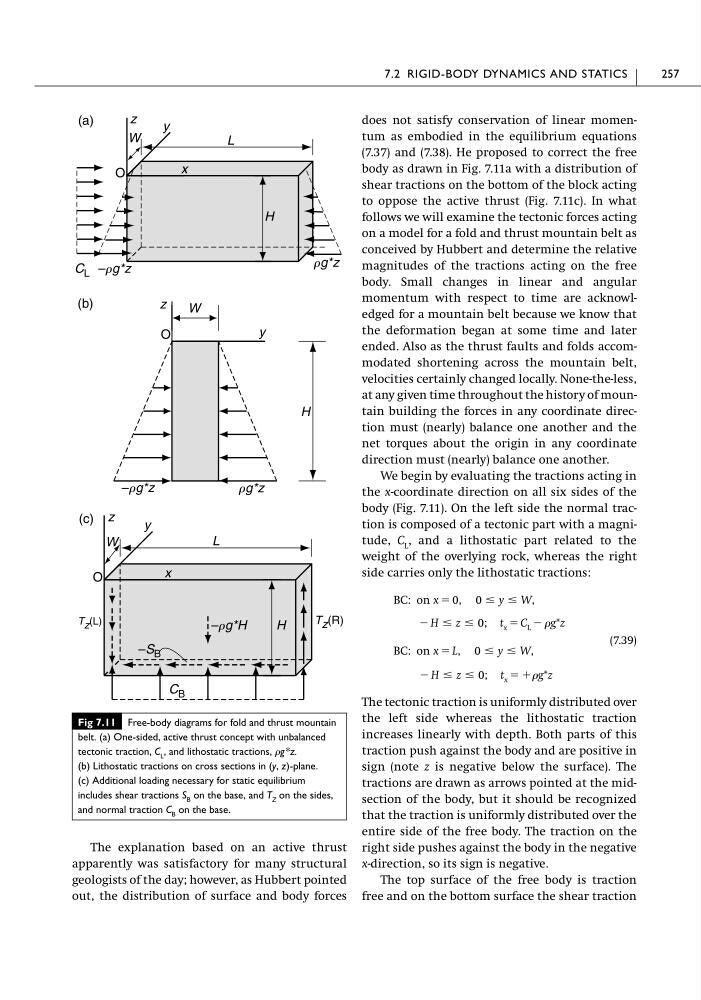
The explanation based on an active thrust
apparently was satisfactory for many structural
geologists of the day; however, as Hubbert pointed
out, the distribution of surface and body forces
does not satisfy conservation of linear momentum as embodied in the equilibrium equations
(7.37) and (7.38). He proposed to correct the free
body as drawn in Fig. 7.11a with a distribution of
shear tractions on the bottom of the block acting
to oppose the active thrust (Fig. 7.11c). In what
follows we will examine the tectonic forces acting
on a model for a fold and thrust mountain belt as
conceived by Hubbert and determine the relative
magnitudes of the tractions acting on the free
body. Small changes in linear and angular
momentum with respect to time are acknowledged for a mountain belt because we know that
the deformation began at some time and later
ended. Also as the thrust faults and folds accommodated shortening across the mountain belt,
velocities certainly changed locally. None-the-less,
at any given time throughout the history of mountain building the forces in any coordinate direction must (nearly) balance one another and the
net torques about the origin in any coordinate
direction must (nearly) balance one another.
We begin by evaluating the tractions acting in
the x-coordinate direction on all six sides of the
body (Fig. 7.11). On the left side the normal traction is composed of a tectonic part with a magnitude, C L , and a lithostatic part related to the
weight of the overlying rock, whereas the right
side carries only the lithostatic tractions:
(7.39)
The tectonic traction is uniformly distributed over
the left side whereas the lithostatic traction
increases linearly with depth. Both parts of this
traction push against the body and are positive in
sign (note z is negative below the surface). The
tractions are drawn as arrows pointed at the midsection of the body, but it should be recognized
that the traction is uniformly distributed over the
entire side of the free body. The traction on the
right side pushes against the body in the negative
x-direction, so its sign is negative.
The top surface of the free body is traction
free and on the bottom surface the shear traction
Ϫ H Յ z Յ 0; t x ϭ ϩg*z
BC: on x ϭ L,0 Յ y Յ W,
Ϫ H Յ z Յ 0; t x ϭ C L Ϫ g*z
BC: on x ϭ 0,0 Յ y Յ W,
7.2 RIGID-BODY DYNAMICS AND STATICS
257
Fig 7.11 Free-body diagrams for fold and thrust mountain
belt. (a) One-sided, active thrust concept with unbalanced
tectonic traction, C L , and lithostatic tractions, g *z.
(b) Lithostatic tractions on cross sections in (y, z)-plane.
(c) Additional loading necessary for static equilibrium
includes shear tractions S B on the base, and T Z on the sides,
and normal traction C B on the base.
x
y
z
O
H
L
W
y
z
O
H
x
y
z
O
H
L
W
W
(a)
(b)
(c)
C L –Rg*z
Rg*z
–Rg*z
Rg*z
T z (L)
C B
–Rg*H
T z (R)
–S B
apparently was satisfactory for many structural
geologists of the day; however, as Hubbert pointed
out, the distribution of surface and body forces
does not satisfy conservation of linear momentum as embodied in the equilibrium equations
(7.37) and (7.38). He proposed to correct the free
body as drawn in Fig. 7.11a with a distribution of
shear tractions on the bottom of the block acting
to oppose the active thrust (Fig. 7.11c). In what
follows we will examine the tectonic forces acting
on a model for a fold and thrust mountain belt as
conceived by Hubbert and determine the relative
magnitudes of the tractions acting on the free
body. Small changes in linear and angular
momentum with respect to time are acknowledged for a mountain belt because we know that
the deformation began at some time and later
ended. Also as the thrust faults and folds accommodated shortening across the mountain belt,
velocities certainly changed locally. None-the-less,
at any given time throughout the history of mountain building the forces in any coordinate direction must (nearly) balance one another and the
net torques about the origin in any coordinate
direction must (nearly) balance one another.
We begin by evaluating the tractions acting in
the x-coordinate direction on all six sides of the
body (Fig. 7.11). On the left side the normal traction is composed of a tectonic part with a magnitude, C L , and a lithostatic part related to the
weight of the overlying rock, whereas the right
side carries only the lithostatic tractions:
(7.39)
The tectonic traction is uniformly distributed over
the left side whereas the lithostatic traction
increases linearly with depth. Both parts of this
traction push against the body and are positive in
sign (note z is negative below the surface). The
tractions are drawn as arrows pointed at the midsection of the body, but it should be recognized
that the traction is uniformly distributed over the
entire side of the free body. The traction on the
right side pushes against the body in the negative
x-direction, so its sign is negative.
The top surface of the free body is traction
free and on the bottom surface the shear traction
Ϫ H Յ z Յ 0; t x ϭ ϩg*z
BC: on x ϭ L,0 Յ y Յ W,
Ϫ H Յ z Յ 0; t x ϭ C L Ϫ g*z
BC: on x ϭ 0,0 Յ y Յ W,
7.2 RIGID-BODY DYNAMICS AND STATICS
257
Fig 7.11 Free-body diagrams for fold and thrust mountain
belt. (a) One-sided, active thrust concept with unbalanced
tectonic traction, C L , and lithostatic tractions, g *z.
(b) Lithostatic tractions on cross sections in (y, z)-plane.
(c) Additional loading necessary for static equilibrium
includes shear tractions S B on the base, and T Z on the sides,
and normal traction C B on the base.
x
y
z
O
H
L
W
y
z
O
H
x
y
z
O
H
L
W
W
(a)
(b)
(c)
C L –Rg*z
Rg*z
–Rg*z
Rg*z
T z (L)
C B
–Rg*H
T z (R)
–S B