

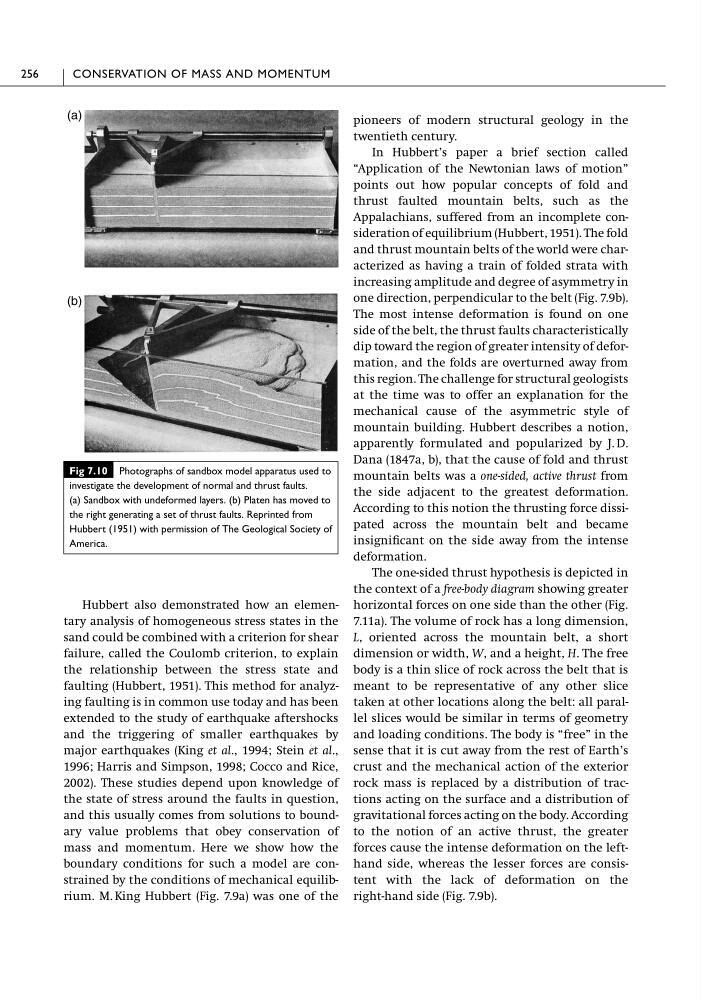
Hubbert also demonstrated how an elementary analysis of homogeneous stress states in the
sand could be combined with a criterion for shear
failure, called the Coulomb criterion, to explain
the relationship between the stress state and
faulting (Hubbert, 1951). This method for analyzing faulting is in common use today and has been
extended to the study of earthquake aftershocks
and the triggering of smaller earthquakes by
major earthquakes (King et al., 1994; Stein et al.,
1996; Harris and Simpson, 1998; Cocco and Rice,
2002). These studies depend upon knowledge of
the state of stress around the faults in question,
and this usually comes from solutions to boundary value problems that obey conservation of
mass and momentum. Here we show how the
boundary conditions for such a model are constrained by the conditions of mechanical equilibrium. M. King Hubbert (Fig. 7.9a) was one of the
pioneers of modern structural geology in the
twentieth century.
In Hubbert’s paper a brief section called
“Application of the Newtonian laws of motion”
points out how popular concepts of fold and
thrust faulted mountain belts, such as the
Appalachians, suffered from an incomplete consideration of equilibrium (Hubbert, 1951). The fold
and thrust mountain belts of the world were characterized as having a train of folded strata with
increasing amplitude and degree of asymmetry in
one direction, perpendicular to the belt (Fig. 7.9b).
The most intense deformation is found on one
side of the belt, the thrust faults characteristically
dip toward the region of greater intensity of deformation, and the folds are overturned away from
this region. The challenge for structural geologists
at the time was to offer an explanation for the
mechanical cause of the asymmetric style of
mountain building. Hubbert describes a notion,
apparently formulated and popularized by J. D.
Dana (1847a, b), that the cause of fold and thrust
mountain belts was a one-sided, active thrust from
the side adjacent to the greatest deformation.
According to this notion the thrusting force dissipated across the mountain belt and became
insignificant on the side away from the intense
deformation.
The one-sided thrust hypothesis is depicted in
the context of a free-body diagram showing greater
horizontal forces on one side than the other (Fig.
7.11a). The volume of rock has a long dimension,
L, oriented across the mountain belt, a short
dimension or width, W, and a height, H. The free
body is a thin slice of rock across the belt that is
meant to be representative of any other slice
taken at other locations along the belt: all parallel slices would be similar in terms of geometry
and loading conditions. The body is “free” in the
sense that it is cut away from the rest of Earth’s
crust and the mechanical action of the exterior
rock mass is replaced by a distribution of tractions acting on the surface and a distribution of
gravitational forces acting on the body. According
to the notion of an active thrust, the greater
forces cause the intense deformation on the lefthand side, whereas the lesser forces are consistent with the lack of deformation on the
right-hand side (Fig. 7.9b).
256
CONSERVATION OF MASS AND MOMENTUM
Fig 7.10 Photographs of sandbox model apparatus used to
investigate the development of normal and thrust faults.
(a) Sandbox with undeformed layers. (b) Platen has moved to
the right generating a set of thrust faults. Reprinted from
Hubbert (1951) with permission of The Geological Society of
America.
(a)
(b)
sand could be combined with a criterion for shear
failure, called the Coulomb criterion, to explain
the relationship between the stress state and
faulting (Hubbert, 1951). This method for analyzing faulting is in common use today and has been
extended to the study of earthquake aftershocks
and the triggering of smaller earthquakes by
major earthquakes (King et al., 1994; Stein et al.,
1996; Harris and Simpson, 1998; Cocco and Rice,
2002). These studies depend upon knowledge of
the state of stress around the faults in question,
and this usually comes from solutions to boundary value problems that obey conservation of
mass and momentum. Here we show how the
boundary conditions for such a model are constrained by the conditions of mechanical equilibrium. M. King Hubbert (Fig. 7.9a) was one of the
pioneers of modern structural geology in the
twentieth century.
In Hubbert’s paper a brief section called
“Application of the Newtonian laws of motion”
points out how popular concepts of fold and
thrust faulted mountain belts, such as the
Appalachians, suffered from an incomplete consideration of equilibrium (Hubbert, 1951). The fold
and thrust mountain belts of the world were characterized as having a train of folded strata with
increasing amplitude and degree of asymmetry in
one direction, perpendicular to the belt (Fig. 7.9b).
The most intense deformation is found on one
side of the belt, the thrust faults characteristically
dip toward the region of greater intensity of deformation, and the folds are overturned away from
this region. The challenge for structural geologists
at the time was to offer an explanation for the
mechanical cause of the asymmetric style of
mountain building. Hubbert describes a notion,
apparently formulated and popularized by J. D.
Dana (1847a, b), that the cause of fold and thrust
mountain belts was a one-sided, active thrust from
the side adjacent to the greatest deformation.
According to this notion the thrusting force dissipated across the mountain belt and became
insignificant on the side away from the intense
deformation.
The one-sided thrust hypothesis is depicted in
the context of a free-body diagram showing greater
horizontal forces on one side than the other (Fig.
7.11a). The volume of rock has a long dimension,
L, oriented across the mountain belt, a short
dimension or width, W, and a height, H. The free
body is a thin slice of rock across the belt that is
meant to be representative of any other slice
taken at other locations along the belt: all parallel slices would be similar in terms of geometry
and loading conditions. The body is “free” in the
sense that it is cut away from the rest of Earth’s
crust and the mechanical action of the exterior
rock mass is replaced by a distribution of tractions acting on the surface and a distribution of
gravitational forces acting on the body. According
to the notion of an active thrust, the greater
forces cause the intense deformation on the lefthand side, whereas the lesser forces are consistent with the lack of deformation on the
right-hand side (Fig. 7.9b).
256
CONSERVATION OF MASS AND MOMENTUM
Fig 7.10 Photographs of sandbox model apparatus used to
investigate the development of normal and thrust faults.
(a) Sandbox with undeformed layers. (b) Platen has moved to
the right generating a set of thrust faults. Reprinted from
Hubbert (1951) with permission of The Geological Society of
America.
(a)
(b)