

For the tractions acting on the surface of the body
the resultant torque, T(s), is:
(7.35)
For the body force acting over the volume of the
body the resultant torque, T(b), is:
(7.36)
The sum of these two integrals represents the
resultant torque acting on the body, and this
torque is thought of as a vector located at the
origin of coordinates, O.
A restatement of conservation of linear and
angular momentum for the continuous rigid
body in equilibrium is that the resultant external
force and torque due to surface tractions and
gravity must be zero:
(7.37)
(7.38)
All of the physical quantities in these equations
are defined at each and every point in the continuum. None of these quantities are functions of
time, but the traction and density may vary spatially and must be integrable functions of the
spatial coordinates. Gravitational acceleration is
taken as uniform in space and constant in time.
7.2.6 An example: Appalachian fold and
thrust mountain belt
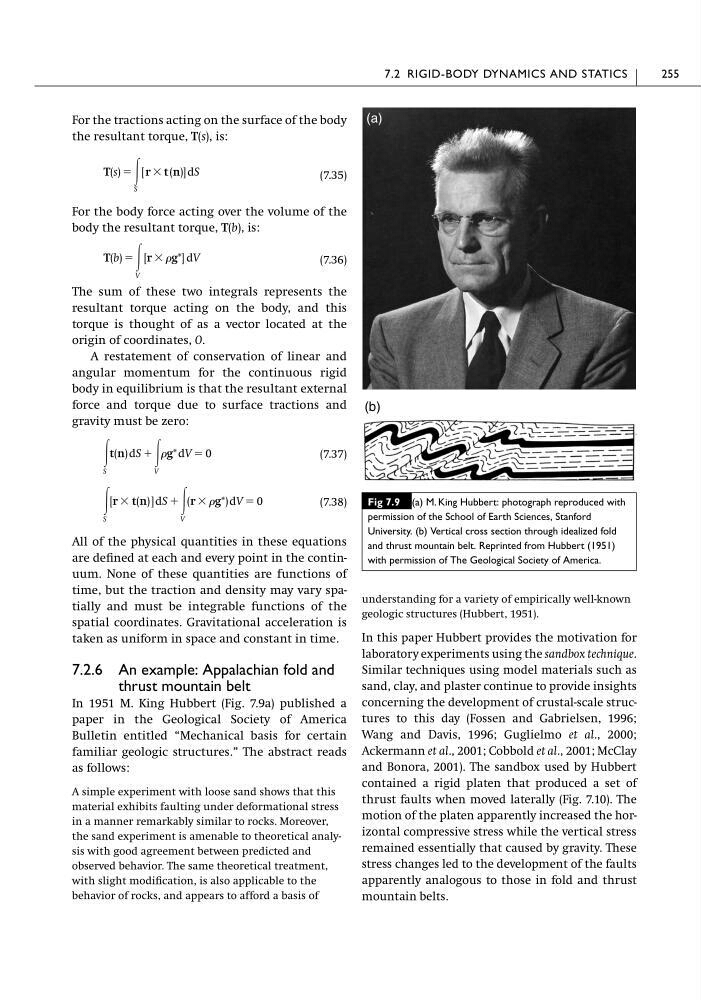
In 1951 M. King Hubbert (Fig. 7.9a) published a
paper in the Geological Society of America
Bulletin entitled “Mechanical basis for certain
familiar geologic structures.” The abstract reads
as follows:
A simple experiment with loose sand shows that this
material exhibits faulting under deformational stress
in a manner remarkably similar to rocks. Moreover,
the sand experiment is amenable to theoretical analysis with good agreement between predicted and
observed behavior. The same theoretical treatment,
with slight modification, is also applicable to the
behavior of rocks, and appears to afford a basis of
Ύ
S
[r ϫ t(n) ] dS ϩ Ύ
V
(r ϫ g*) dV ϭ 0
Ύ
S
t(n) dS ϩ Ύ
V
g* dV ϭ 0
T(b) ϭ Ύ
V
[r ϫ g*] dV
T(s) ϭ Ύ
S
[ r ϫ t (n)] dS
understanding for a variety of empirically well-known
geologic structures (Hubbert, 1951).
In this paper Hubbert provides the motivation for
laboratory experiments using the sandbox technique.
Similar techniques using model materials such as
sand, clay, and plaster continue to provide insights
concerning the development of crustal-scale structures to this day (Fossen and Gabrielsen, 1996;
Wang and Davis, 1996; Guglielmo et al., 2000;
Ackermann et al., 2001; Cobbold et al., 2001; McClay
and Bonora, 2001). The sandbox used by Hubbert
contained a rigid platen that produced a set of
thrust faults when moved laterally (Fig. 7.10). The
motion of the platen apparently increased the horizontal compressive stress while the vertical stress
remained essentially that caused by gravity. These
stress changes led to the development of the faults
apparently analogous to those in fold and thrust
mountain belts.
7.2 RIGID-BODY DYNAMICS AND STATICS
255
Fig 7.9 (a) M. King Hubbert: photograph reproduced with
permission of the School of Earth Sciences, Stanford
University. (b) Vertical cross section through idealized fold
and thrust mountain belt. Reprinted from Hubbert (1951)
with permission of The Geological Society of America.
(b)
(a)
the resultant torque, T(s), is:
(7.35)
For the body force acting over the volume of the
body the resultant torque, T(b), is:
(7.36)
The sum of these two integrals represents the
resultant torque acting on the body, and this
torque is thought of as a vector located at the
origin of coordinates, O.
A restatement of conservation of linear and
angular momentum for the continuous rigid
body in equilibrium is that the resultant external
force and torque due to surface tractions and
gravity must be zero:
(7.37)
(7.38)
All of the physical quantities in these equations
are defined at each and every point in the continuum. None of these quantities are functions of
time, but the traction and density may vary spatially and must be integrable functions of the
spatial coordinates. Gravitational acceleration is
taken as uniform in space and constant in time.
7.2.6 An example: Appalachian fold and
thrust mountain belt
In 1951 M. King Hubbert (Fig. 7.9a) published a
paper in the Geological Society of America
Bulletin entitled “Mechanical basis for certain
familiar geologic structures.” The abstract reads
as follows:
A simple experiment with loose sand shows that this
material exhibits faulting under deformational stress
in a manner remarkably similar to rocks. Moreover,
the sand experiment is amenable to theoretical analysis with good agreement between predicted and
observed behavior. The same theoretical treatment,
with slight modification, is also applicable to the
behavior of rocks, and appears to afford a basis of
Ύ
S
[r ϫ t(n) ] dS ϩ Ύ
V
(r ϫ g*) dV ϭ 0
Ύ
S
t(n) dS ϩ Ύ
V
g* dV ϭ 0
T(b) ϭ Ύ
V
[r ϫ g*] dV
T(s) ϭ Ύ
S
[ r ϫ t (n)] dS
understanding for a variety of empirically well-known
geologic structures (Hubbert, 1951).
In this paper Hubbert provides the motivation for
laboratory experiments using the sandbox technique.
Similar techniques using model materials such as
sand, clay, and plaster continue to provide insights
concerning the development of crustal-scale structures to this day (Fossen and Gabrielsen, 1996;
Wang and Davis, 1996; Guglielmo et al., 2000;
Ackermann et al., 2001; Cobbold et al., 2001; McClay
and Bonora, 2001). The sandbox used by Hubbert
contained a rigid platen that produced a set of
thrust faults when moved laterally (Fig. 7.10). The
motion of the platen apparently increased the horizontal compressive stress while the vertical stress
remained essentially that caused by gravity. These
stress changes led to the development of the faults
apparently analogous to those in fold and thrust
mountain belts.
7.2 RIGID-BODY DYNAMICS AND STATICS
255
Fig 7.9 (a) M. King Hubbert: photograph reproduced with
permission of the School of Earth Sciences, Stanford
University. (b) Vertical cross section through idealized fold
and thrust mountain belt. Reprinted from Hubbert (1951)
with permission of The Geological Society of America.
(b)
(a)