

(7.32)
Here the mass density is an integrable function of
the spatial coordinates, (x, y, z).
Perhaps nowhere in the literature of structural
geology (Pyne, 1980) is the concept of equilibrium
used more decisively to guide the development of
conceptual models than in the writing of G. K.
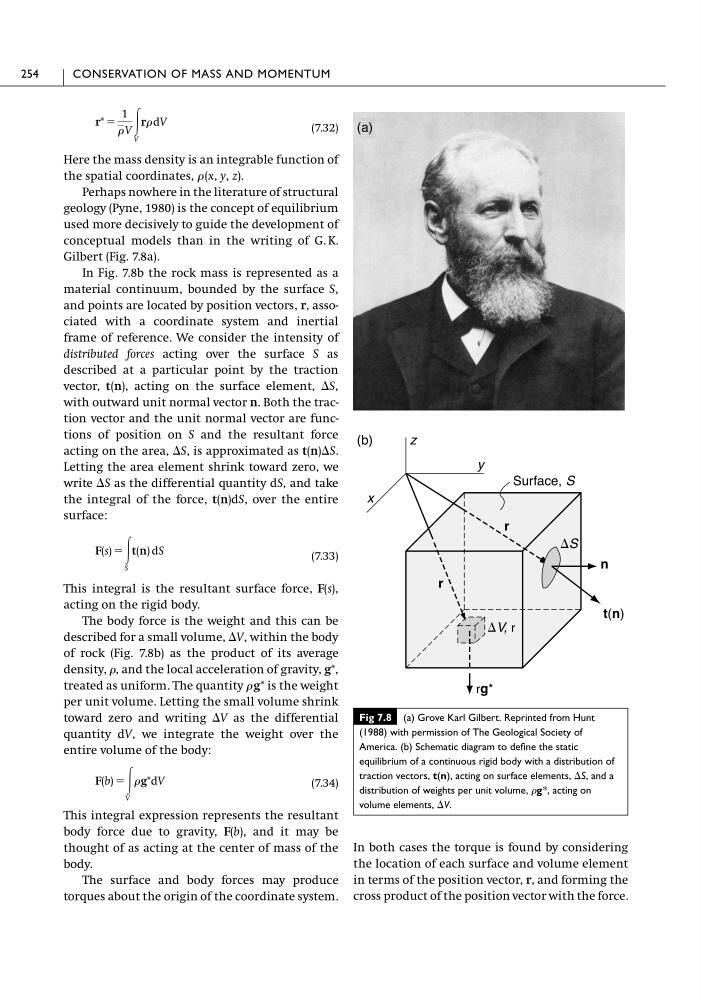
Gilbert (Fig. 7.8a).
In Fig. 7.8b the rock mass is represented as a
material continuum, bounded by the surface S,
and points are located by position vectors, r, associated with a coordinate system and inertial
frame of reference. We consider the intensity of
distributed forces acting over the surface S as
described at a particular point by the traction
vector, t(n), acting on the surface element, ⌬S,
with outward unit normal vector n. Both the traction vector and the unit normal vector are functions of position on S and the resultant force
acting on the area, ⌬S, is approximated as t(n)⌬S.
Letting the area element shrink toward zero, we
write ⌬S as the differential quantity dS, and take
the integral of the force, t(n)dS, over the entire
surface:
(7.33)
This integral is the resultant surface force, F(s),
acting on the rigid body.
The body force is the weight and this can be
described for a small volume, ⌬V, within the body
of rock (Fig. 7.8b) as the product of its average
density, , and the local acceleration of gravity, g*,
treated as uniform. The quantity g* is the weight
per unit volume. Letting the small volume shrink
toward zero and writing ⌬V as the differential
quantity dV, we integrate the weight over the
entire volume of the body:
(7.34)
This integral expression represents the resultant
body force due to gravity, F(b), and it may be
thought of as acting at the center of mass of the
body.
The surface and body forces may produce
torques about the origin of the coordinate system.
F(b) ϭ Ύ
V
g*dV
F(s) ϭ Ύ
S
t(n) dS
r* ϭ
1
V Ύ
V
r dV
In both cases the torque is found by considering
the location of each surface and volume element
in terms of the position vector, r, and forming the
cross product of the position vector with the force.
254
CONSERVATION OF MASS AND MOMENTUM
Fig 7.8 (a) Grove Karl Gilbert. Reprinted from Hunt
(1988) with permission of The Geological Society of
America. (b) Schematic diagram to define the static
equilibrium of a continuous rigid body with a distribution of
traction vectors, t(n), acting on surface elements, ⌬S, and a
distribution of weights per unit volume, g*, acting on
volume elements, ⌬V.
x
y
z
Surface, S
n
r
r
⌬S
t(n)
⌬V, r
rg*
(b)
(a)
Here the mass density is an integrable function of
the spatial coordinates, (x, y, z).
Perhaps nowhere in the literature of structural
geology (Pyne, 1980) is the concept of equilibrium
used more decisively to guide the development of
conceptual models than in the writing of G. K.
Gilbert (Fig. 7.8a).
In Fig. 7.8b the rock mass is represented as a
material continuum, bounded by the surface S,
and points are located by position vectors, r, associated with a coordinate system and inertial
frame of reference. We consider the intensity of
distributed forces acting over the surface S as
described at a particular point by the traction
vector, t(n), acting on the surface element, ⌬S,
with outward unit normal vector n. Both the traction vector and the unit normal vector are functions of position on S and the resultant force
acting on the area, ⌬S, is approximated as t(n)⌬S.
Letting the area element shrink toward zero, we
write ⌬S as the differential quantity dS, and take
the integral of the force, t(n)dS, over the entire
surface:
(7.33)
This integral is the resultant surface force, F(s),
acting on the rigid body.
The body force is the weight and this can be
described for a small volume, ⌬V, within the body
of rock (Fig. 7.8b) as the product of its average
density, , and the local acceleration of gravity, g*,
treated as uniform. The quantity g* is the weight
per unit volume. Letting the small volume shrink
toward zero and writing ⌬V as the differential
quantity dV, we integrate the weight over the
entire volume of the body:
(7.34)
This integral expression represents the resultant
body force due to gravity, F(b), and it may be
thought of as acting at the center of mass of the
body.
The surface and body forces may produce
torques about the origin of the coordinate system.
F(b) ϭ Ύ
V
g*dV
F(s) ϭ Ύ
S
t(n) dS
r* ϭ
1
V Ύ
V
r dV
In both cases the torque is found by considering
the location of each surface and volume element
in terms of the position vector, r, and forming the
cross product of the position vector with the force.
254
CONSERVATION OF MASS AND MOMENTUM
Fig 7.8 (a) Grove Karl Gilbert. Reprinted from Hunt
(1988) with permission of The Geological Society of
America. (b) Schematic diagram to define the static
equilibrium of a continuous rigid body with a distribution of
traction vectors, t(n), acting on surface elements, ⌬S, and a
distribution of weights per unit volume, g*, acting on
volume elements, ⌬V.
x
y
z
Surface, S
n
r
r
⌬S
t(n)
⌬V, r
rg*
(b)
(a)